Wednesday, May 30, 2007

Bahamas 2007, Day 3

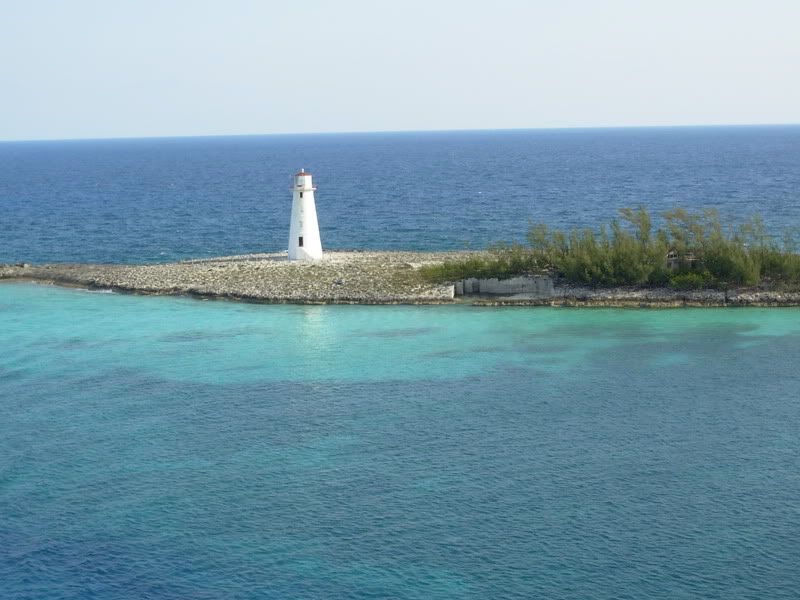
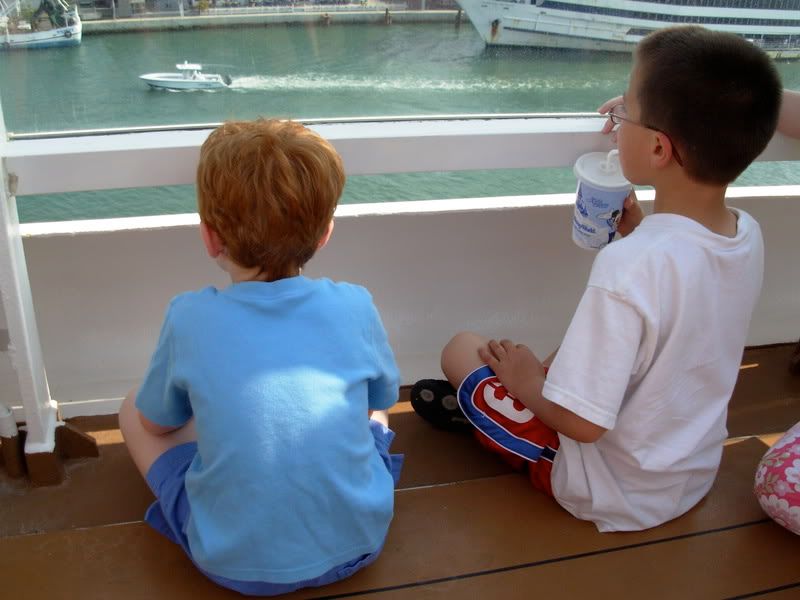
Our first morning at sea found us pulling into the Nassau harbor.


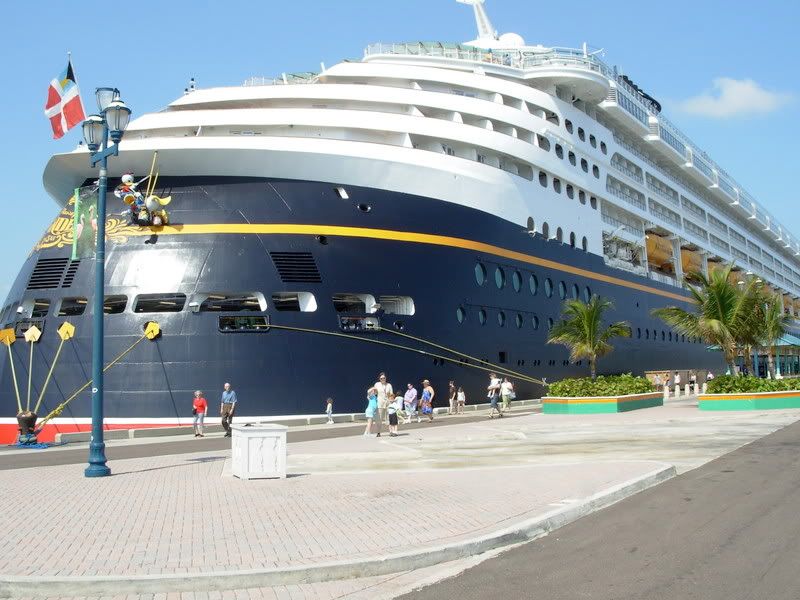
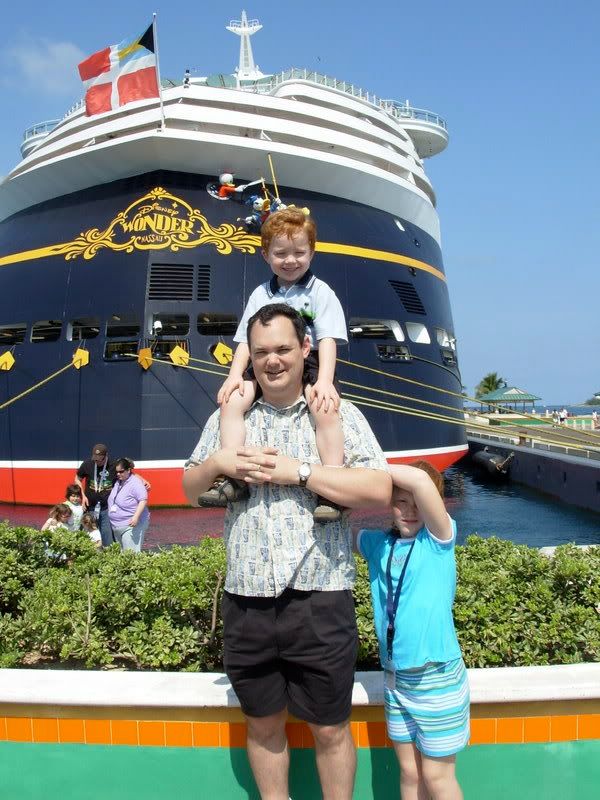
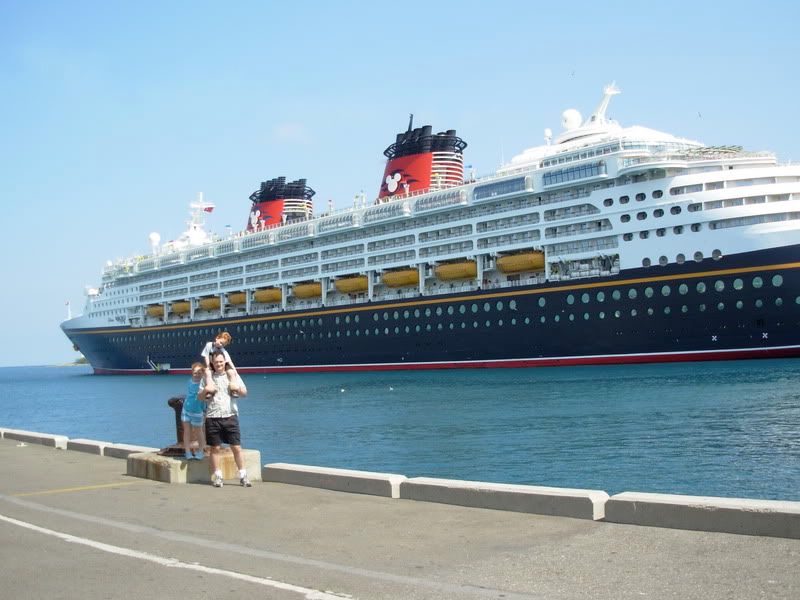
After squeezing through the breakwater, our enormous ship pirouetted within its own length to back into its berth in port. The ship has lateral jets below the waterline that allow those kinds of maneuvers.


Having spent several days in Nassau last year, we did not feel a need to take much time ashore this time.


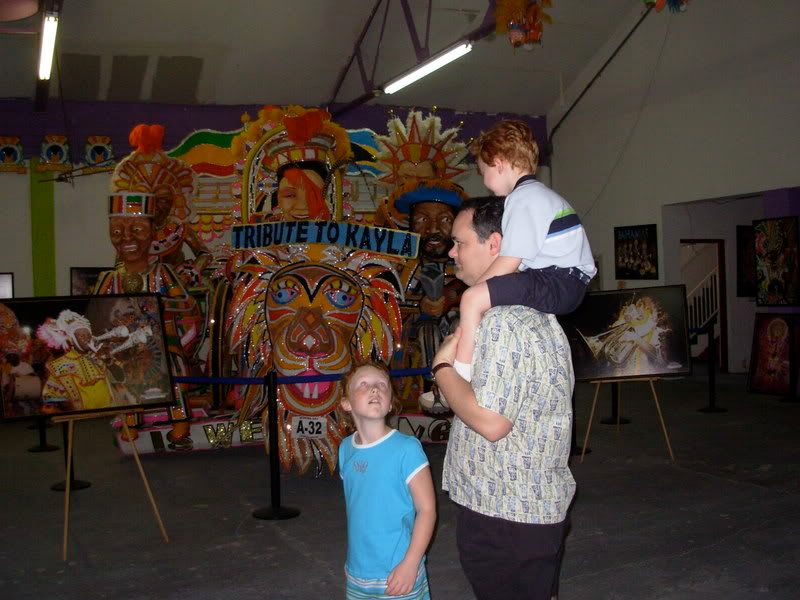
The port has a vendor area constructed specifically for cruise ship passengers, which is where we also saw an exhibit of junkanoo costumes, worn primarily during the massive Boxing Day celebration.


We made sure to drop in on our friend Greg and his family, who are finishing up their stint in the Bahamas as part of the U.S. State Department. Greg then took us on a tour of the U.S. embassy, which was predominantly institutional drab spiked with a little high formality in the ambassador’s office, with the omnipresent security provided by U.S. Marines hovering malevolently just out of view at all times. A fascinating place to work. We happened to be in town just a day ahead of a major election that, believe it or not, was heavily influenced by the Anna Nicole Smith hubbub. The State Department folks were keeping a close eye on the race between the incumbent ruling party and the opposing party running on an anti-corruption platform. Later that evening, while aboard the ship in the harbor, we heard and saw a loud parade demonstration processing down the main road through town; I think we were among the few on board who knew what it was all about.

We headed back to the ship early so that we could maximize our time on board. The kids immediately headed to the pools, where we took advantage of the poolside hamburger-and-hotdog shack for our lunch.


The weather was gorgeous, and we all got a good start on our sunburns.

In the evening, we attended a production of Hercules in the main theater, which was very funny and enjoyable. Many jokes are made at the expense of entertainers who are reputed to have only “cruise ship talent,” but whatever that dismissive assessment may mean, we were treated to the work of some talented actors, musicians, technicians and set builders.

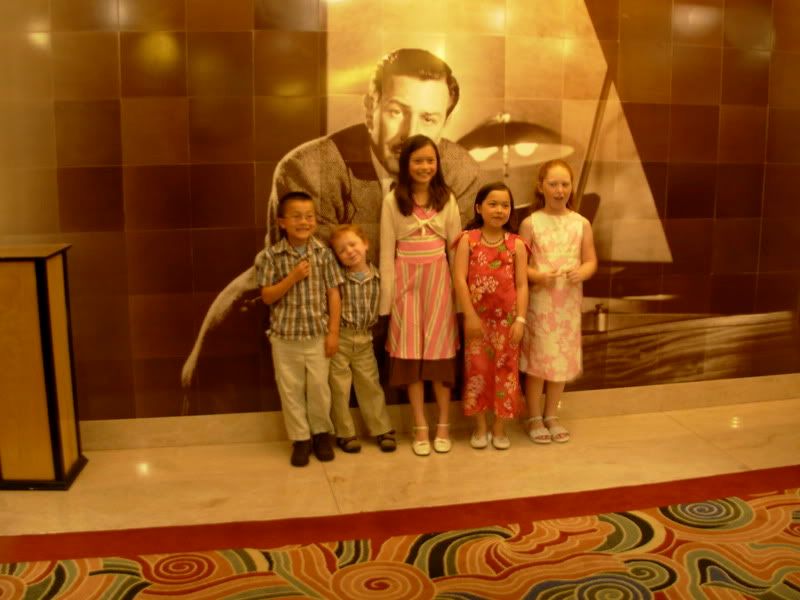
After the show we waited with Uncle Walt for dinner to begin:


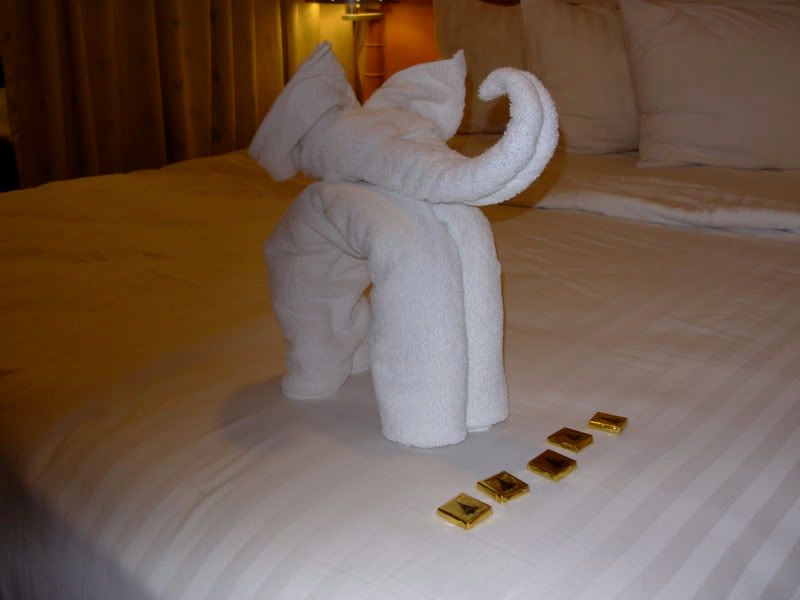
By the time dinner was over, we were exhausted and ready for bed, where we found this little guy:


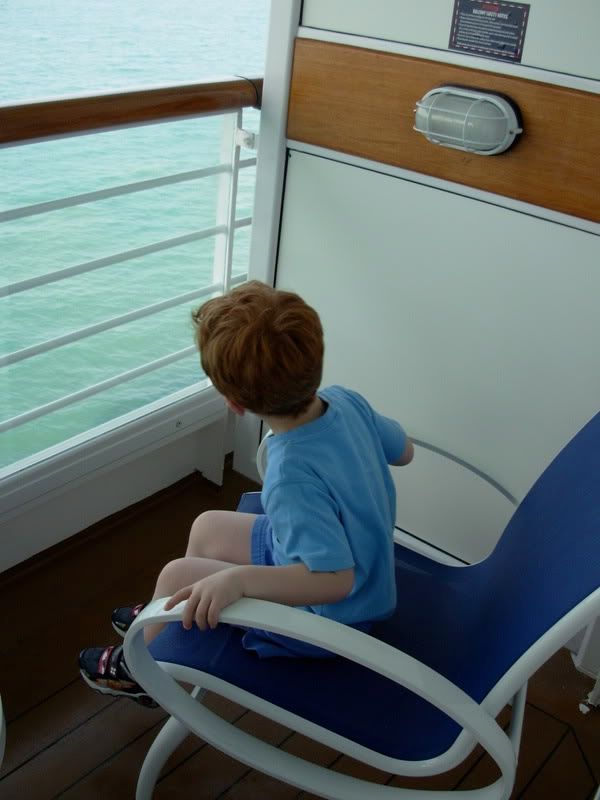
In the middle of the night I was awakened by a sharp bang in the room, which turned out to be one of the closet doors sliding open. It was just a couple of minutes after 2 a.m., the scheduled time of departure, which meant that the door had moved because the ship was no longer in port. I got up to look out over the verandah, and sure enough, the now-familiar profile of Nassau was sliding by silently.

Monday, May 28, 2007

Just Some Simple Maintenance

German cars are notoriously expensive to maintain. One obvious reason is that the parts are usually manufactured overseas, and are not in great supply. I have become convinced, however, that there is another, more sinister cause of high maintainance costs. Those Schwabian pranksters who design Porsches, in particular, seem to take perverse delight in hiding the parts that wear out in the most obscure and difficult to reach places. The 911 is not a large car, and in the nearly 40 years that the original design was produced, the designers devised many clever ways of packaging the various components that became more numerous as time went on. However, clever is not always convenient. Consequently, when the proverbial ten-cent part (ha!) breaks down, you must disassemble the car to get to it.

You think I'm joking. I most assuredly am not. Here is my Memorial Day project:


Behind and below each headlight is a device known as a ballast resistor, a hunk of ceramic about the size of a small cookie with four inches of wire protruding from it. One side works with the oil cooler that is in the lower right front bumper; the other side is part of the air conditioning system that has its condenser in the lower left front bumper area. However, to access these miserable little devices, at a minimum the car must be put on stands, the front wheels removed and the front wheel well liners removed (14 screws total). It doesn't help that on the oil cooler side, the resister is held in place with a nut accessed from below, whereas on the AC side, the resister is fasted with an allen-head bolt accessed from above (I'm sure there are very logical, very German reasons for this). It is said that some can make the repair at that point; however, one would have to have intimate knowledge of each and every milimeter of the inner workings of these systems, and also have hands the size of a newborn. Since most of us do not possess those qualifications, the way the average shade tree mechanic must go about the task is to also remove the entire bumper cover (18 screws total), as well as loosen the oil cooler and AC condenser so they can be moved a critical three inches or so. Even doing that, the resistors can either be seen or touched, but not both at the same time. In fact the oil cooler resistor really can't even be seen very well. In the picture below, even with the oil cooler pulled down a few inches, the resistor is invisible up in a slot between the aluminum-colored object and the painted fender:


Nevertheless, I forged ahead. Five hours to disassemble and reassemble the car, ten minutes total to actually swap out both resistors. I even managed to get everything back together without finding a mysterious surplus of screws at the end of the project, and only forget to reconnect one side marker light (fortunately, I was able to finish the job without further disassembly thanks to one of those long, flexible grabby tools).

It's not setting the timing or replacing a clutch, but the sense of satisfaction is similar, and enough.

Thursday, May 24, 2007

Blast From The Recent Past: R.E.M.

While we wait for the rest of the Disney Cruise pictures to upload...

For those of a certain age, who are now in prime career/childrearing/living life to the fullest years, chances are high that R.E.M. was one of the pillars of their personal musical landscapes. Melodic enough to be accessible to nearly everyone, yet quirky and anti-establishment enough to give suburban kids the feeling that they were really indie, dude, R.E.M. helped define college and, eventually, popular music for about 15 years through the 80s and mid-90s.

As further proof that everything exists on the internet, and that you can find it if you look long enough, an enterprising soul has created a site with a brief analysis of one R.E.M. song every day.

This just might kill off the rest of my week.

Friday, May 18, 2007

Bahamas 2007, Day 2

Our first morning in Florida found us fully encompassed by the Disney gravitational pull. After a great buffet breakfast in the hotel, we packed our bags and set them outside our hotel rooms, festooned with custom Disney Cruise tags. The inscrutable workings of the Disney machine would, we were assured, swoop in to collect our suitcases and deliver them to our cabin on board the ship some four hours hence.

In the meantime, we gathered with sixty other gaily dressed families in the expansive hotel lobby, where we were met by Disney Cruise representatives who checked our papers, nodded sagely and guided us en masse to the busses. Like a bunch of overgrown kindergartners, we traipsed though the Orlando airport traffic to an unused part of the baggage claim, where we were left in one line of several to await boarding of the bus that would take us to the ship (Orlando is about 40 miles inland, after all).

In the course of our 45 minute wait, we saw an astonishing number of Disney busses, some painted as resort-bound, others Cruise-bound with painted faux portholes, endlessly stopping outside the makeshift depot to pick up another shipment of revelers. Predictably enough, the bus came complete with a DVD system that played a film that introduced the entire embarkation procedure in a smile-it’s-Disney sort of way. The film, of course, lasted precisely the amount of time it took to get from the airport to the ship.

We waited an agreeably brief time in the terminal prior to boarding the ship:


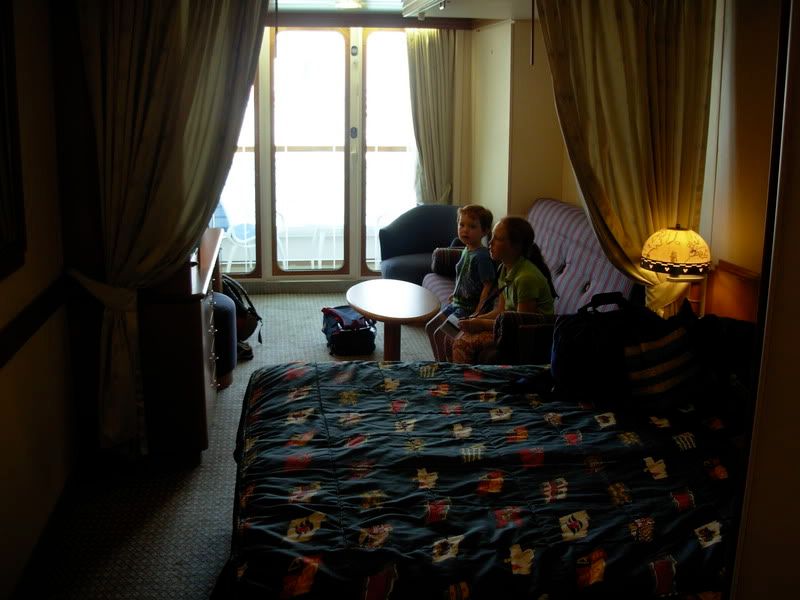
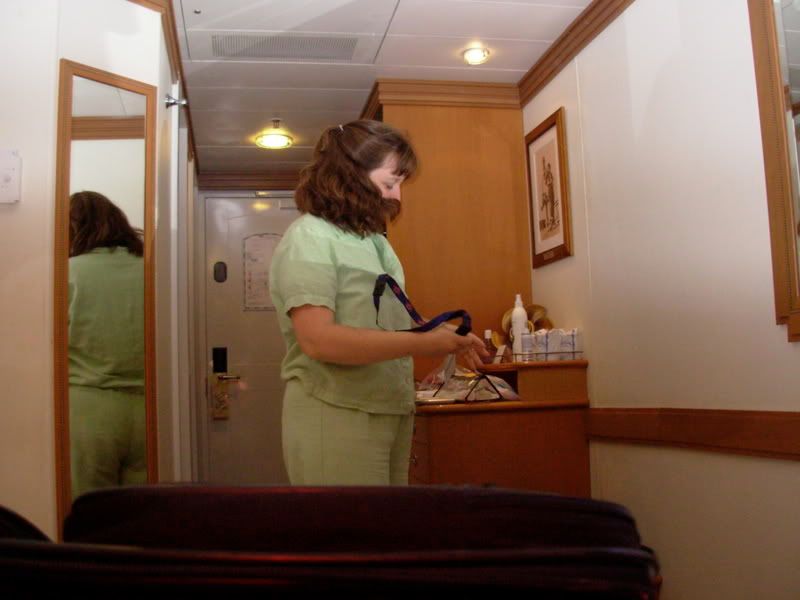
Following a personalized welcome on board that was met with many huzzahs by the ever-cheerful crew, our first task was to get lunch at the 9th deck aft buffet. Here we first encountered the occasional frustration of the elevators, which could be easily overwhelmed by moderate use. Following lunch, we got to know our cabin (or “stateroom,” in the grand language of cruise ships). Regardless of the perceived frivolity that may attend the Disney-fication of a cruise experience, I found myself impressed by the boat itself. Admittedly, I had no basis for comparison, but I was very pleasantly surprised by the convenience and efficiency of our stateroom.


[Michael took that last one]

The front part of the room was the closet and split bathroom (tub/shower with sink in one, toilet and sink in adjacent), which led to the queen size bed. The rest of the cabin, which had a couch, desk with TV, large trunk and chair, could be divided from the front portion by a curtain. The sofa converted to a bed, with a bunk dropping from the ceiling above it, with yet another bed pulling out, Murphy-bed style, beyond those. On top of it all, we had a veranda, as did about half of the cabins on the ship. This is the way to go.


We pulled away from Port Canaveral around 5 pm after a raucous party at the Goofy Pool (amidships).


That evening we had our first go at the dining experience that is the heart of the cruise. We met the three servers who would be with us throughout the cruise, and learned what really great food was all about. I’m pretty middle-class in my tastes when it comes to cuisine, so it was a distinct pleasure to learn that, yes indeed, some food really is better than others. (Rumor has it that the adults-only restaurant on board, for which an extra charge is required, has even more superior food. Something to keep in mind for next time.) As our dinner was scheduled for 8 pm every night and lasted nearly two hours, we found ourselves without sufficient energy to take advantage of all the activities for both kids and adults that carry on deep into the night. Instead, as the ship rushed toward Nassau across light seas at up to 19 knots, we settled in for a pleasant night’s sleep, the TV tuned to the station that plays nothing but classic Disney animated movies to help us on our way.

Thursday, May 17, 2007

Bahamas 2007, Day 1

Our (unexpectedly) second annual trip to the Bahamas began in pre-dawn darkness that felt little removed from post-dusk darkness. I, in particular, had barreled headlong into the trip on the heels of a ridiculously busy week that kept me occupied until midnight the morning we were to leave. After scrambling to finish a trial brief into Friday evening for the trial that had threatened to prevent me from going on the trip, but which was scheduled to begin as early as Monday anyway, I dashed up to a camp above Lake Castaic to give a kickoff speech for a leadership retreat. The trip includes 30 miles of lightly traveled backwoods twisties, which are particularly entertaining in the dark. Fortunately, I’ve made the trip before and had a passing familiarity with the road. I managed to pull into a parking space outside the camp hall at about 8:42, just in time for my 8:45 speaking engagement. Of course, I had to make myself nearly carsick to get there in time, but that’s what Porsches are for, right?

After the speech and a little socializing, I dashed back into the night. We were due to leave for the airport in five hours, I was an hour from home, and I hadn’t packed for the trip yet. Thankfully, Cheryl had taken care of 95% of the packing, including much of my own, so after throwing a bunch of brightly colored shirts and bathing suits in my bag, I was pretty well done. Lights out at 1, lights on again at 3. It’s vacation, kids, get a move on!

We caravanned with Cheryl’s parents down to LAX, arriving about half an hour ahead of the beginning of the Saturday travel rush.

Check in and all of the security measures were easy and quick at that hour, made much easier by the fact that we no longer have to travel with either a stroller or car seat.

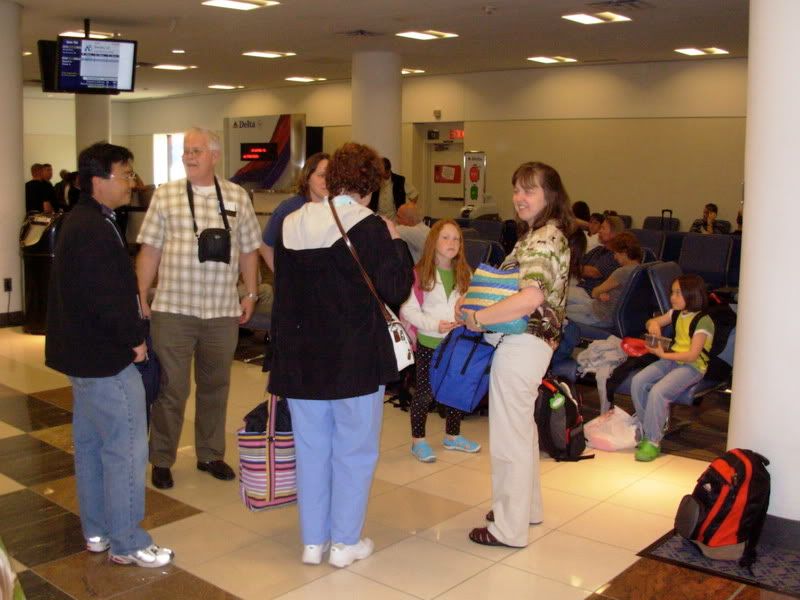
The last time we made this trip, we traveled on Delta’s Song subsidiary, their answer to JetBlue. That means one thing: in-flight TV. Flying on Delta itself, we had no such luck this time. Michael was quite disappointed, which made Daddy quite disappointed, too. Still, the flight was uneventful, and we landed on time in Atlanta, where we were to meet up with Cheryl’s sister and her family, who had flown in from San Francisco just minutes ahead of us. The cousins enjoyed their reunion:


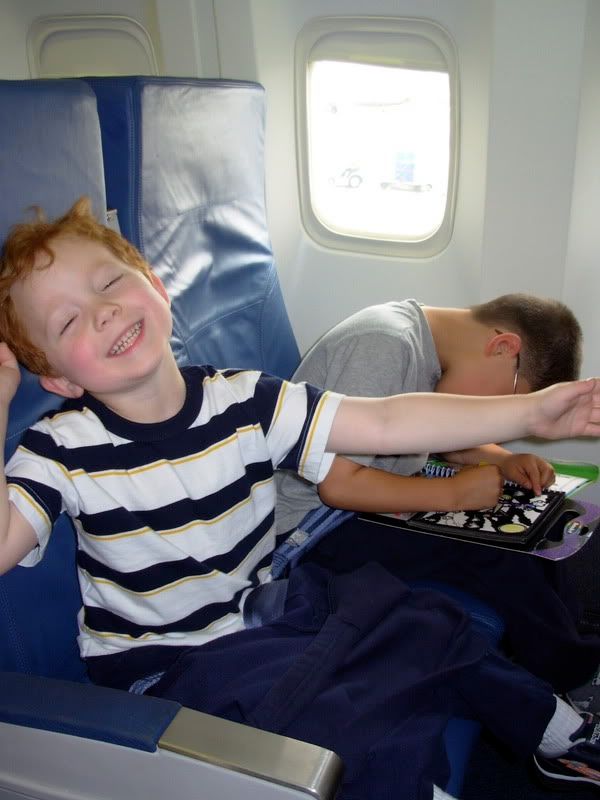
Our next flight, aboard the same airplane that delivered the San Francisco crew, took us to Orlando, where we would spend the night. I can only imagine that Orlando has a unique and feared reputation among flight attendants. Upon boarding the (substantially overbooked) flight, it became obvious that this was the Disney milk run. Adults and children populated the airplane in about equal number, and the preflight din was unusually loud and high pitched. Much to the delight of all, the seating was perfect. Cheryl’s parents had two seats to themselves on one side of the plane, Cheryl’s sister and her husband had two seats together on the other side of the plane, Cheryl and I were in the middle section roughly between them, the three girl cousins took up the middle section behind us, and the two boy cousins sat together across the aisle from them:


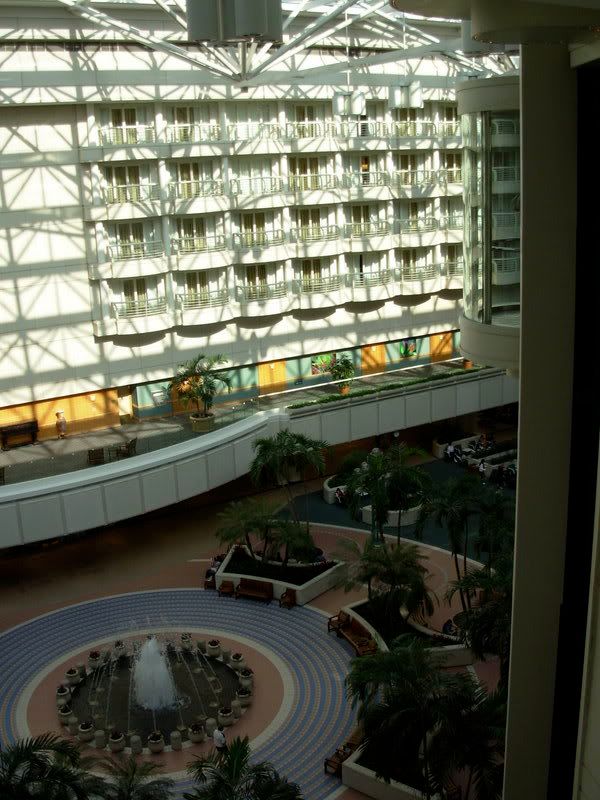
The Orlando airport comes complete with a Hyatt right in the middle of the facility.


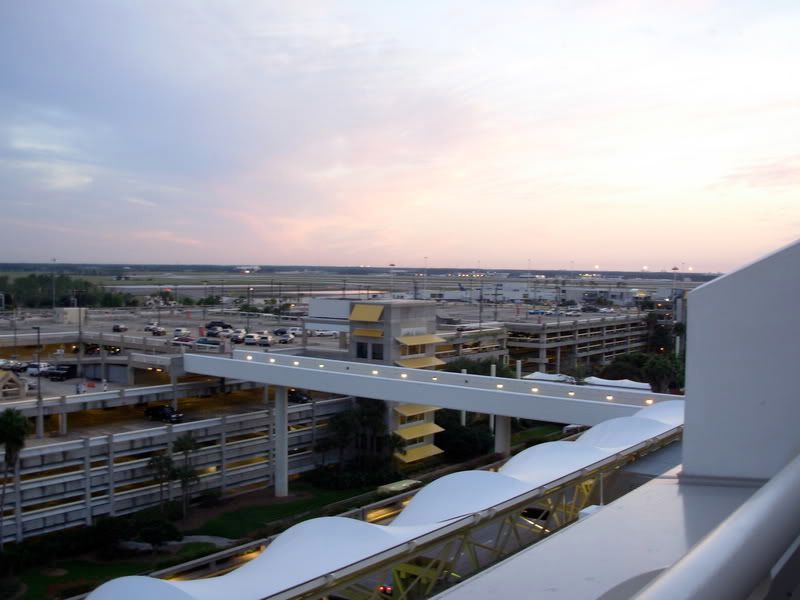
The airport is so immense, spread out over 23 square miles (I looked it up), that there is little more jet noise in the hotel than you would find just living in the general vicinity of a regional airport. The Hyatt is quite a nice hotel, and we got a room with a balcony overlooking the runways (my request).


After a very nice dinner in a hotel restaurant, we finally got some needed sleep in preparation for the start of the cruise the next day.

Wednesday, May 16, 2007

Good Times

Sorry for the dearth of posts recently, especially since a couple of you may be waiting to see happy snaps of our recent vacation. Those will be coming shortly, I promise.

However, I've been a bit distracted recently. Professionally, this is about how I feel these days:


(if you don't get the reference, Google "Peter Finch" and "Network".)

I hope to resume normal programming within the next three months or so. Stay tuned.

Wednesday, May 09, 2007

Cool Views in Hot City

Twice in the past month I have watched the hillside hear my office erupt in flames, the most recent occasion being yesterday. The office is at about fire height, so we get a great view of the spectacular work performed by the LA City Fire helicopter pilots as they drop water and fire retardants on the hillsides. Unfortunately, because I use Griffith Park for part of my commute, I've been forced to contend with LA traffic a little more often than I would prefer because of the fires.

A friend of mine who lives directly up the hill from us took this picture last night of the Griffith Park fire, showing both the Los Feliz section (to the left) that has received most of the publicity because of the danger to homes, and the main Park element of the fire (to the right):


Before the place totally goes up in flames, take a look at this interesting "photograph" of the park. There are other similar works available at the artist's site. (Incidentally, the artist happens to be the guy who played Lurch in the "Addams Family" movie and the Giant in Twin Peaks, among many others.) I haven't taken the time to investigate the technology that yields these images, but the result is interesting and beautiful, and uniquely computer-based. You really could not view these images in a gallery, unless the gallery included computer screens and a few basic controls. Neat stuff.

Yes, vacation pictures will be coming soon!

Tuesday, April 24, 2007

Now Departing from Dock 1 ...

It has been touch and go for weeks now, with a trial standing in the way. However, I'm relieved to be able to now look forward to this:


and this:


and this:


If that scene seems vaguely familiar, that's because it is.

Grandma and Grandpa are taking all the grandkids and their parents on one of those trips that we will all remember forever. And I came this close to missing it.

Friday, April 20, 2007

Hybrids are Great -- Ow!

A new section is currently being written in the Law of Unintended Consequences. Automobiles using a so-called “hybrid” powertrain, which combine a conventional internal combustion engine with a battery-powered electric motor, are all the rage these days. There are a select few systems on the market, principally offered by Honda and Toyota (which licenses its technology to Ford and Nissan). The Toyota system’s unique feature is that, unlike the Honda, under the proper conditions it can run on the electric motor alone.

Toyota’s unique engine/motor management system is good for fuel conservation, at least around town, but not so good for pedestrian safety. Have you ever been near a Prius as it was driven into or out of a parking space? Absolutely dead silent. That’s quite an achievement, until you realize that one of the senses we use when walking about in the presence of cars is the sense of hearing. Without thinking about it, we are attuned to be wary of what we hear in parking lots, knowing instinctively that cars can approach without us seeing them.

The Prius and its kin render this sense of self-preservation useless. I was recently startled by a Prius backing up in the small parking lot of Michael’s preschool. It had pulled almost completely out of its parking space as I walked nearby before I noticed it, because it made no sound. I hate to sound like a nanny-state advocate (whose adherents have succeeded in adding weight, complexity and ugliness to cars the world over – another post), but these things really should have some sort of warning beeper when they are operating in reverse, at which time the driver’s outward vision is more limited. After all, even golf carts, which are louder but much lighter than a Prius, typically emit a raucus beep or buzz whenever reverse is engaged.

I have a tangential connection to a major development in this area. Surely you have been awakened by the obnoxious bleating of a garbage truck or other heavy vehicle as it reversed. That noise is prescribed by law in California in no small part due to a tragedy that befell a schoolmate of mine. When I was in junior high, the older brother of one of my classmates was killed by a garbage truck that was driving in reverse, without audible backup warnings, on the wrong side of the road. I recall an assembly at which his death was announced and explained to the students; a scholarship was created shortly thereafter, of which someone in my class was the first recipient. More importantly, my classmate’s mother lobbied the California state legislature until the vehicle code was amended to require garbage trucks to be equipped with audible backup warnings. Vehicle Code section 27000(b) exists because of her efforts.

While a Prius does not have the mass of a garbage truck, a small child is in just as much danger, and would be difficult for a driver to see. I don’t ordinarily push for government-mandated devices on cars, but unless Toyota and other hybrid or electric car makers voluntarily install audible warning systems, a tragedy that would have been simple to prevent is going to result in just such legislation.

Monday, April 16, 2007

Book Review: Cormac McCarthy’s “The Road”

Cormac McCarthy has long been described as this generation’s William Faulkner (it is not accidental that McCarthy’s first major editor had been Faulkner’s). In simple terms, that means he eschews conventional rules of grammar, and is difficult to read. In a broader sense, however, while McCarthy’s writing carries some of the same brutal weight of Faulkner’s best work, McCarthy is a unique voice in American literature, a true living classic. His recent novel, “The Road,” has a chance to be one of the most discussed and dissected novels of our day, although perhaps not for the usual reasons.

I have read a couple of McCarthy’s breakthrough novels, “All the Pretty Horses” and “The Crossing.” In both novels, the desolation of the bleak south Texas/northern Mexico landscape is matched by the spare yet richly textured prose and thin dialog. McCarthy has been fairly described as a most masculine writer, chronicling the exploits of dusty, hard men in fraught circumstances, who communicate in fragments of sentences. “The Road” follows in this vein, following the journey of “the man” and “his son” through a landscape for which the term “bleak” would bestow a sense of joy and comfort the setting does not deserve.

“The Road” has come to the attention of the average reader in part due to its somewhat inexplicable inclusion recently in Oprah’s Book Club, and as of today because it won the Pulitzer Prize for fiction. Ironically, I found the book on a rack in an airport last week, and, knowing nothing about it, bought it because of the author and before I noticed the Oprah seal of approval (which might have put me off buying the book, snob that I am). Oprah viewers, I’m sure, and others drawn to the novel because of its awards and the author’s pedigree are likely to be in for a shock. While ultimately deeply affecting, “The Road” is not an easy read. Oh, it is a fast read, as it is actually relatively short (I managed to get through it in about four hours), but rather than tricks of grammar, it is the subject matter that troubles the reader.

“The Road” takes place in somewhere in the southeastern United States at an indeterminate time following a nonspecified holocaust. Just about everything living thing on or in the earth has been annihilated. Those humans that remain (as it does not appear that any other form of life survived, save one dog glimpsed from afar for a moment) are reduced to terrifying bands of cannibalistic savages who roam the still-smoldering roads, or terrified individuals who stay in hiding away from the roads and who must go to scarcely imaginable measures to survive. Into this searing, seared landscape of endless ash and unrelenting gloom, the man and his son travel to the unnamed coast in search of … what? In the end, all that matters is that they cannot stay where they are, wherever it is they happen to be.

The author has stripped the land completely bare. Every place the reader would hope that the man and his boy would find something with life, something that represents hope, McCarthy takes it all away. The man of the story must be clever, determined and downright lucky at times in his efforts to provide food, shelter and clothing for himself and the boy, who constantly hover on the edge of starvation. McCarthy is also not above shocking the reader, in the brief glimpses one would take upon unexpectedly encountering the detritus of a car crash, with imagery that man, boy and reader all wish could be unseen immediately thereafter. The oppressiveness of the falling ashes, the cold, grey skies, the endless, hopeless hunt for food, and the constant fear of exposure to any other person eats away at the reader. Against this hideous tableau, a father lovingly looks after his son. Here is a sample from the first part of the book, starting with the very first words:

When he woke in the woods in the dark and the cold of the night he'd reach out to touch the child sleeping beside him. Nights dark beyond darkness and the days more gray each one than what had gone before. Like the onset of some cold glaucoma dimming away the world. His hand rose and fell softly with each precious breath. ...

When it was light enough to use the binoculars he glassed the valley blow. Everything paling away into the murk. The soft ash blowing in loose swirls over the blacktop. He studied what he could see. The segments of road down there among the dead trees. Looking for anything of color. Any movement. Any trace of standing smoke. He lowered the glasses and pulled down the cotton mask from his face and wiped his nose on the back of his wrist and then glassed the country again. Then he just sat there holding the binoculars and watching the ashen daylight congeal over the land. He knew only that the child was his warrant. He said: If he is not the word of God God never spoke.

When he got back the boy was still asleep. He pulled the blue plastic tarp off of him and folded it and carried it out to the grocery cart and packed it and came back with their plates and some cornmeal cakes in a plastic bag and a plastic bottle of syrup. He spread the small tarp they used for a table on the ground and laid everything out and he took the pistol from his belt and laid it on the cloth and then he just sat watching the boy sleep. He'd pulled away his mask in the night and it was buried somewhere in the blankets. He watched the boy and he looked out through the trees toward the road. This was not a safe place. They could be seen from the road now it was day. The boy turned in the blankets. Then he opened his eyes. Hi, Papa, he said.
I'm right here.
I know.


Remember “bleak?”

And yet the relationship between the father and son redeems both them and the story. The tender yet murderous determination the man shows in caring and providing for his son tugs every bit as firmly on the heartstrings as the richest, most lush Dickensian serial. The boy struggles to come to terms with his father’s fierce loyalty to him that includes a aggressive dismissal of any and all other beings that place themselves in his path. The boy, who cannot share his father’s memories of the world we know, innocently implores his father to intercede on behalf of the few others they encounter, and must learn to understand how the man, who will do anything for his son’s sake, will exhibit the worst forms of self-preservation when faced with other lonely stragglers.

It is too simple to label “The Road” as merely a fine novelist’s foray into science fiction, with a chilling view of what happens when man allows his inhumanity to rule. The barren world is too vividly conjured, the relationship too preciously rendered, for that analysis to hold. The richness of “The Road” is in how life is to be lived in the small, desperate spaces of a father’s heart, in the expression of the universal longing of every father to see his son grow and succeed. That the man’s quest to see his son survive is under circumstances blessedly far removed from anything we know, and hope never to know, only heightens the intensity of McCarthy's portrayal.

Notwithstanding Oprah’s pedigree and the approbation of the Pulitzer committee, “The Road” really is not for everyone. This is not a feel-good story unless the meter with which you evaluate human existence can be calibrated to find joy and hope in minute discoveries and victories that are usually undetectable in our everyday experience. The depth of the love between the man and his son, however, is undiminished by the death of the earth around them, and will linger profoundly even as the reader seeks out the real sun to escape the sadness and waste of so much of McCarthy's goulish, fallen world. Ultimately, although death is visited upon a horrifyingly large portion of the human race in "The Road," it cannot kill humanity.


Thursday, April 12, 2007

The Romance of Language

I spent much of yesterday in the company of a business associate who was in town (that town being San Francisco, incidentally) from Florida for a meeting. As we chatted genially about e-mails, time zones and cross country flights, it occurred to me that, even in the midst of our post-modern, 21st Century digital lives, the questing, adventurous spirit that is uniquely American lives on, embedded in our very language.

Those of us who have spent most of our lives on the West Coast speak of going "back East" when traveling to the East Coast. Conversely, travel in the other direction is usually expressed in terms of going "out West." Have you ever spoken of flying "out East" or "back West?" There is something inherent in our language, it seems to me, that preserves the sense that the East Coast is the starting place, the home and the root, and that all else West is the destination, out there somewhere. I even edited the first sentence of this post to take out my original construction, describing my collegue as having "flown out" to California. Even us Westerners (or at least this one) acknowledge by our language that this is still the outpost, to which others journey from the well-established settlements in the East.

As reduced in size and time as we believe our world has become over the recent decades, there is something in this unconcious mapping of our syntax that comforts me, that there is still a cultural memory of journey, adventure and hope.

Wednesday, April 04, 2007

A Melodious Reunion

This past weekend I had the opportunity to take part in a reunion of the Schubertians, the men's chamber choir of which I was a part while at UCSB. The group was in existence from 1964 to 1995, and had just over 200 total members in the course of its history. We have had a few formal reunions in the past, which now take on greater significance since the group is no longer active and Carl Zytowski, the director, is in his mid-80s (but still going strong).

The reunion was great fun. I knew very few of the men, some of them older than my parents, but the sensation of picking up a song that even the youngest of the group last sang regularly more than ten years ago and being able to hit every note and clip every cutoff was extraordinary. Thirty years worth of singers with a common thread in the music and director can yield a uniquely unified group of people that spans generations. I had the opportunity to be a part of a sub-group of Southern California Schubertians that sang two songs, plus one in combination with a Northern California sub-group that itself sang two extra songs. The one rehearsal we had at one of our members' homes in Santa Monica was the very definition of what these songs were all about: a group of musicians enjoying a fine afternoon of great music and friendship.

The reunion concert itself was great fun, a mixture of hard work, nostalgia, and sentimentality. It was a sweet thing to have wives and children fill the auditorium seats that were once occupied by girlfriends and (extraordinarily loyal) roommates back in our student days. The concert was dedicated to one of the forces behind the reunion, who is dying of cancer and wanted to have another chance to hear the songs before his time was up. Thankfully, he rallied over the last couple of months and was able to participate in the concert. He was even able to set aside his oxygen line and rise from his wheelchair to sing a solo verse in the last song. I think most of us had difficulty seeing our music to sing the last chorus after he was done.
The local Santa Barbara News Press published a very nice review of the concert that accurately captured the feel of the event. Ordinarily I would link to an article, but because the News Press has an annoying registration requirement, please indulge me while I republish the whole thing here:

IN CONCERT: Schubert never sounded sweeter

GEORGE GELLES, NEWS-PRESS CORRESPONDENT

April 3, 2007 9:02 AM

Among his peers in the pantheon of great composers, Franz Schubert holds a special place. Bach and Haydn might be known for all-embracing industry, Mozart for dogged determination, Beethoven for innovations that swept away all before him, but Schubert was utterly unique in a different way: he was an archetype of sociability. He lived his life in a tight circle of colleagues, and his music welled from a source that, above all, valued intimacy of expression and companionship.
Listening to Schubert draws you into his circle. He is at his best when emotions are shared one-to-one, as in his more than 600 songs, and it is no surprise that he flops at forms, like opera, where a premium is placed on public spectacle. Though his later compositions are visionary in shape and substance (works such as the late piano sonatas and the final two symphonies), most of his output celebrates the amity of friendship.

The quintessential get-together for the composer and his friends was known as a Schubertiad, a word that referred to informal performances of Schubert's music at the home of a fellow musician or patron. These events got started in 1816 and found full flower during the following dozen years. We got a fine idea what such an occasion might have felt like on Saturday afternoon in UCSB's Lotte Lehmann Hall, when a Schubertiad was presented, logically enough, by the Schubertians.

The Schubertians, as we learned this weekend, were an enterprising group of UCSB vocalists who banded together to explore the wonderful repertory of Schubert's songs for men's voices. Carl Zytowski, who joined the music faculty in 1951 and set enviably high standards for all things vocal, was the group's founder and director. Established in 1964 and disbanded in 1995, when Professor Zytowski retired, the Schubertians included more than 200 singers during their impressive history. Approximately 70 alums from California and beyond participated in Saturday's performance, which was the ensemble's fourth major reunion in the past dozen years. With almost all of them active in professions other than music, they gave amateurism a good name.
Schubert composed for men's voices throughout his career, first as a teenage student in 1812 and finally as an acknowledged master facing a far-too-early death in 1828, and the songs span the gamut of emotions.

At the Schubertiad, we heard the light Italianate composition "La Pastorella" (The Shepardess), convivial drinking songs ("Bruder, unser Erdenwallen" and, even better, "Edit Nonna, Edit Clerus, A 16th Century Drinking Song," wrongly attributed to the 14th century in the Schubert Complete Edition and in Saturday's program), and works that pushed contemporary boundaries of temperament and technique: "Der Gondelfahrer" (The Gondolier), "Grab und Mond" (Grave and Moon) and "Der Entfernten" (To an Absent Lover), where the classically steeped Schubert defines the atmospherics of a new Romantic era.

Schubert was neither the first nor the only composer to write songs in praise of music, but far more than others, Schubert's wrench at your gut. They have immense evocative powers, and the two works of this sort that we heard, "Zur Guten Nacht" and "An die Musik," were prime. "An die Musik," in fact, which was sung by bass-baritone Michael Dean -- it's a solo song and not a choral work -- should be the national anthem for everyone who toils in music's fields.

"Nachthelle" (Brilliance of Night) was another masterpiece heard Saturday, exceptional even for Schubert, and it got a fine performance from tenor soloist Scott Whitaker, with the men's chorus led by guest conductor Jameson Marvin, UCSB alum and former Schubertian, who now is director of the Harvard Glee Club.

Conducting his choristers in the other compositions was Carl Zytowski, who, with a discreet gesture here, a telling nod there, was the picture of efficiency, leading his singers in winning performances. Their Schubertiad is one that Schubert himself surely would have enjoyed.

Indeed.

Tuesday, April 03, 2007

Internet Directions Are The Best

Yet more evidence that through the miracle of internet-based mapping systems, you really can get there from here.

Pay particular attention to step 20.

Wednesday, March 28, 2007

Sometimes Chicken Little Is Right

Just when you thought you had enough to worry about when travelling by air (are my carry-on liquids in clear plastic containers? Am I wearing clothing that is easy to remove and put back on at the security check?), now comes the story that space junk just about took out a commercial airliner.

It seems that a flight between Chile and New Zealand (how quaint -- people do stuff in the Southern Hemisphere just like people here in the real world) nearly crossed paths with Russian satellite that was, in the antiseptic phrase of rocket scientists, de-orbiting. The pilot of a westbound overnight flight was more than a little alarmed to see flaming chunks of space junk falling within five miles of his airplane. Consider that at the usual speed such aircraft fly, the separation between the airplane full of sleepy passengers and a flaming hunk of used-to-be satellite was about ten seconds. Just to make the adrenaline flow a little faster, the pilot said he could hear the roar of the falling debris over the sound of his own craft's engines. (Incidentally, I have no trouble believing this. On my last trip to Florida, we passed alarmingly close to aircraft headed west in the same flight corridor. The engine note of those jets was clearly audible.)

The Russians were little help. They had alerted the airlines that the satellite would be re-entering the atmosphere so that pilots could plan for the potential danger. Unfortunately, the Russians got a few details wrong: the day, time and place of the re-entry. Bummer, dude-ski.

Monday, March 26, 2007

Stay Off Washington Roads On Weekends

Think this kid is headed for a tough future? It seems that a Washington state 17-year-old was arrested for drunk driving. Apparently the combination of a minor driver (statistically the most dangerous) and drinking is not something Washington worries about, since it let the boy go. Washington cracks down on adults who drink and drive, though. Later that night, the same cop stopped the same kid for drinking and driving. Unfortunately for the kid (but apparently a huge stroke of good fortune for the good citizens of Washington), as night turned to early morning, he turned eighteen. Just like that, he got his very first adult DUI and was promptly locked up.

The same (former) kid had been stopped for drunk driving earlier in the month. Did nobody tell him that the get-out-of-jail-free cards he had been getting as a juvenile would out when he turned eighteen? Geez, what good are high school counselors, anyway?

Saturday, March 17, 2007

Sporting Frenzy

This is one of those weird, fun weekends when the sporting world offers up one of its better days of the year, particularly for those like me with, let's say, eclectic interests. The NCAA men's basketball tournament, of course, is the colossus that stands astride the sports landscape. The first weekend, packed as it is with 48 games, in which the rarely seen pure joy of sport makes an appearance every once in a while, is probably the best time for the casual fan. In that many games, there is bound to be a fun one or two (as Oregon found out, nearly to their regret). Plus, the now-mandatory filling out of tournament brackets has created perhaps the most effective vehicle for non-fans to experience the fun of following a particular sports team. Pick a team to win, for any reason at all, and you suddenly have a rooting interest. There's nothing quite like pulling hard for Winthrop (who?) to beat Notre Dame, believe me.

Since you asked, yes, my brackets are doing quite well. Historically well, actually. 28 out of 32 correct picks on one sheet, and 27 out of 32 on two others. It has helped that nearly all of the favorites have won.

In addition to basketball, the 12 Hours of Sebring, a venerable and important sports car race, is now underway. More importantly, the Formula One season kicks off this evening with the Grand Prix of Australia. It looks like this will be the most interesting season in years, now that Michael Schumacher has retired. Two-time defending champion Fernando Alonso has left Renault to join super-rookie Lewis Hamilton at McLaren, which seems to be back on form. Always quick Kimi Raikkonen has filled Schumacher's place at Ferrari, and has shown the expected speed. BMW Sauber appear ready to join the ranks of the elite teams, Renault is off the pace, and last year's comic relief, Super Aguri, is dominating the works cars of its patron, Honda.

Um, is anyone still here?

Did I mention that there is a full slate of English Premier League soccer games on as well?

And that I also have drafts for two different fantasy baseball teams today?

Okay, that should have eliminated everyone else. To the couch I go.

Friday, March 16, 2007

Another Reason to Love the Internet

It's been a reasonably good day at the office, it's Friday, and the weather is perfect. Naturally, one does in such situations, I'm thinking, "happy dance!" Hit number one on Google using that search term:


Thanks, Al Gore!

Tuesday, March 13, 2007

The Brilliant Potential of the Human Mind

Are you feeling smart today? On top of your game, are you? Well, meet UCLA's 31-year-old mathematics professor who happens to have made some significant discoveries pertaining to a 2,300 year old math problem, among other things. He seems like a nice-enough guy, he just happened to be working through high school problem sets when most of us were struggling with the nuances of the "plus" sign. Stupendous brainpower apparently runs in the family. One of his brothers is mildly autistic and can play any piece of music on the piano after hearing it once. And pity the poor youngest brother, who had to beg his parents to recognize that he was not like his brother. No, that poor wretch only has degrees in economics, math and computer science and holds down a job as a computer programmer.

Want to know how you know you are a prodigy? Solve these problems. Without paper. At eight years old.

Can you even solve them now? [Yes, Andy, I'm sure you can, but you always did have a little Rainman in you when it came to math.]

Monday, March 12, 2007

My (Shared) Birthday Gift

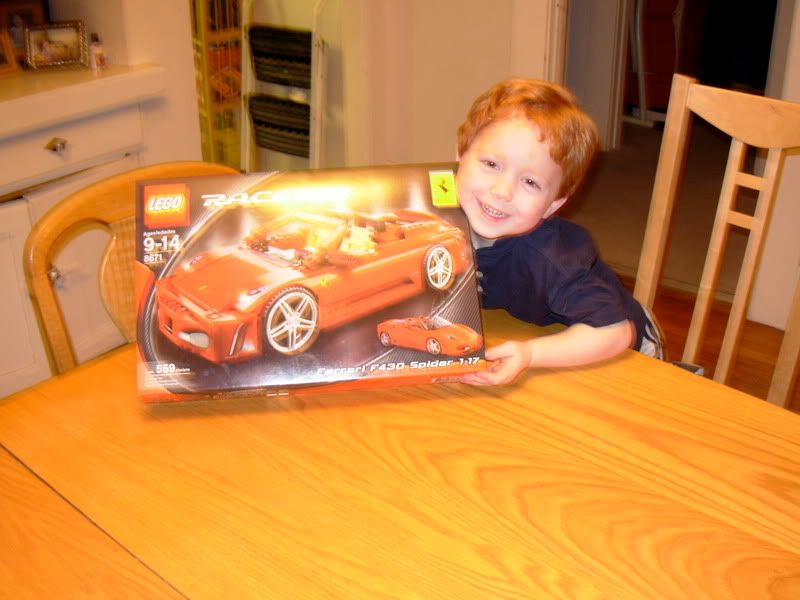
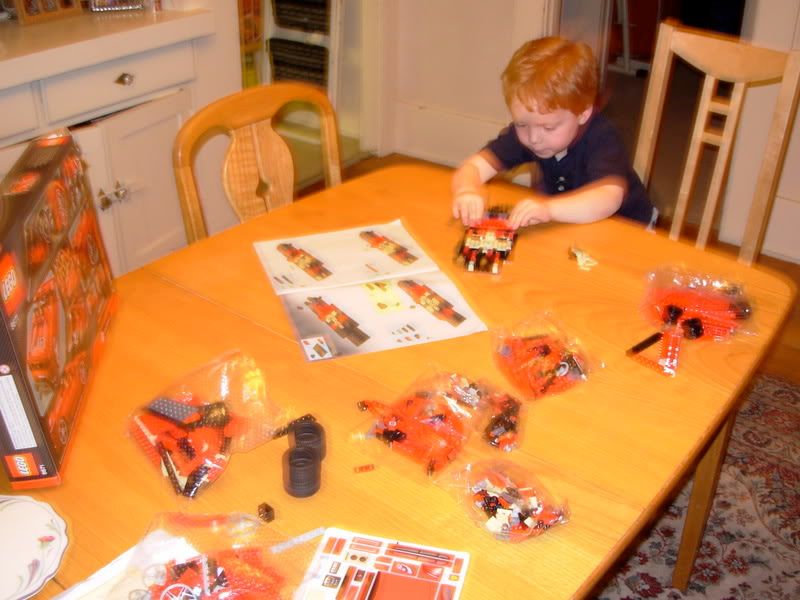
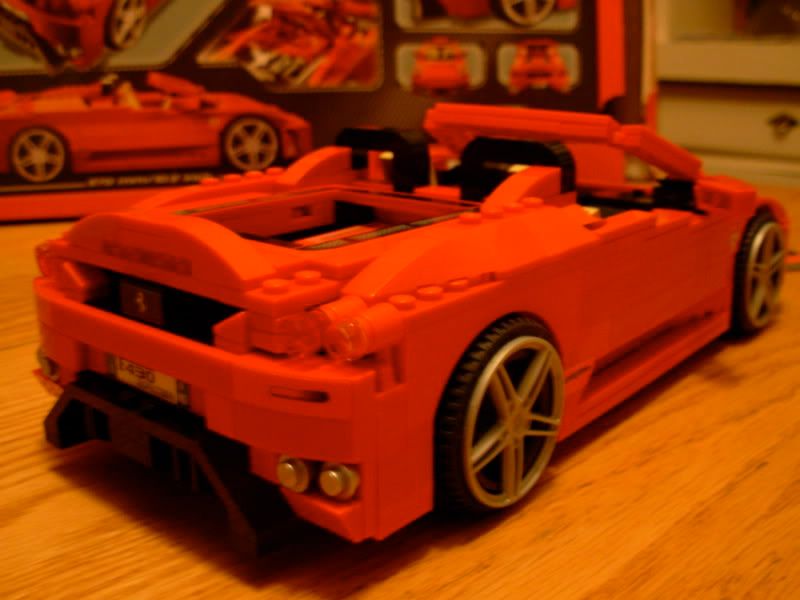
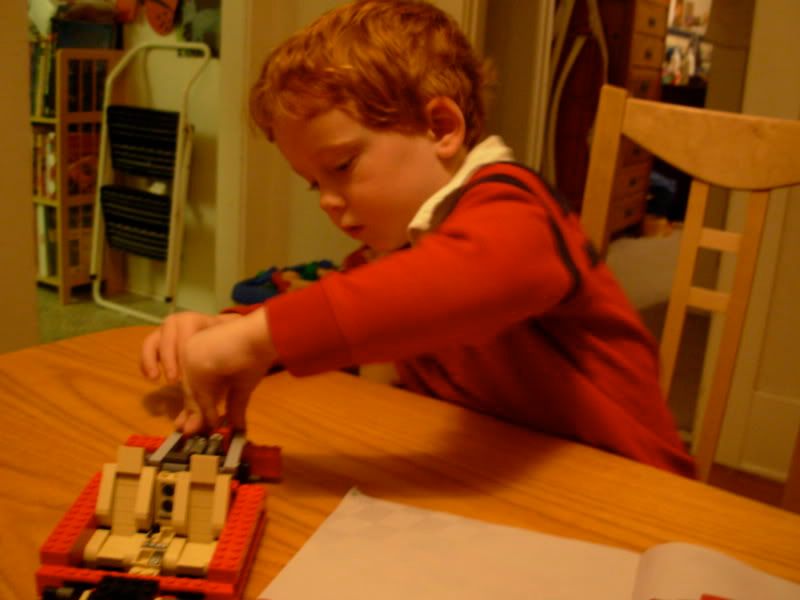
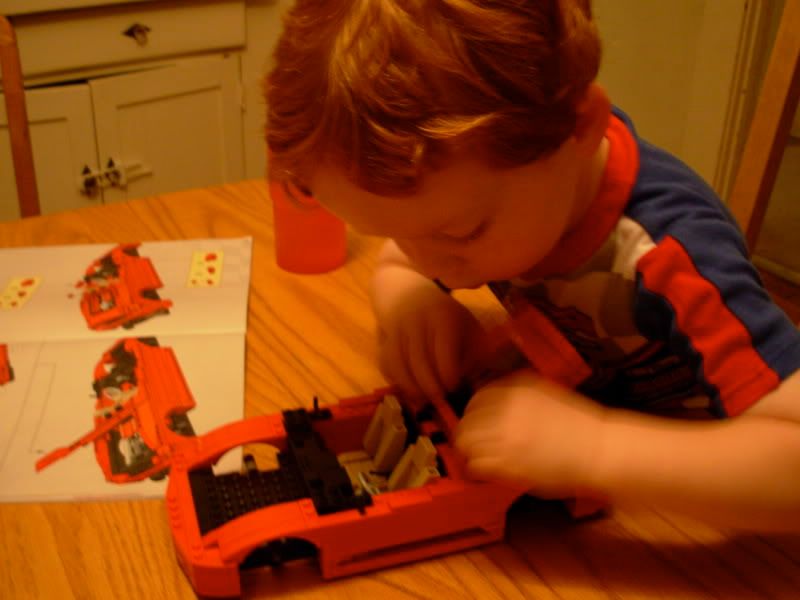
As has been chronicled elsewhere, Michael is quite the whiz with Legos. Knowing this, Grandma Janet got clever and gave me a 1/17th scale Lego Ferrari F430 kit for my birthday. As she undoubtedly knew would happen, it was immediately appropriated by the Lego Kid:


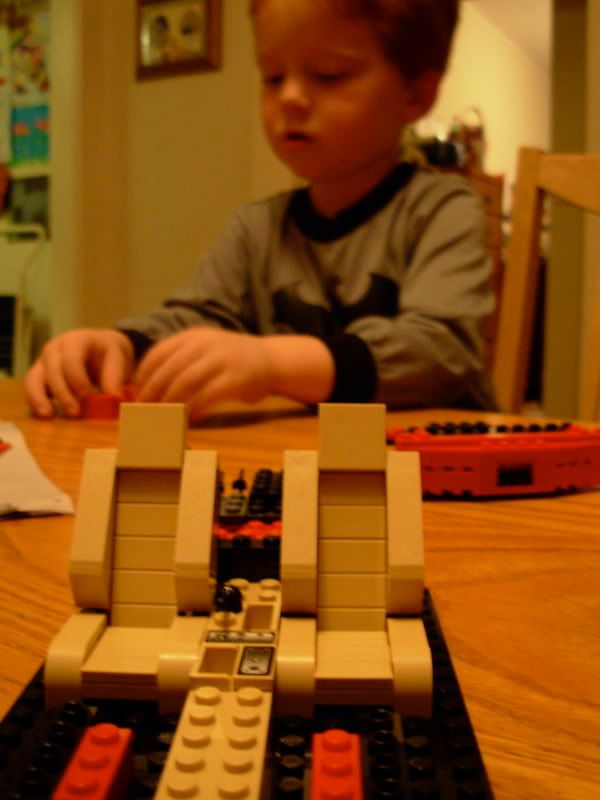
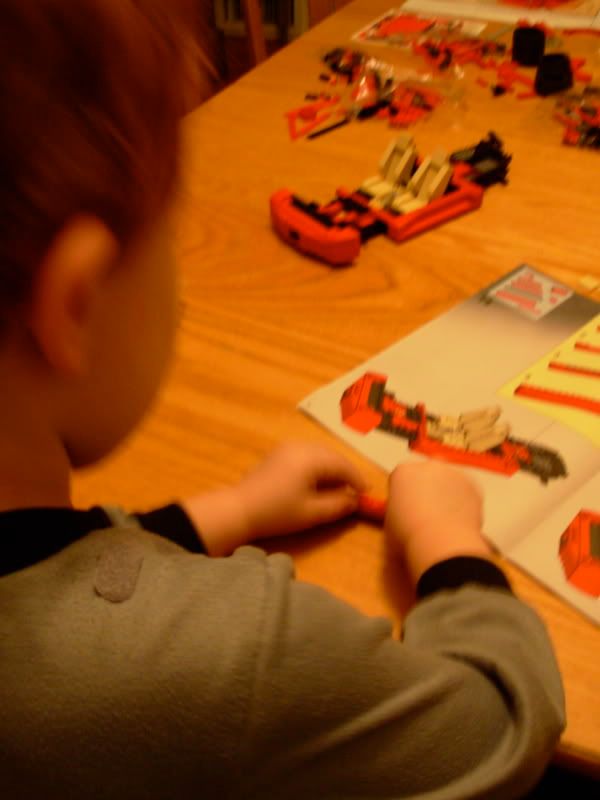
We agreed to share the construction duties, each taking charge of every other construction step, of which there were about 34. It took three evenings, but we did it.


Just Because


Too bad the kid's so camera shy.