Thursday, August 27, 2009

So It Begins, Again

For the first time in three years, when Michael was still in pre-school, the school year began exactly like the previous year. Last year, everything was new. This year, we are building on everything that happened last year. Instead of sitting on a bench while a playground full of joyfully reuinited friends whirled around him, Michael was part of the frenzy, hardly looking back to say goodbye on his first day of second grade. Instead of bravely looking forward to making new friends out of everyone she would meet because she did not know a soul, Kelly headed to seventh grade eagerly looking forward to seeing which of her friends she would find in each of her classes.

Both got off to good starts, with positive reviews for their classes and friends. Kelly has eight class periods, and Michael is in a split second/third grade class that was put together with some of the better students in each grade (because they all have to be able to work semi-independently, and be capable of pushing a little faster than most students). Most of Michael's class is made up of kids from the swim team, so unlike last year when he knew nobody, he knows just about everybody in his class this year.

We're all sorry to see the summer come to an end, but the school year seems to be off to a good start.

Monday, August 24, 2009

Feed Me, Seymour

Do you have a rodent problem? Ditch the traps and poisons. Get a carnivorous plant. The Venus Flytrap is a mere popgun compared to the big-barreled, newly-discovered meat eater from the Phillipines:

The plant lures in the rats with the promise of sweet nectar. When the rat leans into the plant to drink the saccharine liquid, it slips on the pitcher's waxy interior, and gets stuck in the gooey sap. Once it is trapped, acid-like digestive enzymes break down the still-living rodent.

Yummy. It's your very own Little Shop of Horrors for your domestic pests.

Tuesday, August 11, 2009

(Falling) Stargazing

Spend some time outside tonight watching meteors streak across the firmament. The annual Perseid meteor shower will be at its peak overnight. The most spectacular meteor streaks are expected to appear between 9 and 11 pm local time, while the best time for sheer frequency will be closer to dawn on Wednesday.

Brew some coffee, pop some popcorn, put the deck chairs on the lawn and prepare to say "ooh" a lot.

Thursday, August 06, 2009

The Eternal Breakfast Club

This is a sad day for Gen-Xers. The man who simultaneously reflected and shaped our teen years, John Hughes, has died. He is the man behind "Sixteen Candles," "Ferris Beuller's Day Off," and "The Breakfast Club," among other '80s hits.

A generation of people who saw much of themselves in Hughes' slightly nerdy but good-hearted characters mourns today.

Tuesday, August 04, 2009

The Madness Reaches Fever Pitch

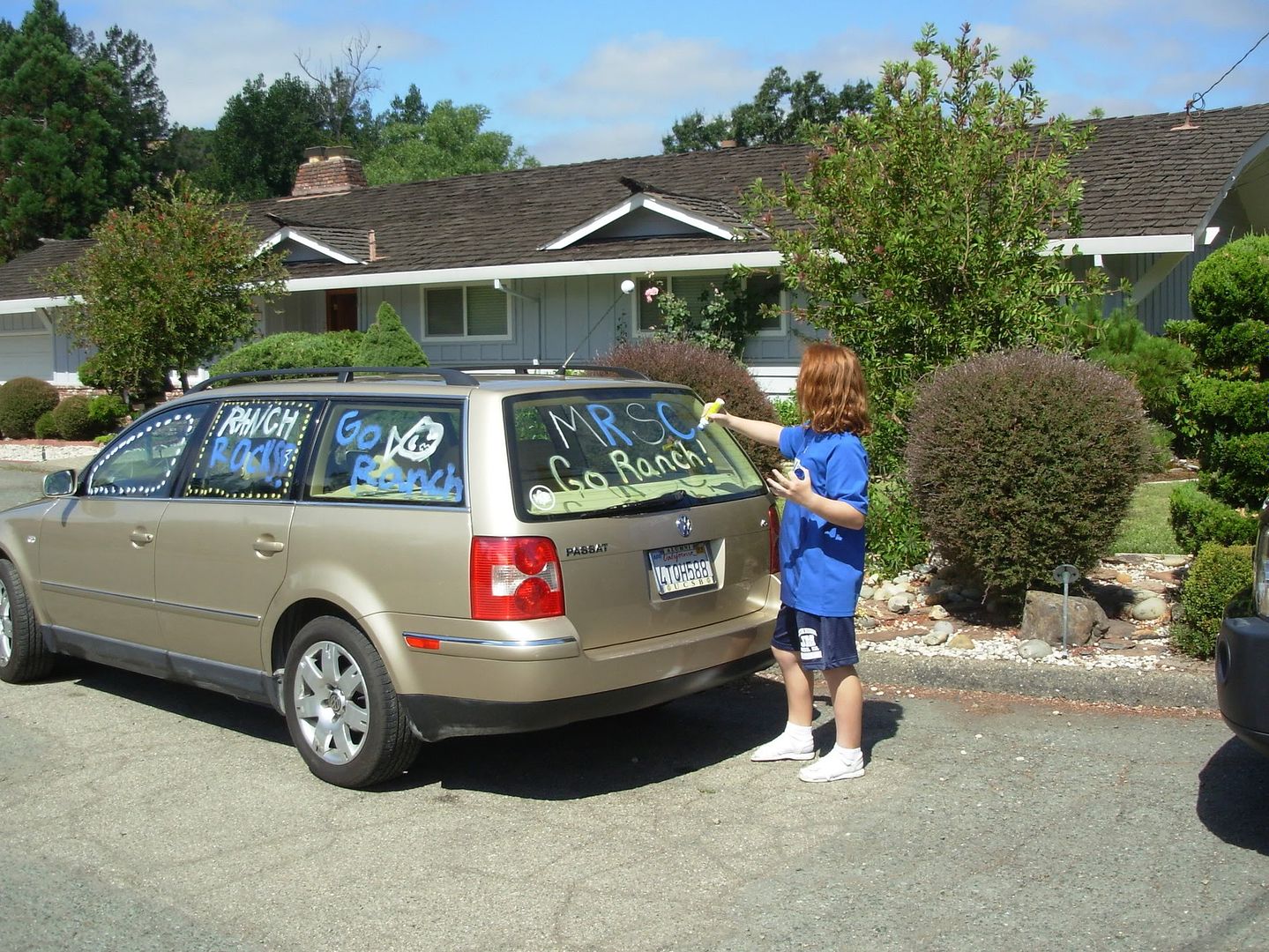
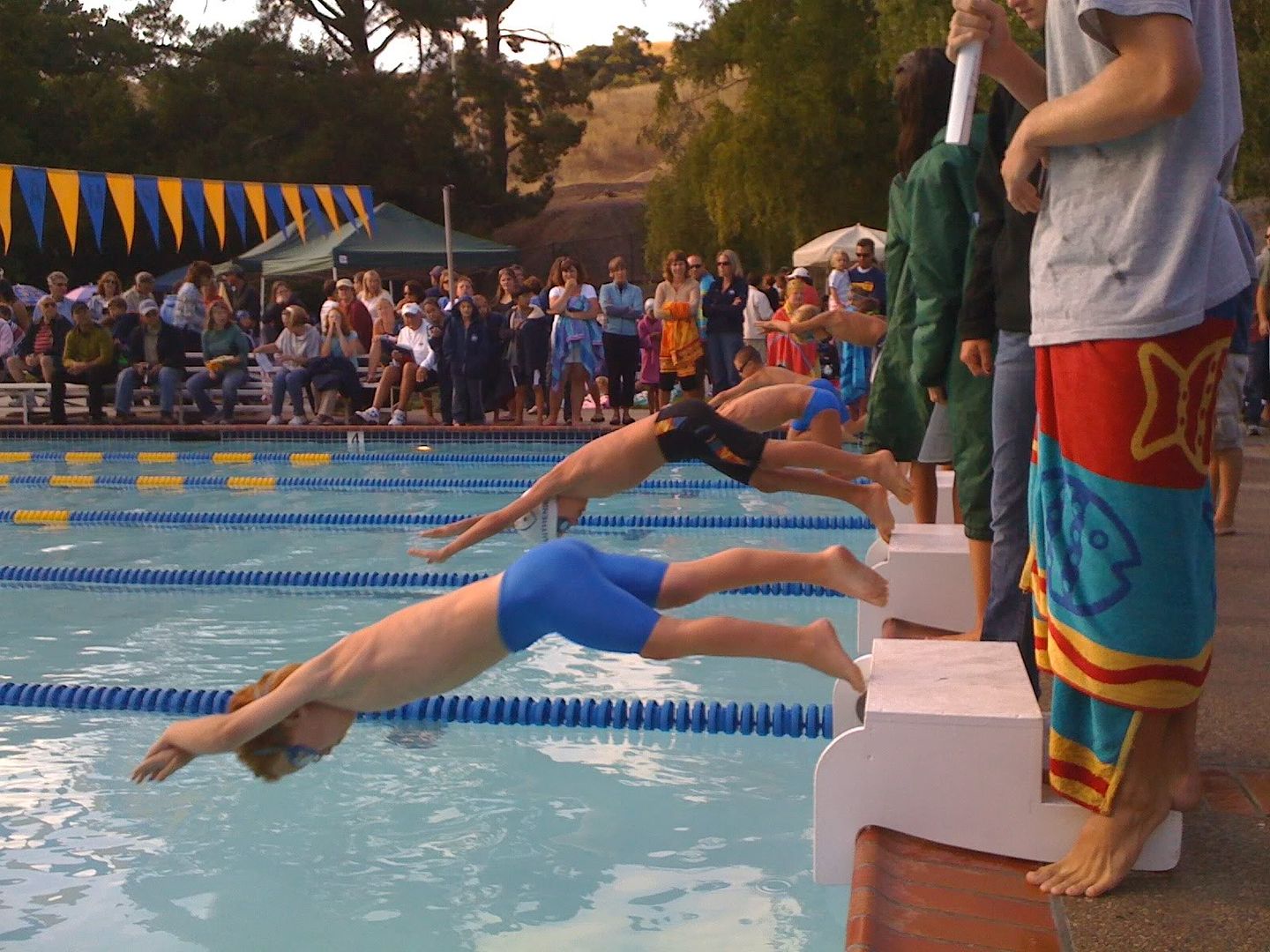
The swim season is nearly over, but the intensity has ratcheted up in advance of the league finals. The kids had two-a-day practices last week, and have now backed way off, preserving their strength and energy for the final meet. In preparation for the ceremonial parade to the aquatic center at Campolindo High School later this week, we joined everyone else in festively decorating the car:


It has been quite a year for Michael. He has reduced his freestyle time from 36 to 25 seconds, and now is very competitive over the first half of each race (and no longer doggie-paddles to catch his breath at the end). His backstroke has improved dramatically over the course of the year as well. When we noticed that he seemed to be very quick during warmups while swimming the butterfly, we had him swim it at the last dual meet of the season last week. Once again, he dropped his personal best dramatically, getting closer to a "bronze" time with that stroke than any other. Unfortunately, a scheduling quirk will prevent him from swimming the fly at OMPA, but he is already looking forward to next year. He figures, probably correctly, that he will probably hit bronze times next year as one of the older kids in his division after a full season of competition.

And yet, his biggest accomplishment for the season was not in a race. At the beginning of "Survival Week" last week, the team held a swim-a-thon to benefit a swim team family whose mother is struggling with a recurrence of cancer. The workout for all of the swimmers was to swim as many laps as they felt comfortable doing during their regular workout time, which is 45 minutes for Michael's division. I figured that Michael would swim a few laps and call it a day. Not quite; he swam 44 laps ... 1,100 yards, more than half a mile.

I am officially old. My seven year old son has done something athletic that I cannot do.

Friday, July 31, 2009

The Kid Can't Help It

Our daughter has been known, on occasion, to exhibit extreme sensitivity to... let's call it "sensation." Ever since she has been old enough to talk, she has recoiled in horror from all sorts of foods that she called too "spicy." In my gentle, nurturing form of parenting, I routinely and openly mock her, telling her that what she is sensing is "flavor." Brushing her hair is a grim exercise of pain management. Brushing her teeth with anything more than the lightest pressure sends her into paroxysms of agony.

I have not always been terribly sympathetic to her plight. It will take her all of her teen years to catch up to me in the eye-rolling department.

Now it turns out I may have been more of a jerk than I realized. According to a new study conducted by a dental organization, redheads are significantly more likely to feel pain, and be less responsive to anesthesia, than anyone else. According to the study, redheads need 20 percent more anesthesia than people of other hair colors to achieve the same result. Conventional local anesthetics are far less effective on redheads. Apparently, there may be connection between a gene that affects hair and skin color and pain sensitivity.

One of the phrases that I never like to hear from my kids is "I can't help it." It turns out that to some degree, they really can't help it. Nobody tell Kelly, okay?

Thursday, July 30, 2009

Safety Is Job One

To non-fans, car racing makes little sense. It is loud, expensive, wasteful of resources and, worst of all, boring. Even if all of those things are true, though, it is undeniable that the car driving public has benefited from products developed in the crucible of automobile racing. Countless engine, suspension, tire and aerodynamic advances have been made by and through race teams.

Another area that has yielded benefits to race drivers as much, if not more so, than the public, is safety. Long gone are the days when the racing season in review inevitably included an in memoriam segment. Thankfully, deaths, or even serious injuries, are rare in nearly all racing formats, particularly at the highest levels of the sport.

The abuse that modern race cars can take while still protecting the driver from debilitating injury or worse is astonishing. Formula 1 driver Robert Kubica walked away from this horrific crash with nothing more than a sprained ankle.

It has been 15 years since a Formula 1 driver died on the track. Legendary champion Ayrton Senna died in a high speed crash when the front suspension of his own car struck his head in the impact. Drivers of open-wheel race cars now sit very low in the car, with padding nearly up their ears, as a direct consequence of the Senna accent.

The safety of Formula 1 cars came to the fore again this past week when Ferrari driver Felipe Massa crashed head-on into a tire barrier at 120 mph after being struck on the helmet by a part that had fallen off a car ahead of him. Massa suffered a skull fracture around his eye from the impact on the track, but no injuries directly attributable to the ensuing crash. After spending several days in the hospital, Massa is up and around and eager to resume his career.

Unfortunately, just one week before, young Henry Surtees, the teenaged son of former Formula 1 world champion John Surtees, was killed in a freak accident in a Formula 2 race by a tire that had come loose from another car. Some things even the best of safety equipment can't prevent.

Doctors may not let Massa drive for the rest of the season, which has led to the most interesting development in years: retired seven-time world champion Michael Schumacher will come out of retirement to return to the Ferrari cockpit while Massa recuperates. In his heyday, Schumacher and Ferrari were utterly dominant, which often led to predictable (maybe even boring) racing. A number of young guns have come along since Schumacher retired two years ago, and this year's championship is wide open. The return of the old lion will surely lead to great intrigue and even better racing. Take it from a fan: the next race, on August 23rd, will be an excellent spectacle and well worth the time spent to watch it.

Sunday, June 28, 2009

The Cloud Lifts

It's now nearly midnight on a Sunday night, and I just got home from work after putting in about 15 hours at the office over the weekend. This would have to have been a warm weekend, of course, so not only did I miss out on a lot of outdoor fun, the air conditioning in the office goes to an energy saving sauna setting.

I feel great, though. Vacation started as soon as I left the office building. Working hard to finish important projects, both long term and suddenly-appearing, is very satisfying. I could not, in good conscience, have left without finishing them. A clear conscience is really underrated.

Now, in less than seven hours, we point the car north ... for the next ten hours after that.

Saturday, June 27, 2009

Saturday Sports Highlights

Welcome to the premiere of video at Nowhere Near The Edge. Not a link to a YouTube clip, but original content. You always get prime product for your blogging dollars here.

Welcome to Moraga Ranch Swim Club, at the dual meet between the Piranhas of Moraga Ranch Swim Team and the Legends of Orinda's Sleepy Hollow Swim Team. We join the action in heat five of freestyle for the 7/8 year old boys division ...

Friday, June 26, 2009

Legends Do Not Pass Quietly

Michael Jackson's death has made its mark on popular culture in ways that echo the significance he and his music had. His iconic album, Thriller, is again number one, this time in sales on Amazon. And the demand for information about him and his rumored passing was so intense that even the mighty Google servers could not handle the surge of search requests.

Michael Jackson will always stand as a cautionary tale on the pressures of fame and fortune, but his talent was undeniable, and "Thriller" holds up, 26 years later, as a terrific album.

Wednesday, June 24, 2009

Too Early To Hope?

70 games into the season, the New York Yankees, the colossus of a franchise with the eleventy-billion dollar payroll, has a record of 38 wins and 32 losses. That's a solid season, one that keeps the Yanks within sight of the division-leading Red Sox and well within the early consideration for a wild-card playoff spot.

The other team in baseball to have a 38-32 record? That would be the San Francisco Giants, leading the race for the National League wild-card playoff spot. The experts always say that pitching and defense win championships. The Giants, with their stellar pitching and anemic offense, will put that theory to a severe test. It's a long season, but the Giants have not been anywhere close to this successful in many years. It will make for an entertaining summer.

Tuesday, June 23, 2009

Prison Sentence Lotto

One man runs over and kills a pedestrian while driving drunk in the middle of the night. Another man steals three bikes.

One of these men receives a three year prison sentence. The other, a 30 day jail term.

Children's placemats in restaurants often include simple games in which the child is to match items in one column with something related in a second column. Imagine, if you will, the placemat a particularly demented restaurant could produce in which the crimes listed in one column are matched with the sentences in the other. At our hypothetical CPK (California Penal Kitchen), little Johnny would confidently lay a crayon line between the bike thief and the 30 day stay in the pokey, and from the drunk driver to the three year trip to the Big House.

Little Johnny would be wrong.

The drunk driver, who happens to be a star NFL player (and who also agreed to a financial settlement with the dead man's family), is serving his 30 day sentence now. He has, however, been suspended indefinitely by the NFL.

The bicycle thief, who stole three bikes during this year's Tour of California from Lance Armstrong's team, including one of Lance Armstrong's $10,000 bikes, will soon be sentenced to three years in prison.

Monday, June 22, 2009

When Keeping The Home Fires Going Is Not A Good Thing

More amusing than cops who commit crimes, more obvious than the dentist who doesn't brush, a group of Oahu firefighters recently caused a fire at their station. It seems that they really did leave the stove on when they went out on a call, returning to their station to find a kitchen fire that caused $25,000 in damage.

The View From The Back Of The Field Is Just Fine

Just as we were told by many people before we joined, the swim team experience has, to a significant degree, taken over our lives. It has done so, however, in what I believe to be positive way. The most immediate benefit is that both kids are well on their way to becoming water safe, a concern we probably share with nearly every parent. A second benefit is that the kids get to be around friends all summer long, and we get to meet many adults as we slowly but surely enlarge our new circle of friends. We have all been having a great time so far. The meets cause a fair amount of angst for Michael when he has been scheduled to swim, but he is working through it well.

I have identified a more subtle, personal reason why I am enjoying the swim season. I get to see how my kids handle adversity, and how we as parents deal with our kids' lack of success. It sounds perverse, but it is proving to be an important development for all of us.

We have been very, very blessed to have kids who have never struggled in the classroom, the primary yardstick of "success" for children and, more perniciously, their parents. Neither child falls into the freakish genius category, but both have responded well to everything that the classroom has thrown at them. Kelly's marks have always been good, and she brought home straight A's for sixth grade (including two A+'s in the second semester). In the two years that Michael has received report cards, he has almost always received excellent marks. We know just how blessed we are, and are continually thankful that the classroom has not proven to be a discouraging place for them.

The downside to relatively easy classroom success is that the lessons of hard work are often not learned, since the kids' grades are often the product of a basic quick understanding and retention of the concepts taught, not hard work. Kelly has learned a lot about working hard in studying this year, and she rose to the challenge and did very well. She did not always enjoy the experience, but she pulled it off and learned some valuable time management and study habit lessons along the way.

Both kids have also been moderately successful with sports. Neither has blown anybody away with their prowess, but they have both become reliably competent soccer players, Michael is becoming a good baseball player, and Kelly quickly learned to be a solid volleyball player. In keeping with their academic tendencies and strengths, in almost every instance they have picked up and executed textbook techniques in each sport, even while generally lacking the dash of inspiration that characterizes elite athletes.

Swimming, however, is a very different story. Until two months ago, neither could be called a competent swimmer. While their peers darted and cavorted in and out of the water, our kids would play in the shallow end of the pool, not venturing beyond where their feet touched the bottom. When we signed Michael up for the swim team, we had no idea quite what would happen. The anxiety I felt for him on the day of the first time trials was nearly as intense as the fear he felt about actually doing them. I have no idea if he could even swim the length of the pool, let alone do it with four different strokes. I worried for him and his own pride, imagining how he would feel struggling down the lane in full view of all of his friends. When he finished his first 25 yard swim without stopping, I almost popped out of my skin with pride and happiness for him. He came in nearly dead last, but the time was completely secondary. The completion of the task was all.

Michael now has a couple of swim meets under his (skin-tight Lycra) belt. At the first week, he went slower in two strokes, but improved his backstroke time from "nearly drowning" to "just fine for a beginner." At the most recent meet this Saturday, Michael improved his freestyle time by a bit and dramatically increased his backstroke time again.

Even with the improvements, he was still dead last (albeit not by much) in freestyle and next-to-last in the backstroke. This is where the life lessons come in. Michael may be slow, but he is still learning, he is a lot smaller than most of his peers, and he is showing improvements. Consistent with his achievements in other sports and in the classroom, he is also demonstrating outstanding technique. His backstroke, in particular, is quite pretty. He may never develop much speed, but as he grows, the foundation will be there for improved performance if he wants it. That, applied in all areas of the kids' lives, is all we can hope for.

Kelly, too, has shown significant improvements in the water as a result of watching the swim team's activities and having a few lessons. She goes about it in her quiet, solitary way, but for someone who has always been uncomfortable with water on her face, she is showing great determination in improving her swimming.

As I watch the fast swimmers and their parents at every meet, I appreciate what those kids can do, and identify with the pride their parents feel. It certainly would be fun to one of them. However, I have found just as much satisfaction in watching our kids face their fears, process instructions, and improve themselves in areas that they know are weak. They probably will never be great competitive swimmers. I have to believe, however, that the determination they must commit to simply reach competence will be as valuable a lesson as shaving a couple of tenths off a time to earn a medal could ever be.

As parents, learning how to encourage, challenge and support the kids as they stuggle with something that doesn't come easy to them is also an important lesson for us. I see little value in systems that only reward participation and do not recognize excellence. However, I have found great value in challenges that must be measured in incremental progress rather than ultimate "success." All we have ever asked of the kids is to give their best effort, but that request has usually sounded a little hollow since their classroom achievement masked how much (or how little) effort they put out. Good grades have made it easy for us to praise them and have not challenged our own convictions. When the kids are faced with real challenges, though, we are forced to make good on our promise to support effort over final result.

It's working. The kids are showing that they have the will to learn and improve, and not give up when they don't meet with instant success, and I am learning how to give them positive support as they work through it. We're the caboose on the swimming train in this town (improving all the time!), and yet I could not be more satisfied or proud of my kids.

Sunday, June 21, 2009

Eichler Homes In Prime Time

The latest series of Volkswagen ads, which feature a Microbus voiced by Thomas Hayden Church, also include another mid-century icon: the Eichler home. Perhaps a reflection of the growing popularity of the spare furniture and architecture of the pre-space age, the VW ads are set in front of rectilinear, modernist houses designed by John Eichler (located, in this instance, in a neighborhood in Orange County, California). Found in several communities in the western US, Eichler homes are characterized by their open design, flat roofs, atriums and radiant (in-slab) heating systems. The design concept, achieved through floor-to-ceiling windows and sliding glass doors throughout the houses, was to promote the ideal of gracious California living by engendering a sense of being outside even when inside.

I lived in an Eichler home as a kid. Mid-century designs were not in vogue at the time, since the culture was still in the middle of rejecting everything that would invoke anything having to do with the mid-twentieth century. All high concept design ideas aside, I remember the house as stifling hot in the summer, cold in the winter, leak-prone in the rain, and generally lacking in storage space. The almost yearly re-tarring of the roof, when the smothering scent of the tar combined with roofing gravel filtering through the ceiling planks, added to the general discomfort of living in the house. Like many consumer products exalted for their aesthetics or philosophy over function, the high concept design left quite a bit to be desired in execution.

Friday, June 19, 2009

High Noon At The F1 Corral

Motorsport is perhaps the most unstable of all forms of professional sports. Not only are rules changes implemented on an annual basis (at a minimum) to keep up with advancing technology, but sanctioning bodies themselves regularly rise, merge with others, and fold. Although racing fans in the United States have enjoyed relative stability with NASCAR, which has been owned by the France family for its entire existence, other forms of stateside racing have not enjoyed similar stability. USAC at one time controlled most forms of motorsports, including the Indianapolis 500, but its influence has waned to the point where its major series is local dirt sprint tracks. Sports car racing has undergone countless changes in racing series, from Can-Am to IMSA to the current Grand-Am/ALMS split.

The racing world meltdown that received the most mainstream attention was the fissure of open wheel racing a decade ago, when Tony George, whose family owns the Indianapolis Motor Speedway, broke away from CART to create a new open wheel series. The Indy Racing League was, at its inception, intended to promote American drivers on American-style tracks (i.e., ovals) with costs kept in check by using spec chassis and engines. The American appetite for open wheel racing, however, was not hearty enough to support two top-level open wheel series. CART had the more technologically advanced cars, more interesting tracks and better drivers, but it did not have the Indianapolis 500, the only open wheel race that most casual sports fans will watch, if they watch any at all. The IRL had Indy, but it had inferior cars and drivers.

Over time, the IRL discovered that its business model simply did not make for interesting racing. Once the IRL added road courses and drivers from all over the world to its schedule, there was little to differentiate it from CART. But because the IRL had sole rights to the Indianapolis 500, the eventual fate of the two series was set. Last year, the two series unified. That is to say, the IRL drove CART out of business. Now, with fewer races, better teams and better drivers, top-level open wheel racing has the best chance for success it's going to have.

The situation is no different elsewhere in the world. Today, the racing world is on the verge of one of the biggest shakeups it has ever seen. The majority of the teams in Formula One, including the crown jewel, Ferrari, are engaged in a ultra- high stakes game of brinksmanship with its sanctioning body and the organization that owns the commercial rights to the series. The FIA typically tinkers with Formula One's technical specifications, but recently proposed a new level of control. Starting next year, the FIA has proposed that the teams voluntarily limit themselves to a development budget of $60 million for the year, but that teams would be allowed to exceed that budget. However, teams that adhered to the budget would be permitted technical advantages over the higher-spending teams. Teams representing major auto manufacturers such as Toyota, BMW, McLaren (Mercedes) and Ferrari (which is not a major street car manufacturer but is the heart and soul of Formula One), which routinely half a billion dollars or more a year on their teams, objected to the creation of a dual-tier championship. Formula One's self-proclaimed mission has always been to race the most technologically advanced that the engineers could devise. In the estimation of eight of the ten race teams, the Formula One governors want to turn Formula One into a mere spec series.

On the day the teams were required to state their commitment to the series for next season, the major teams have announced their intention to withdraw from Formula One and create their own series. Part of their motivation comes from the technical restrictions imposed by the FIA, but another part of their motivation comes from their desire to have greater control over the commercial rights of their product. The governing body and commercial rights holder usually win these fights, which arise with some regularity, usually because the teams cannot hold a coalition together. This dispute is different, because Ferrari is leading the charge. Ferrari, which is the only team to have competed in every season of Formula One since its inception, is the one team in Formula One cannot do without. In a major blow to the FIA, there is now word that Monte Carlo would not hold its race if Ferrari were not part of the field. Monte Carlo holds the same position in Formula One that Indianapolis holds over stateside open wheel racing. Without Ferrari, there is no Monaco. Without Monaco and Ferrari, there is no Formula One.

I share the view of many racing fans I have heard from that I would much rather see Ferrari and the other major teams compete at the highest level rather than in a contrived series with all teams using the same engines as the FIA suggested it wants in the future. Although the FIA holds contracts with the best tracks, with Ferrari in the fold the breakaway teams would presumably be able to secure the use of the most of those tracks, such is the allure of teh Ferrari race team.

The next few weeks will tell the tale. The battle for Formula One's soul barely registers a blip on the radar of the American sporting landscape (in part because the commercial rights holder idiotically wrote off both the Canadian and US grands prix this year), but for those who follow the sport, it is a clash of epic proportions.

Thursday, June 18, 2009

Now Departing From Launchpad 41

Originally scheduled to follow the Enterprise, the Lunar Reconnaissance Orbiter mission has leapfrogged the manned mission and is scheduled to launch today at 5:12 EDT. If you are so inclined (and why wouldn't you be?), the launch will be broadcast on NASA TV. Sadly, the once-ubiquitous Miles O'Brien will not be hosting a cut-in on CNN, which cut its science and technology unit last year.

Wednesday, June 17, 2009

Dodging Raindrops

This week's Mythbusters episode dealt with whether it is possible to stay dry in a convertible in the rain by driving fast. I could have saved them a lot of time and effort (and saved a very nice Porsche from a wet interior). I conducted that experiment under real-world conditions, and can conclude that the myth is confirmed.

Dad and I contrived a plan to drive his convertible (the sadly departed M Roadster) from LA to Oregon a few years ago. Our plan was to drop the top and take the spectacular coast roads all the way up. After going as far as Santa Barbara the first evening after work, we awoke to rainy skies. Not ones to let a little precipitation get in the way of our plans, we set off for points north with the convertible top stowed behind us and jackets zipped up to our chins. I can only imagine what people bundled up in their SUVs thought of us as we scooted past them in our open roadster in a driving rainstorm, but we stayed remarkably dry. A little water curled in the side, soaking our outboard shoulders, but otherwise the rain stayed away from the cockpit.

As long as we kept at speed on the freeway.

Everything changed when we pulled off in Pismo Beach for breakfast. At a stoplight at the end of the freeway exit, we got more wet in ten seconds than we had in the prior ninety minutes. Despite our clever use of aerodynamics to keep us dry and yet enjoy the outdoors for well over an hour, we still dragged into Marie Callendar's looking exactly like what most people would think someone would look like who didn't have enough sense to put the convertible top up in a rainstorm. What they didn't know is that nearly all of that soaking happened in the couple of minutes since we had pulled off the freeway. If we had managed to keep driving until we got out of the storm, nobody would have been able to tell that we had driven for miles though rain without a roof over our heads.

Best road trip I ever took.

Tuesday, June 16, 2009

It's The Most Activity-Laden Time Of The Year

Summer vacation has arrived for the kids, much to their relief. Although they began their academic careers in a year-round system, they have adapted quickly to the more traditional rhythms of late spring, marked by the joyous cries of school children raised microseconds after the sounding of the final bell of the school year.

What better way to kick off these happy days of newfound freedom, then, than to pile on more activities? Michael’s 45-minute afternoon swim team practices have turned into hour-long morning workouts. Both kids also have 20-minute one-on-one lessons in the afternoon this week. Michael has swim meets this Wednesday evening and Saturday morning; I will be working as a timer at both events.

On top of all that, Michael started rec-league basketball this week. The neighboring city of Lafayette puts on a short basketball league that shows a keen awareness of the lives people like us lead around here. Practices are scheduled for Saturday afternoons specifically to avoid interference with swim meets, and games are Monday nights, sufficiently late enough that the teams will have full parental support. The teams are also large enough that they can absorb the vacation schedules of the players without resulting in forfeitures.

Michael has never played organized basketball before, but has spent a lot of time in the last few days practicing. He can barely get a regulation size basketball up to the rim, but that hasn’t stopped him from shooting all afternoon at the hoop at the swim club. The work paid off; he had a very good debut at his team’s first game last night, scoring two-thirds of his team’s points. Of course, he only scored four points, but the six points his team scored were enough for a tied final score.

Michael had a great time, and showed some innate understanding of the game. He usually brought the ball up the court like a proper point guard, even walking it up casually away the truly arrogant great players do. He made the first shot of the game off of a series of crisp passes from his teammates, and later (much later) made the last basket for his team on a swished 10 foot jump shot from the corner that was truly impressive considering his tiny stature. Michael also showed a tenacity and willingness to challenge the ball on defense, while still staying in his assigned zone position, that he seldom showed when playing soccer. When the other five person unit from his team was on the floor, he was so into what was happening that he couldn’t sit down. Overall, his team of second-graders-to-be showed a lot more interest in passing then I would have expected, and chaotic though it was, the game was a lot of fun to watch.

An interesting dynamic we observed was that the kids quickly developed a sense of comfort with certain other kids on their team. Some boys would only pass to certain other boys, whereas the tallest player on the team, a girl from Michael’s class, probably received more passes than anybody on the team because she was a very visible target. We are hopeful that as the season goes on, they will learn to distribute the ball evenly, rather than look past teammates they don’t know to force a bad passes to their buddies.

This team has reinforced for us yet again what a different and pleasant experience it is to live and play in this relatively small and self-contained community. Michael knows half of the kids on his team already from school, which gives us yet another chance to get to know the parents better. We will see them at school, on other sports teams, at the swim club, at church, at stores or at parks around town. After many years in which sports were merely an outlet for the kids’ physical activity but never a social event, the integration between the kids’ sports and the rest of our lives as an entire family is a welcome development, and has been a crucial factor in our quick and enjoyable adjustment to living here.

The kids still have some free time in their schedules somehow, though. We’d better figure out a way to fill it up. I hear there may be a lacrosse summer league, or maybe origami lessons at the community center. Stanford doesn’t take slackers!

Remembering Apollo 11

In recognition of the upcoming 40-year anniversary of the Apollo 11 moon landing, Popular Mechanics has compiled an oral history of the events of the launch, landing and splashdown of that historic mission from some of the people who were involved. PM makes good use of the multi-media capabilities of the internet by mixing in video and audio clips as well. The multi-part report is a long but engrossing read.