In an unusual mid-week excursion, we saw the latest Die Hard movie last night. If you liked the first movie and you can suspend your disbelief that a human being can survive falling from great heights or from moving vehicles at high velocity with some random cuts and scrapes, there is a good chance that you will enjoy the movie. What brings the movie to mind, however, is the catalyst of the plot that because all of the infrastructure and financial systems of the country are computerized, these systems can be infiltrated and crashed, bringing life as we know it to a halt. In light of that premise, and my misadventures with United last week, I had to pass on this artful film clip that, as The Professor noted, is tailor-made for aviation and data geeks (like me!).
I can't help thinking that a computerized voice will come on at the end to say, "would you like to play a game?"
Thursday, June 28, 2007


Wednesday, June 27, 2007
Batteries Not Included ... Or Needed
As seems to have become normal during the summer months around here, we had a blackout this morning that lasted nearly an hour. Michael, who is on a brief vacation before he starts kindergarten in a week, was flummoxed. For a few minutes, he pretended to play Lego Star Wars (Playstation game) with his own sound effects. Playing a videogame in one's head only can only go on so long, however. (On the plus side, I'm pretty sure he won.)
The enterprising imagination of a child soon prevailed, as he came up with a novel idea. He told Cheryl, "You can read to me. Books don't have a light." And so they did, reading through several Dr. Seuss books until the lights came back on.
The enterprising imagination of a child soon prevailed, as he came up with a novel idea. He told Cheryl, "You can read to me. Books don't have a light." And so they did, reading through several Dr. Seuss books until the lights came back on.
Monday, June 25, 2007
Look, Up In The Sky!
Astrophysics must be a mathematician’s dream. With no environmental factors to distort the outcomes, the behavior of celestial bodies can be predicted with absolute precision based solely on principles of physics, which is, at its core, little more than the application of mathematics to the movement of energy and objects in the real world. Although the equations necessary to, say, determine the timing, velocity and vectors necessary to cause an Earth-launched rocket to intersect with the path of a comet are frighteningly complex, once solved, such events can be predicted with astonishing precision.
I took advantage of these principles last week, and managed to snag a view of both the International Space Station and the Space Shuttle Atlantis. Thanks to this simple but effective website, I determined that the ISS would travel over our area at an angle high enough to the horizon to be visible above the nearby mountains and rooftops. Those NASA propeller-heads know their stuff. At precisely the time indicated, in exactly the location predicted, a bright spot of light flew across the sky from the northwest. (If you are ever inclined to look for the ISS, watch for a dot in the sky that is about the same size and brightness as Venus at its most prominent, moving at about the speed of a low-flying aircraft. Take the time; it’s quick and easy to do.)
Following the same path, about two minutes behind, was a slightly smaller light, the Atlantis. The Shuttle had undocked from the ISS two days before, and would land in California the next day. (No, we did not drive out to see it, but we turned on the television to watch the landing about two seconds before the wheels touched down.) As both man-made satellites tracked overhead, they each faded into red and then disappeared as they flew out of the sunlight that had already disappeared for us, 200 miles below, about an hour earlier. For a space geek like me, it was a brief but thoroughly enjoyable moment of connection, knowing that there were people in those little blobs of light streaking over us.
I took advantage of these principles last week, and managed to snag a view of both the International Space Station and the Space Shuttle Atlantis. Thanks to this simple but effective website, I determined that the ISS would travel over our area at an angle high enough to the horizon to be visible above the nearby mountains and rooftops. Those NASA propeller-heads know their stuff. At precisely the time indicated, in exactly the location predicted, a bright spot of light flew across the sky from the northwest. (If you are ever inclined to look for the ISS, watch for a dot in the sky that is about the same size and brightness as Venus at its most prominent, moving at about the speed of a low-flying aircraft. Take the time; it’s quick and easy to do.)
Following the same path, about two minutes behind, was a slightly smaller light, the Atlantis. The Shuttle had undocked from the ISS two days before, and would land in California the next day. (No, we did not drive out to see it, but we turned on the television to watch the landing about two seconds before the wheels touched down.) As both man-made satellites tracked overhead, they each faded into red and then disappeared as they flew out of the sunlight that had already disappeared for us, 200 miles below, about an hour earlier. For a space geek like me, it was a brief but thoroughly enjoyable moment of connection, knowing that there were people in those little blobs of light streaking over us.
Thursday, June 21, 2007
And I Thought Arguing Before the Court of Appeal Would Be the Most Significant Event of My Day
I spent yesterday in San Francisco, participating in oral argument before California’s First District Court of Appeal. Actually, I was done by 10:15 a.m., but I still spent yesterday in San Francisco. That’s the second part of the story.
General civil litigation of the sort I do on a daily basis is a little like being on the roster of a mid-level major league baseball team. I’m like the backup shortstop: I can play any position in the infield, and I can hit a little, but it’s my defense (i.e. research and writing skills) that has kept me in the bigs. Being summoned to argue before the Court of Appeal is like suddenly being asked to start in centerfield and bat third in a nationally televised game.
[For comparison purposes, arguing before the California Supreme Court would be the equivalent of starting in left field and batting cleanup at Yankee Stadium. Arguing before the Ninth Circuit Court of Appeals is like being the starting pitcher in a playoff game. Appearing before the U.S. Supreme Court is like being handed the ball in the seventh game of the World Series with one out in the ninth, up by a run, two runners on, and the home crowd screaming at afterburner decibel levels. So, comparatively speaking, no pressure.]
I lost sleep for days ahead of the event. I reviewed every brief and every case cited in every brief. I lugged all of it with me to a hotel the night before the hearing, setting myself up at the desk in my room just the way the commercials show it. Even the room service waiter commented on the long night I appeared to have ahead of me.
I arrived at the Court an hour early. The Court of Appeal and the California Supreme Court share a courtroom, so it is appropriately grand. The ceiling is about three stories up, and the justices appear to sit on a bench about halfway that high. After listening to nearly an hour of dense questioning in a water quality and regulation case, our case was up. Without any pause, the chief judge of the three judge panel deftly summarized the argument our opponent, the appellant, was trying to make. The panel then engaged my opposing counsel in questioning for about ten minutes, and appeared to have had enough.
My turn. Having observed the lawyers who had appeared before me, I found the button to electrically raise the lectern to an appropriate height without being coached to do so by the justices. Act like you’ve been here before -- smooth. I then introduced myself as counsel for the appellant, which caused one of the justices to immediately scramble through the paperwork and interrupt me before I was through my first sentence to confirm that I was actually counsel for the respondent. Ah, nicely done. Rookie.
I spoke for about five minutes to bring clarity back to the proceedings. Each of the justices nodded in agreement (I think) to what I was saying. I finished up and they looked at me with benign expressions and no words, so I sat down. After a brief follow up from my opponent, the panel dismissed us, and we were done. I have to like our chances to prevail, because I was not subjected to any questioning.
It was all exciting, but even a little anticlimactic in the end. However, I would much rather be in our position, where the Court seems well-inclined to our position, rather than the other side. I’ll take an easy appearance over a hard one any day. Actually, I think the Court used our little case like a sorbet at a fancy meal: something that is simple and goes down easily in between more complicated cases.
So I headed back to the hotel and thence to the airport in the hope of finding a flight back home earlier than the 4 p.m. flight on which I was booked. I missed the morning flight, but there was a noon-ish flight that I could get to … but it had been cancelled for “computer failure.” Huh?
My flight had not yet appeared on the departure screens, so I did not even know what gate to go to. I picked an empty gate at random that had people working behind the counter and asked about getting on an earlier flight. I was put on standby for a 2:15 flight. Not much better, but a little. However, I was about 14th in line, so my chances of making the already-full flight were pretty slim. Then, while I was moseying around, Cheryl called to inform me that United had had some sort of catastrophic computer failure earlier in the day that had affected all of its flights. Uh oh. Well, I do love to be part of a CNN story.
After lunch, I noticed that my flight’s departure time had slipped to almost 5 pm. I wandered back to the flight on which I was on standby to watch it board, nearly an hour late itself. No luck for me. I passed the departure boards again … and my flight was listed as cancelled, for “computer failure.” Wait, what?
I went to the nearest agent to confirm that my flight had been killed. After conferring with her computer, she said, “oh yes, that one’s been cancelled.” Okay, well, what do I do now? Is there a later flight I can catch? “Oh, okay, let me see.” She signed me up for a flight that left at 8:50 p.m. Um, is there anything between then and now (about 3 p.m.)? She managed to put me on standby for a 7:40 p.m. flight. I ultimately found a seat on that airplane. It was even a good one: window, near the front, in one of the expanded legroom rows.
Thankfully, SFO is a pretty reasonable airport in which to spend some time. There are some good restaurants, a good bookstore, reasonable views of the airfield, and an interesting art/culture installation covering the history of audio-visual equipment from an Edison cylinder machine up through iPods. Still, I and several hundred other increasingly disheveled travelers spent many more hours in that place than we had intended, and I had to lug heavy bags laden with case file materials. Just my luck; I rarely travel on business, and the one day I do this quarter, I manage to hit the day and airline that said airline has a historic computer meltdown. As it turns out, 24 flights had been cancelled. Of those, two were SFO to Burbank, both flights that directly affected me.
After effectively finishing my working day at 10:15 in the morning, I finally pulled into the driveway eleven ours later. If there was ever a day when a membership to the Red Carpet Club would have been worth the money, yesterday was that day.
General civil litigation of the sort I do on a daily basis is a little like being on the roster of a mid-level major league baseball team. I’m like the backup shortstop: I can play any position in the infield, and I can hit a little, but it’s my defense (i.e. research and writing skills) that has kept me in the bigs. Being summoned to argue before the Court of Appeal is like suddenly being asked to start in centerfield and bat third in a nationally televised game.
[For comparison purposes, arguing before the California Supreme Court would be the equivalent of starting in left field and batting cleanup at Yankee Stadium. Arguing before the Ninth Circuit Court of Appeals is like being the starting pitcher in a playoff game. Appearing before the U.S. Supreme Court is like being handed the ball in the seventh game of the World Series with one out in the ninth, up by a run, two runners on, and the home crowd screaming at afterburner decibel levels. So, comparatively speaking, no pressure.]
I lost sleep for days ahead of the event. I reviewed every brief and every case cited in every brief. I lugged all of it with me to a hotel the night before the hearing, setting myself up at the desk in my room just the way the commercials show it. Even the room service waiter commented on the long night I appeared to have ahead of me.
I arrived at the Court an hour early. The Court of Appeal and the California Supreme Court share a courtroom, so it is appropriately grand. The ceiling is about three stories up, and the justices appear to sit on a bench about halfway that high. After listening to nearly an hour of dense questioning in a water quality and regulation case, our case was up. Without any pause, the chief judge of the three judge panel deftly summarized the argument our opponent, the appellant, was trying to make. The panel then engaged my opposing counsel in questioning for about ten minutes, and appeared to have had enough.
My turn. Having observed the lawyers who had appeared before me, I found the button to electrically raise the lectern to an appropriate height without being coached to do so by the justices. Act like you’ve been here before -- smooth. I then introduced myself as counsel for the appellant, which caused one of the justices to immediately scramble through the paperwork and interrupt me before I was through my first sentence to confirm that I was actually counsel for the respondent. Ah, nicely done. Rookie.
I spoke for about five minutes to bring clarity back to the proceedings. Each of the justices nodded in agreement (I think) to what I was saying. I finished up and they looked at me with benign expressions and no words, so I sat down. After a brief follow up from my opponent, the panel dismissed us, and we were done. I have to like our chances to prevail, because I was not subjected to any questioning.
It was all exciting, but even a little anticlimactic in the end. However, I would much rather be in our position, where the Court seems well-inclined to our position, rather than the other side. I’ll take an easy appearance over a hard one any day. Actually, I think the Court used our little case like a sorbet at a fancy meal: something that is simple and goes down easily in between more complicated cases.
So I headed back to the hotel and thence to the airport in the hope of finding a flight back home earlier than the 4 p.m. flight on which I was booked. I missed the morning flight, but there was a noon-ish flight that I could get to … but it had been cancelled for “computer failure.” Huh?
My flight had not yet appeared on the departure screens, so I did not even know what gate to go to. I picked an empty gate at random that had people working behind the counter and asked about getting on an earlier flight. I was put on standby for a 2:15 flight. Not much better, but a little. However, I was about 14th in line, so my chances of making the already-full flight were pretty slim. Then, while I was moseying around, Cheryl called to inform me that United had had some sort of catastrophic computer failure earlier in the day that had affected all of its flights. Uh oh. Well, I do love to be part of a CNN story.
After lunch, I noticed that my flight’s departure time had slipped to almost 5 pm. I wandered back to the flight on which I was on standby to watch it board, nearly an hour late itself. No luck for me. I passed the departure boards again … and my flight was listed as cancelled, for “computer failure.” Wait, what?
I went to the nearest agent to confirm that my flight had been killed. After conferring with her computer, she said, “oh yes, that one’s been cancelled.” Okay, well, what do I do now? Is there a later flight I can catch? “Oh, okay, let me see.” She signed me up for a flight that left at 8:50 p.m. Um, is there anything between then and now (about 3 p.m.)? She managed to put me on standby for a 7:40 p.m. flight. I ultimately found a seat on that airplane. It was even a good one: window, near the front, in one of the expanded legroom rows.
Thankfully, SFO is a pretty reasonable airport in which to spend some time. There are some good restaurants, a good bookstore, reasonable views of the airfield, and an interesting art/culture installation covering the history of audio-visual equipment from an Edison cylinder machine up through iPods. Still, I and several hundred other increasingly disheveled travelers spent many more hours in that place than we had intended, and I had to lug heavy bags laden with case file materials. Just my luck; I rarely travel on business, and the one day I do this quarter, I manage to hit the day and airline that said airline has a historic computer meltdown. As it turns out, 24 flights had been cancelled. Of those, two were SFO to Burbank, both flights that directly affected me.
After effectively finishing my working day at 10:15 in the morning, I finally pulled into the driveway eleven ours later. If there was ever a day when a membership to the Red Carpet Club would have been worth the money, yesterday was that day.
Friday, June 15, 2007
A Linguistic Pet Peeve
Sportscasters are often in search of phrases that convey a sense of testosterone flung about with abandon. Somewhere along the way, someone thought it would be a good idea to appropriate a Spanish idiom that described hand to hand combat. Unfortunately, it appears that nobody who uses that particular phrase ever took high school Spanish.
Sportscasters of the US, please. It's mano a mano. Hand-to-hand.
Not "mano y mano." Hand-and-hand.
The former is suitable for the squared circle. The latter is suitable for a lovely walk in the park, which is, I suspect, not quite the image they are looking for. Just a hunch.
Sportscasters of the US, please. It's mano a mano. Hand-to-hand.
Not "mano y mano." Hand-and-hand.
The former is suitable for the squared circle. The latter is suitable for a lovely walk in the park, which is, I suspect, not quite the image they are looking for. Just a hunch.
Wednesday, June 13, 2007
Well, Portland and LA Are Both on I-5
A clever artist once gave us "A Parochial New Yorker's View of the World":

Perhaps the view from Ohio is similar. Or, perhaps, the expected first pick in the upcoming NBA draft is simply a product of a short lifetime spent more inside a gym than a classroom. Greg Oden, the hyped Ohio State freshman who is expected to be taken by the Portland TrailBlazers with the number one pick in this summer's draft, recently expressed his excitement about moving out to the Pacific Northwest:
So I must ask my Oregon-based family: why don't I see you more often?
Perhaps the view from Ohio is similar. Or, perhaps, the expected first pick in the upcoming NBA draft is simply a product of a short lifetime spent more inside a gym than a classroom. Greg Oden, the hyped Ohio State freshman who is expected to be taken by the Portland TrailBlazers with the number one pick in this summer's draft, recently expressed his excitement about moving out to the Pacific Northwest:
"It's going to be different," he said. "I know it rains a lot. I know it's close to L.A. and I love that. I want to go to L.A. and go to the beach."
So I must ask my Oregon-based family: why don't I see you more often?
Tuesday, June 12, 2007
Bahamas 2007, Day 4
Welcome back. We now resume our story, in the second full day at sea...
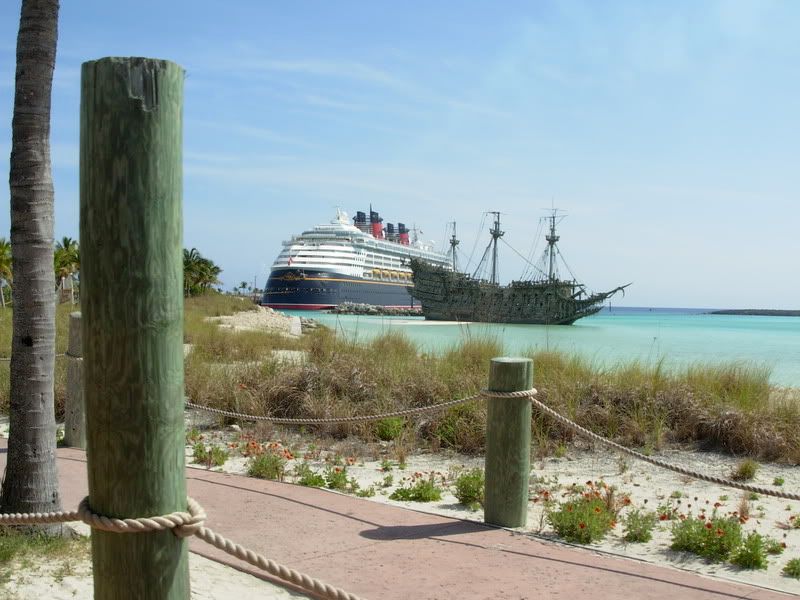
Following our departure from Nassau under cover of darkness, dawn found us dropping anchor at Disney's own Castaway Cay (pronounced "key," by the way). At its heart, this small island is little different than most others in the Bahamian archepelogo: no elevation to speak of, scrubby underbrush, white coral-based sand and soil. It even has a lovely natural lagoon:

Ah, but this island has been Touched by a Mouse, mon. So the lagoon is also home to Captain Jack Sparrow's ship:

Once ashore, the Disneyfication of the island becomes apparent. The winding path from the ship to the main activity area is wide and smooth, lined with well-tended flora and carefully weathered posts and ropes to keep guests in their place.
Castaway Cay has two basic elements: the lagoon, and the adult beach. The lagoon and the surrounding beach themselves are subdivided into several components. The seaward portion is reserved for boating activities. The main family beach, with conveniently located snack and sand toy shops, takes up the majority of the lagoon. A teens-only area is tucked away where the beach bends around at the end of the lagoon, affording previously glum teenagers, who presumably had spent the preceding weeks moaning in agony at the thought that their parents would drag them on a Disney cruise, the quite unDisneylike opportunity to cavort with each other in dangerous ways. The middle portion of the lagoon, away from the beaches, is set aside as the designated snorkel area, delimited by ropes and buoys. The camp areas for the childrens' activities are also in the general area of the lagoon, and offer games, scavenger hunts and other simple activities that bear a light sheen of education about them.
The adults, having unceremoniously dumped their children at the gates of the play areas blinking in confusion, can beat a hasty retreat away from the lagoon and down the ruins of an old airstrip to the adult beach. This beach, stretching away from the beachside bar (again, how unDisneylike!) in a gentle arc hundreds of yard long, is lightly populated, and adorned only with lounge chairs and umbrellas.

Ahhh.
We spent our late morning enjoying the water and the sun, then headed back to the family beach to collect the kids and give them some solid playtime in the lagoon. That, of course, was also the plan of most of our 2800 fellow passengers, but the beach and lagoon handled all the activity well.
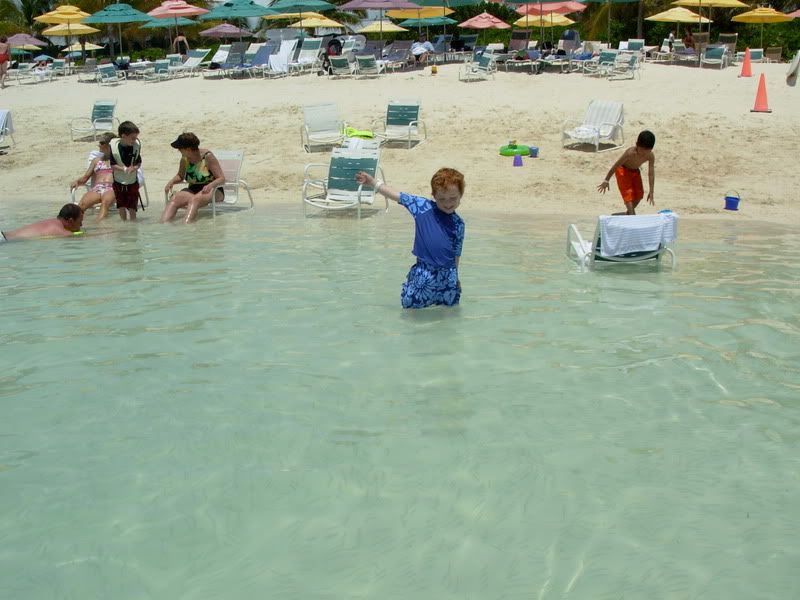
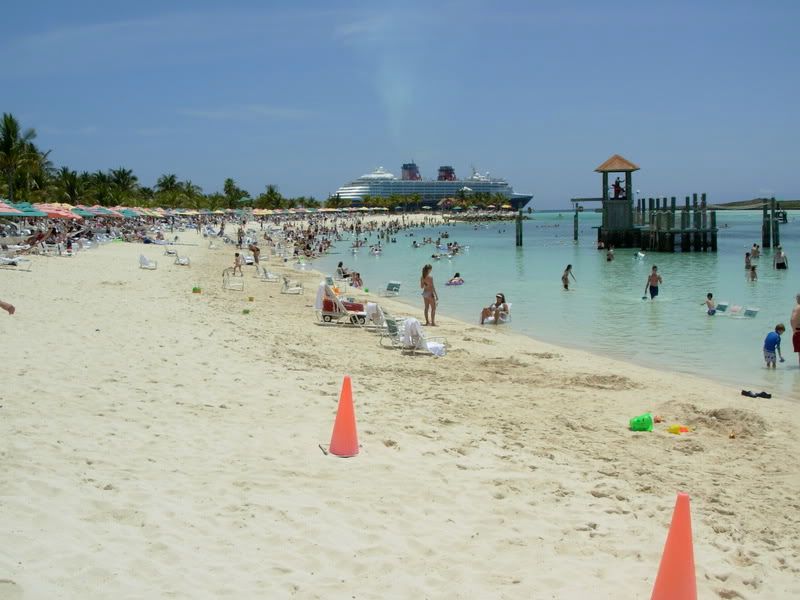

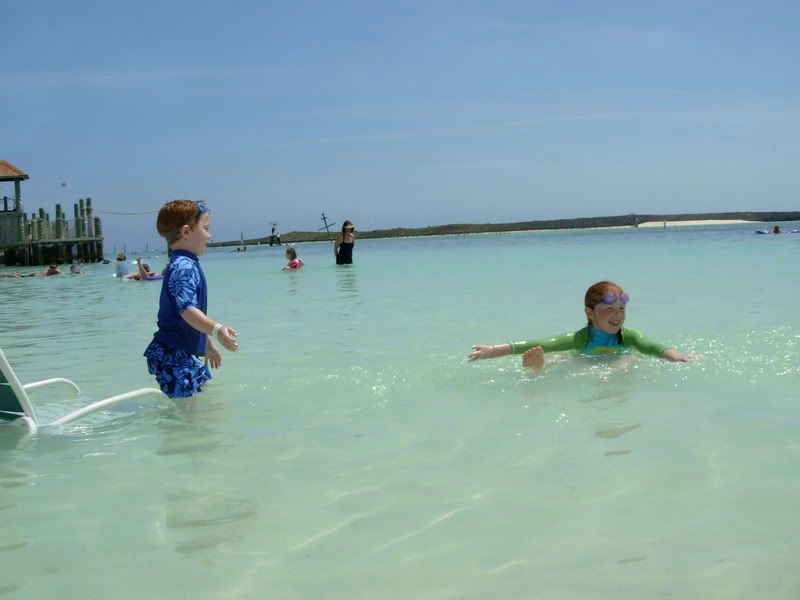
The shallow, still waters offer a perfect, safe place for kids to play. I spent my time snorkeling for more than an hour. Disney placed a number of shelters on the floor of the lagoon for the fish, but on the whole, the snorkeling cannot compare to a natural reef. The fish were fun to follow, but there was none of the coral, anemone or plant life that dazzled us last year when we snorkeled at an open reef. Still, it was great fun to putter around in the water. I eventually swam to all of the borders of the snorkel area. I earned a righteous sunburn, which made me feel ill that evening. The day of fun in the sun, though, was worth it.
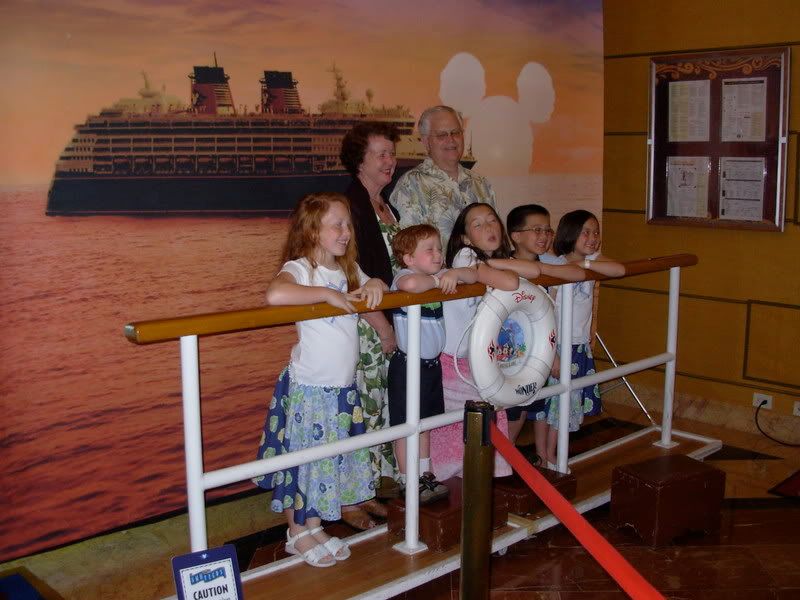
We finished our evening with another show (a revue of Disney characters in the guise of an awards show) and proper cruise pictures:
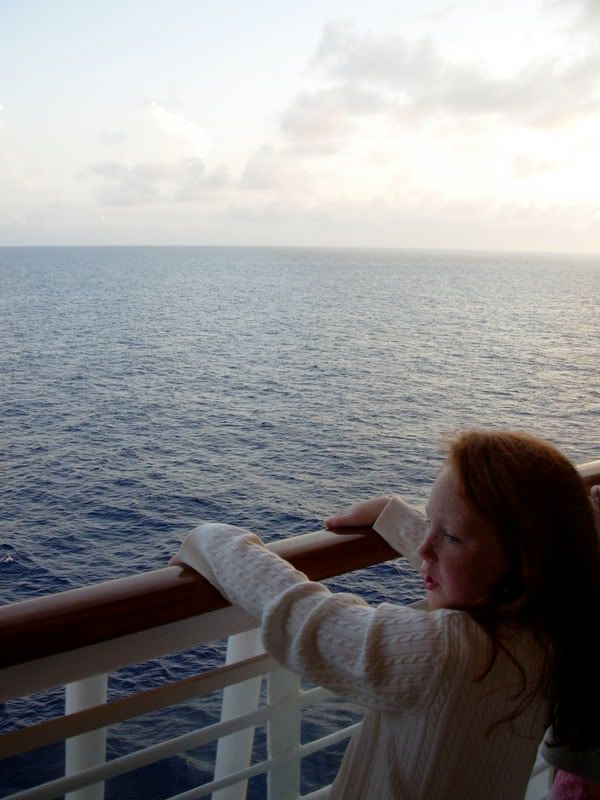
We were left with some extra time before dinner to enjoy the sunset.
Later that night, fireworks were launched over the ship to accompany the raucous (but family friendly!) party held at the middle pool deck. We all slept well that night.
Following our departure from Nassau under cover of darkness, dawn found us dropping anchor at Disney's own Castaway Cay (pronounced "key," by the way). At its heart, this small island is little different than most others in the Bahamian archepelogo: no elevation to speak of, scrubby underbrush, white coral-based sand and soil. It even has a lovely natural lagoon:
Ah, but this island has been Touched by a Mouse, mon. So the lagoon is also home to Captain Jack Sparrow's ship:
Once ashore, the Disneyfication of the island becomes apparent. The winding path from the ship to the main activity area is wide and smooth, lined with well-tended flora and carefully weathered posts and ropes to keep guests in their place.
Castaway Cay has two basic elements: the lagoon, and the adult beach. The lagoon and the surrounding beach themselves are subdivided into several components. The seaward portion is reserved for boating activities. The main family beach, with conveniently located snack and sand toy shops, takes up the majority of the lagoon. A teens-only area is tucked away where the beach bends around at the end of the lagoon, affording previously glum teenagers, who presumably had spent the preceding weeks moaning in agony at the thought that their parents would drag them on a Disney cruise, the quite unDisneylike opportunity to cavort with each other in dangerous ways. The middle portion of the lagoon, away from the beaches, is set aside as the designated snorkel area, delimited by ropes and buoys. The camp areas for the childrens' activities are also in the general area of the lagoon, and offer games, scavenger hunts and other simple activities that bear a light sheen of education about them.
The adults, having unceremoniously dumped their children at the gates of the play areas blinking in confusion, can beat a hasty retreat away from the lagoon and down the ruins of an old airstrip to the adult beach. This beach, stretching away from the beachside bar (again, how unDisneylike!) in a gentle arc hundreds of yard long, is lightly populated, and adorned only with lounge chairs and umbrellas.
Ahhh.
We spent our late morning enjoying the water and the sun, then headed back to the family beach to collect the kids and give them some solid playtime in the lagoon. That, of course, was also the plan of most of our 2800 fellow passengers, but the beach and lagoon handled all the activity well.
The shallow, still waters offer a perfect, safe place for kids to play. I spent my time snorkeling for more than an hour. Disney placed a number of shelters on the floor of the lagoon for the fish, but on the whole, the snorkeling cannot compare to a natural reef. The fish were fun to follow, but there was none of the coral, anemone or plant life that dazzled us last year when we snorkeled at an open reef. Still, it was great fun to putter around in the water. I eventually swam to all of the borders of the snorkel area. I earned a righteous sunburn, which made me feel ill that evening. The day of fun in the sun, though, was worth it.
We finished our evening with another show (a revue of Disney characters in the guise of an awards show) and proper cruise pictures:
We were left with some extra time before dinner to enjoy the sunset.
Later that night, fireworks were launched over the ship to accompany the raucous (but family friendly!) party held at the middle pool deck. We all slept well that night.
Tuesday, June 05, 2007
Finally, Living in LA Pays Off
Last night, thanks to the generosity of an acquaintance, we attended a special performance of "George Gershwin Alone." This one-man play provided the opportunity to spend an evening with Gershwin, embodied by actor/pianist Hershey Felder, as he explained his life and his work. It was a fascinating, engaging performance. The play is a mixture of biography, music theory master class and concert performance. Mr. Felder's vocal talents do not keep pace with his work at the keyboard, but that is hardly a criticism of his singing, as his musicianship on the piano is dazzling. The play closed with a stirring solo piano rendition of "Rhapsody in Blue" which brought the audience leaping to its feet at the end.
The occasion for this fine perfomance was a benefit for the local ALS (Lou Gehrig's Disease) support and advocacy association. One of my car buddies is the president and CEO of the organization, and he offered free tickets to those of us car folks that wanted to go. A few of us took him up on his offer, and got the chance to rub shoulders with the famous (Michael Crichton, Brad Garrett) and nearly-famous. (Actually, rubbing shoulders with Crichton and Garrett requires a stepstool -- both of those guys are seriously tall.) We were offered a chance to walk down the red carpet, which came complete with TV cameras and other photographers, but we were content to slip in the side entrance to the Geffen Playhouse. As we nibbled on hors d'oeurves and perused the silent auction items (which, in addition to the usual spa-treatments-in-Malibu and cooking-lessons-with-Wolfgang-Puck items included a flag from last year's Open Championship signed by Tiger Woods), the vibe of the entire event was happy and relaxed. The event doubled as a birthday party for one of the organization's key people, an ALS sufferer but, by all accounts, also a tireless lobbyist. The evening concluded with a sing-along of Gershwin tunes led by Mr. Felder and a rendition of Happy Birthday sung by the entire house to the guest of honor.
All told, it was a very special evening of great music and storytelling, and a rare opportunity for us 'burb dwellers to get a peek at the life of rich and famous Westsiders. If you want to see a little bit of what it was like, watch Entertainment Tonight this week (their feature will probably air tonight, but I'm not certain of that).
The occasion for this fine perfomance was a benefit for the local ALS (Lou Gehrig's Disease) support and advocacy association. One of my car buddies is the president and CEO of the organization, and he offered free tickets to those of us car folks that wanted to go. A few of us took him up on his offer, and got the chance to rub shoulders with the famous (Michael Crichton, Brad Garrett) and nearly-famous. (Actually, rubbing shoulders with Crichton and Garrett requires a stepstool -- both of those guys are seriously tall.) We were offered a chance to walk down the red carpet, which came complete with TV cameras and other photographers, but we were content to slip in the side entrance to the Geffen Playhouse. As we nibbled on hors d'oeurves and perused the silent auction items (which, in addition to the usual spa-treatments-in-Malibu and cooking-lessons-with-Wolfgang-Puck items included a flag from last year's Open Championship signed by Tiger Woods), the vibe of the entire event was happy and relaxed. The event doubled as a birthday party for one of the organization's key people, an ALS sufferer but, by all accounts, also a tireless lobbyist. The evening concluded with a sing-along of Gershwin tunes led by Mr. Felder and a rendition of Happy Birthday sung by the entire house to the guest of honor.
All told, it was a very special evening of great music and storytelling, and a rare opportunity for us 'burb dwellers to get a peek at the life of rich and famous Westsiders. If you want to see a little bit of what it was like, watch Entertainment Tonight this week (their feature will probably air tonight, but I'm not certain of that).
Wednesday, May 30, 2007
Bahamas 2007, Day 3
Our first morning at sea found us pulling into the Nassau harbor.
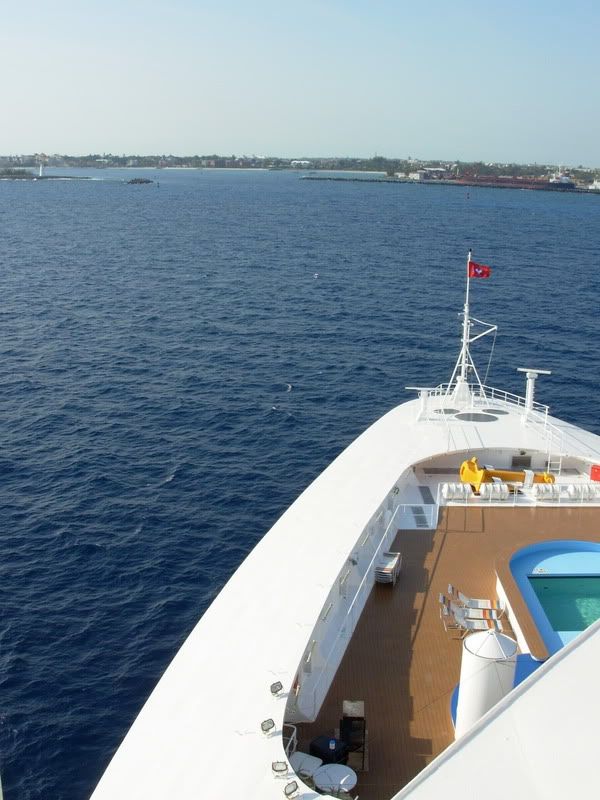
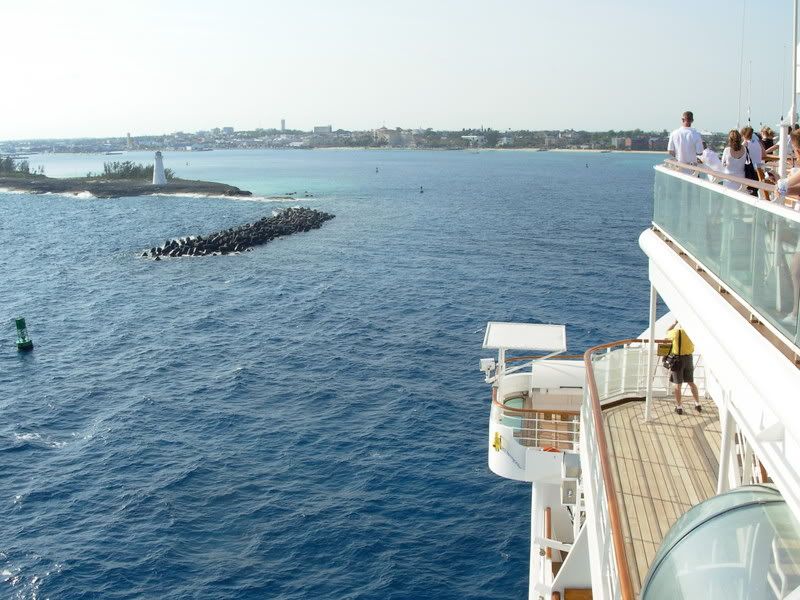
After squeezing through the breakwater, our enormous ship pirouetted within its own length to back into its berth in port. The ship has lateral jets below the waterline that allow those kinds of maneuvers.
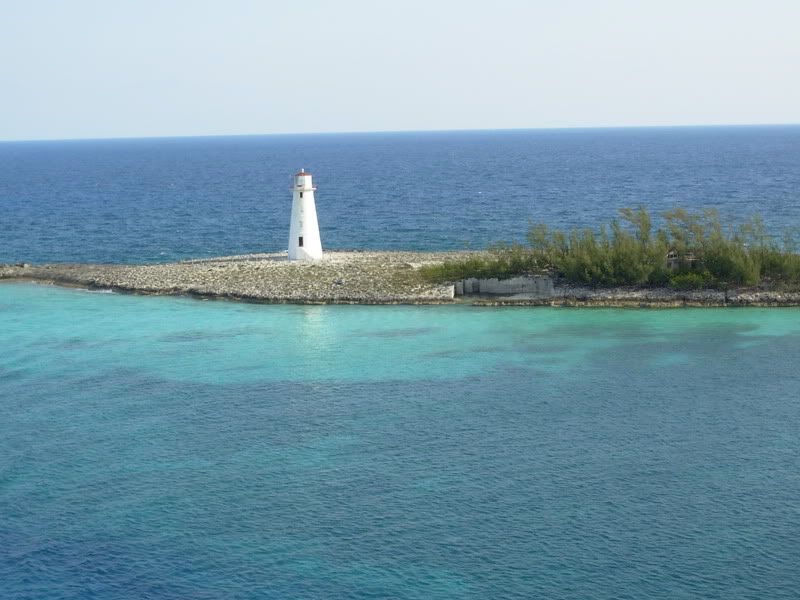
Having spent several days in Nassau last year, we did not feel a need to take much time ashore this time.
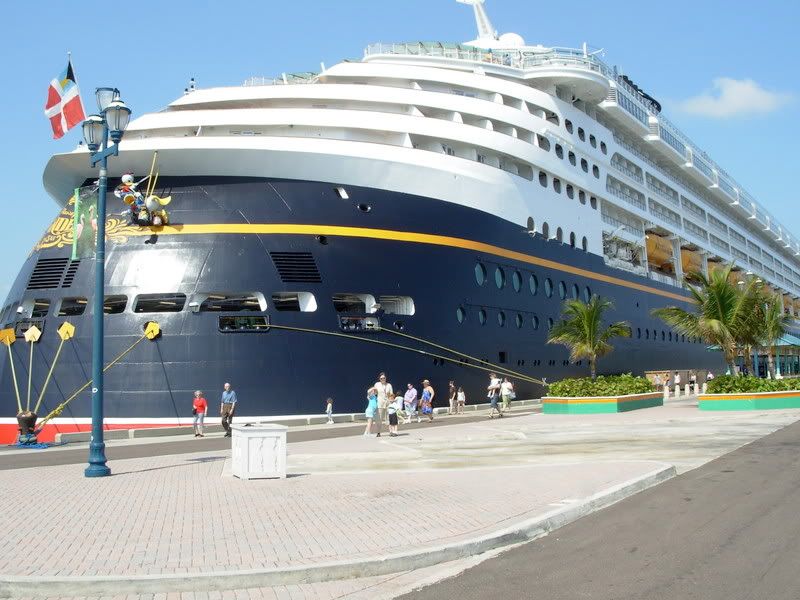
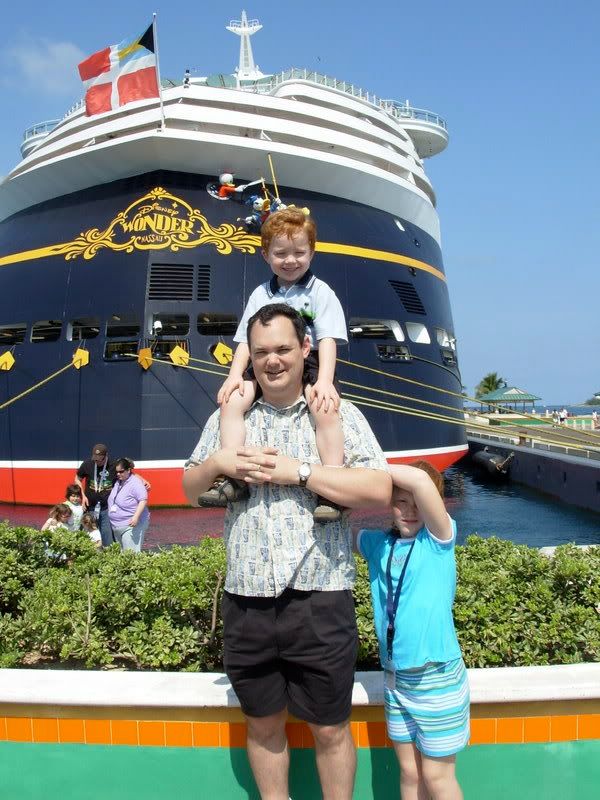
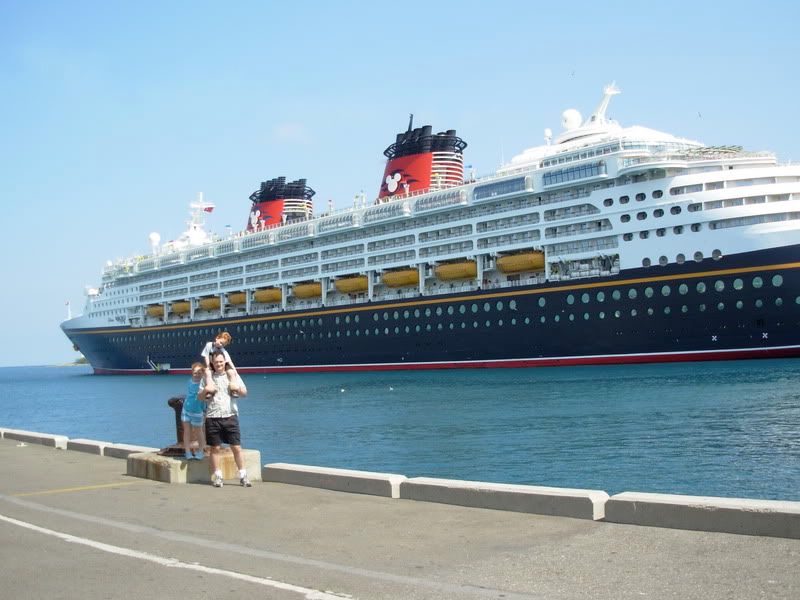
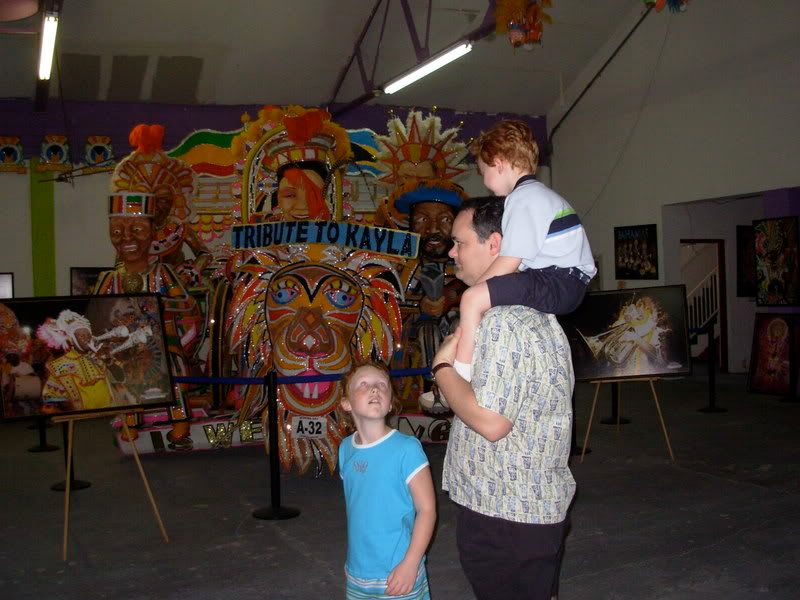
The port has a vendor area constructed specifically for cruise ship passengers, which is where we also saw an exhibit of junkanoo costumes, worn primarily during the massive Boxing Day celebration.
We made sure to drop in on our friend Greg and his family, who are finishing up their stint in the Bahamas as part of the U.S. State Department. Greg then took us on a tour of the U.S. embassy, which was predominantly institutional drab spiked with a little high formality in the ambassador’s office, with the omnipresent security provided by U.S. Marines hovering malevolently just out of view at all times. A fascinating place to work. We happened to be in town just a day ahead of a major election that, believe it or not, was heavily influenced by the Anna Nicole Smith hubbub. The State Department folks were keeping a close eye on the race between the incumbent ruling party and the opposing party running on an anti-corruption platform. Later that evening, while aboard the ship in the harbor, we heard and saw a loud parade demonstration processing down the main road through town; I think we were among the few on board who knew what it was all about.
We headed back to the ship early so that we could maximize our time on board. The kids immediately headed to the pools, where we took advantage of the poolside hamburger-and-hotdog shack for our lunch.

The weather was gorgeous, and we all got a good start on our sunburns.
In the evening, we attended a production of Hercules in the main theater, which was very funny and enjoyable. Many jokes are made at the expense of entertainers who are reputed to have only “cruise ship talent,” but whatever that dismissive assessment may mean, we were treated to the work of some talented actors, musicians, technicians and set builders.
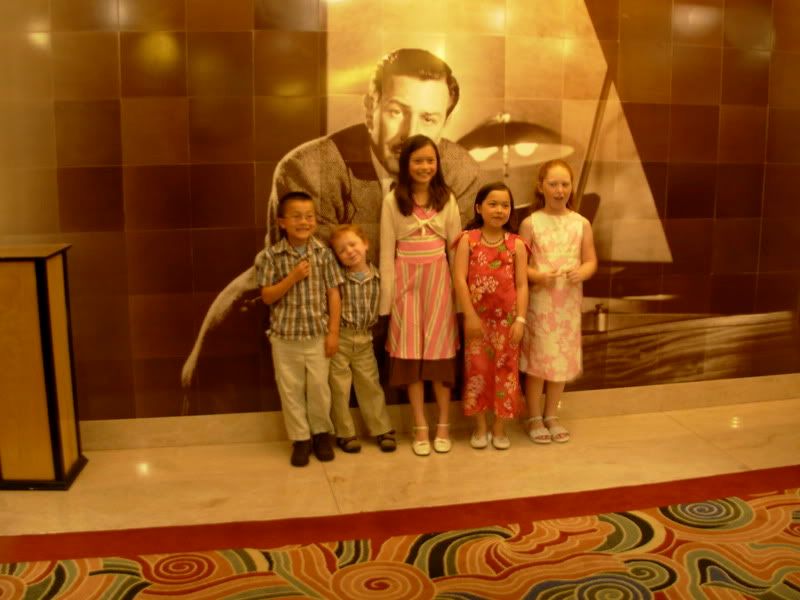
After the show we waited with Uncle Walt for dinner to begin:
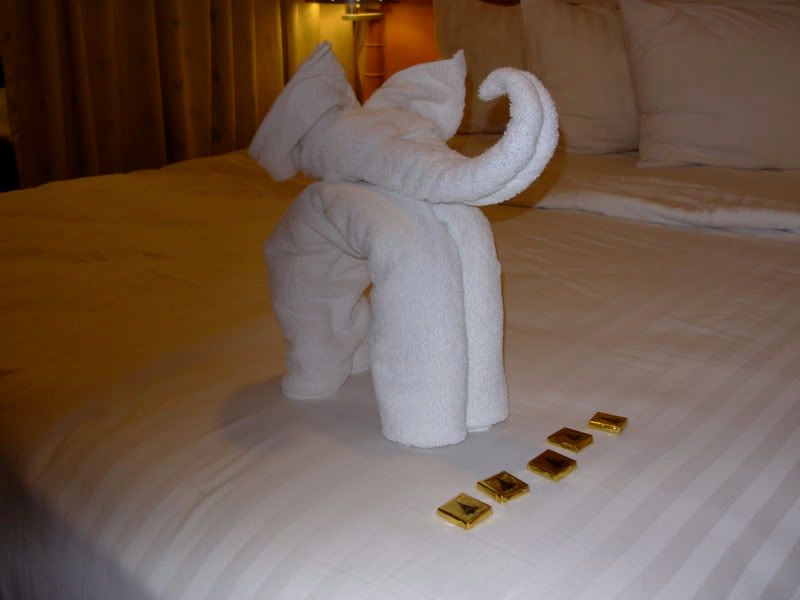
By the time dinner was over, we were exhausted and ready for bed, where we found this little guy:
In the middle of the night I was awakened by a sharp bang in the room, which turned out to be one of the closet doors sliding open. It was just a couple of minutes after 2 a.m., the scheduled time of departure, which meant that the door had moved because the ship was no longer in port. I got up to look out over the verandah, and sure enough, the now-familiar profile of Nassau was sliding by silently.
After squeezing through the breakwater, our enormous ship pirouetted within its own length to back into its berth in port. The ship has lateral jets below the waterline that allow those kinds of maneuvers.
Having spent several days in Nassau last year, we did not feel a need to take much time ashore this time.
The port has a vendor area constructed specifically for cruise ship passengers, which is where we also saw an exhibit of junkanoo costumes, worn primarily during the massive Boxing Day celebration.
We made sure to drop in on our friend Greg and his family, who are finishing up their stint in the Bahamas as part of the U.S. State Department. Greg then took us on a tour of the U.S. embassy, which was predominantly institutional drab spiked with a little high formality in the ambassador’s office, with the omnipresent security provided by U.S. Marines hovering malevolently just out of view at all times. A fascinating place to work. We happened to be in town just a day ahead of a major election that, believe it or not, was heavily influenced by the Anna Nicole Smith hubbub. The State Department folks were keeping a close eye on the race between the incumbent ruling party and the opposing party running on an anti-corruption platform. Later that evening, while aboard the ship in the harbor, we heard and saw a loud parade demonstration processing down the main road through town; I think we were among the few on board who knew what it was all about.
We headed back to the ship early so that we could maximize our time on board. The kids immediately headed to the pools, where we took advantage of the poolside hamburger-and-hotdog shack for our lunch.
The weather was gorgeous, and we all got a good start on our sunburns.
In the evening, we attended a production of Hercules in the main theater, which was very funny and enjoyable. Many jokes are made at the expense of entertainers who are reputed to have only “cruise ship talent,” but whatever that dismissive assessment may mean, we were treated to the work of some talented actors, musicians, technicians and set builders.
After the show we waited with Uncle Walt for dinner to begin:
By the time dinner was over, we were exhausted and ready for bed, where we found this little guy:
In the middle of the night I was awakened by a sharp bang in the room, which turned out to be one of the closet doors sliding open. It was just a couple of minutes after 2 a.m., the scheduled time of departure, which meant that the door had moved because the ship was no longer in port. I got up to look out over the verandah, and sure enough, the now-familiar profile of Nassau was sliding by silently.
Monday, May 28, 2007
Just Some Simple Maintenance
German cars are notoriously expensive to maintain. One obvious reason is that the parts are usually manufactured overseas, and are not in great supply. I have become convinced, however, that there is another, more sinister cause of high maintainance costs. Those Schwabian pranksters who design Porsches, in particular, seem to take perverse delight in hiding the parts that wear out in the most obscure and difficult to reach places. The 911 is not a large car, and in the nearly 40 years that the original design was produced, the designers devised many clever ways of packaging the various components that became more numerous as time went on. However, clever is not always convenient. Consequently, when the proverbial ten-cent part (ha!) breaks down, you must disassemble the car to get to it.
You think I'm joking. I most assuredly am not. Here is my Memorial Day project:


Behind and below each headlight is a device known as a ballast resistor, a hunk of ceramic about the size of a small cookie with four inches of wire protruding from it. One side works with the oil cooler that is in the lower right front bumper; the other side is part of the air conditioning system that has its condenser in the lower left front bumper area. However, to access these miserable little devices, at a minimum the car must be put on stands, the front wheels removed and the front wheel well liners removed (14 screws total). It doesn't help that on the oil cooler side, the resister is held in place with a nut accessed from below, whereas on the AC side, the resister is fasted with an allen-head bolt accessed from above (I'm sure there are very logical, very German reasons for this). It is said that some can make the repair at that point; however, one would have to have intimate knowledge of each and every milimeter of the inner workings of these systems, and also have hands the size of a newborn. Since most of us do not possess those qualifications, the way the average shade tree mechanic must go about the task is to also remove the entire bumper cover (18 screws total), as well as loosen the oil cooler and AC condenser so they can be moved a critical three inches or so. Even doing that, the resistors can either be seen or touched, but not both at the same time. In fact the oil cooler resistor really can't even be seen very well. In the picture below, even with the oil cooler pulled down a few inches, the resistor is invisible up in a slot between the aluminum-colored object and the painted fender:

Nevertheless, I forged ahead. Five hours to disassemble and reassemble the car, ten minutes total to actually swap out both resistors. I even managed to get everything back together without finding a mysterious surplus of screws at the end of the project, and only forget to reconnect one side marker light (fortunately, I was able to finish the job without further disassembly thanks to one of those long, flexible grabby tools).
It's not setting the timing or replacing a clutch, but the sense of satisfaction is similar, and enough.
You think I'm joking. I most assuredly am not. Here is my Memorial Day project:


Behind and below each headlight is a device known as a ballast resistor, a hunk of ceramic about the size of a small cookie with four inches of wire protruding from it. One side works with the oil cooler that is in the lower right front bumper; the other side is part of the air conditioning system that has its condenser in the lower left front bumper area. However, to access these miserable little devices, at a minimum the car must be put on stands, the front wheels removed and the front wheel well liners removed (14 screws total). It doesn't help that on the oil cooler side, the resister is held in place with a nut accessed from below, whereas on the AC side, the resister is fasted with an allen-head bolt accessed from above (I'm sure there are very logical, very German reasons for this). It is said that some can make the repair at that point; however, one would have to have intimate knowledge of each and every milimeter of the inner workings of these systems, and also have hands the size of a newborn. Since most of us do not possess those qualifications, the way the average shade tree mechanic must go about the task is to also remove the entire bumper cover (18 screws total), as well as loosen the oil cooler and AC condenser so they can be moved a critical three inches or so. Even doing that, the resistors can either be seen or touched, but not both at the same time. In fact the oil cooler resistor really can't even be seen very well. In the picture below, even with the oil cooler pulled down a few inches, the resistor is invisible up in a slot between the aluminum-colored object and the painted fender:

Nevertheless, I forged ahead. Five hours to disassemble and reassemble the car, ten minutes total to actually swap out both resistors. I even managed to get everything back together without finding a mysterious surplus of screws at the end of the project, and only forget to reconnect one side marker light (fortunately, I was able to finish the job without further disassembly thanks to one of those long, flexible grabby tools).
It's not setting the timing or replacing a clutch, but the sense of satisfaction is similar, and enough.
Thursday, May 24, 2007
Blast From The Recent Past: R.E.M.
While we wait for the rest of the Disney Cruise pictures to upload...
For those of a certain age, who are now in prime career/childrearing/living life to the fullest years, chances are high that R.E.M. was one of the pillars of their personal musical landscapes. Melodic enough to be accessible to nearly everyone, yet quirky and anti-establishment enough to give suburban kids the feeling that they were really indie, dude, R.E.M. helped define college and, eventually, popular music for about 15 years through the 80s and mid-90s.
As further proof that everything exists on the internet, and that you can find it if you look long enough, an enterprising soul has created a site with a brief analysis of one R.E.M. song every day.
This just might kill off the rest of my week.
For those of a certain age, who are now in prime career/childrearing/living life to the fullest years, chances are high that R.E.M. was one of the pillars of their personal musical landscapes. Melodic enough to be accessible to nearly everyone, yet quirky and anti-establishment enough to give suburban kids the feeling that they were really indie, dude, R.E.M. helped define college and, eventually, popular music for about 15 years through the 80s and mid-90s.
As further proof that everything exists on the internet, and that you can find it if you look long enough, an enterprising soul has created a site with a brief analysis of one R.E.M. song every day.
This just might kill off the rest of my week.
Friday, May 18, 2007
Bahamas 2007, Day 2
Our first morning in Florida found us fully encompassed by the Disney gravitational pull. After a great buffet breakfast in the hotel, we packed our bags and set them outside our hotel rooms, festooned with custom Disney Cruise tags. The inscrutable workings of the Disney machine would, we were assured, swoop in to collect our suitcases and deliver them to our cabin on board the ship some four hours hence.
In the meantime, we gathered with sixty other gaily dressed families in the expansive hotel lobby, where we were met by Disney Cruise representatives who checked our papers, nodded sagely and guided us en masse to the busses. Like a bunch of overgrown kindergartners, we traipsed though the Orlando airport traffic to an unused part of the baggage claim, where we were left in one line of several to await boarding of the bus that would take us to the ship (Orlando is about 40 miles inland, after all).
In the course of our 45 minute wait, we saw an astonishing number of Disney busses, some painted as resort-bound, others Cruise-bound with painted faux portholes, endlessly stopping outside the makeshift depot to pick up another shipment of revelers. Predictably enough, the bus came complete with a DVD system that played a film that introduced the entire embarkation procedure in a smile-it’s-Disney sort of way. The film, of course, lasted precisely the amount of time it took to get from the airport to the ship.
We waited an agreeably brief time in the terminal prior to boarding the ship:

Following a personalized welcome on board that was met with many huzzahs by the ever-cheerful crew, our first task was to get lunch at the 9th deck aft buffet. Here we first encountered the occasional frustration of the elevators, which could be easily overwhelmed by moderate use. Following lunch, we got to know our cabin (or “stateroom,” in the grand language of cruise ships). Regardless of the perceived frivolity that may attend the Disney-fication of a cruise experience, I found myself impressed by the boat itself. Admittedly, I had no basis for comparison, but I was very pleasantly surprised by the convenience and efficiency of our stateroom.
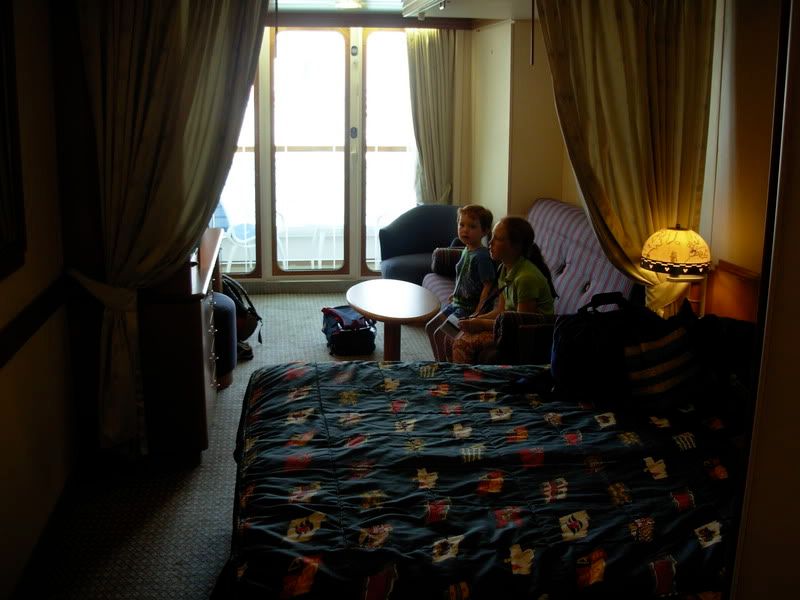
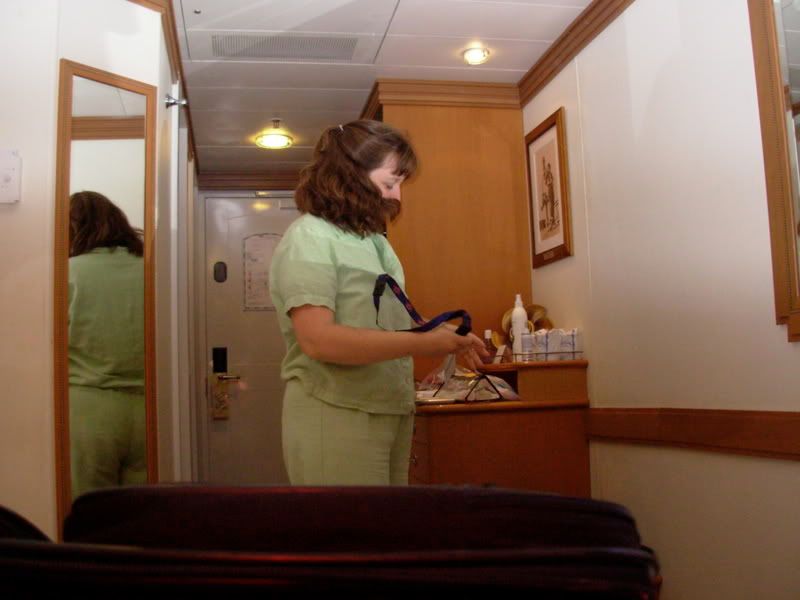 [Michael took that last one]
The front part of the room was the closet and split bathroom (tub/shower with sink in one, toilet and sink in adjacent), which led to the queen size bed. The rest of the cabin, which had a couch, desk with TV, large trunk and chair, could be divided from the front portion by a curtain. The sofa converted to a bed, with a bunk dropping from the ceiling above it, with yet another bed pulling out, Murphy-bed style, beyond those. On top of it all, we had a veranda, as did about half of the cabins on the ship. This is the way to go.
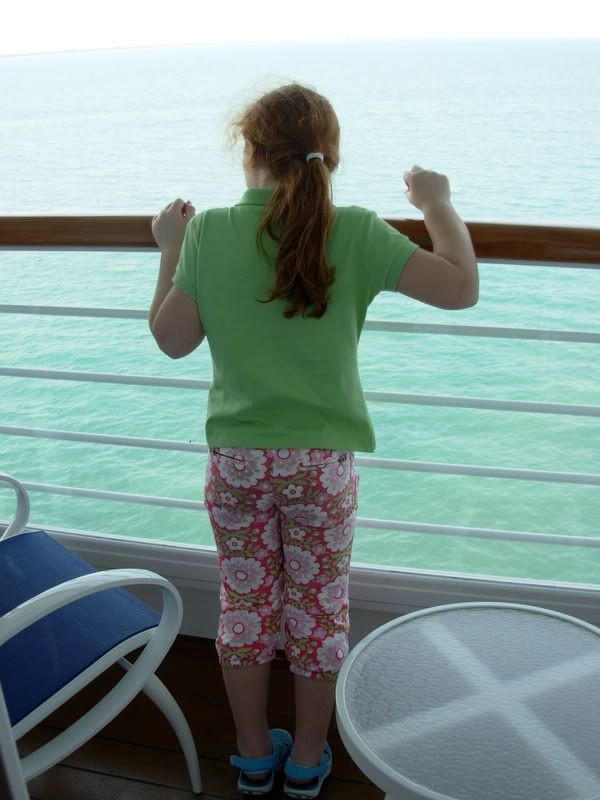
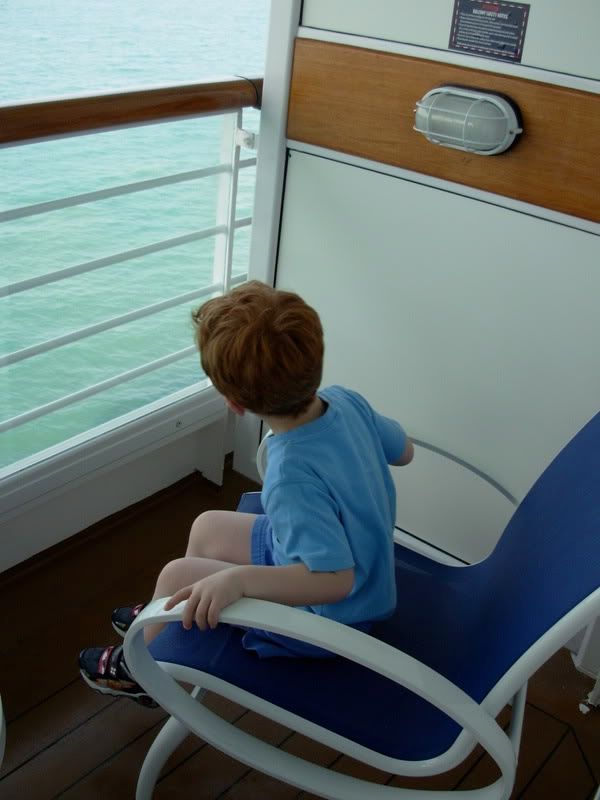
We pulled away from Port Canaveral around 5 pm after a raucous party at the Goofy Pool (amidships).
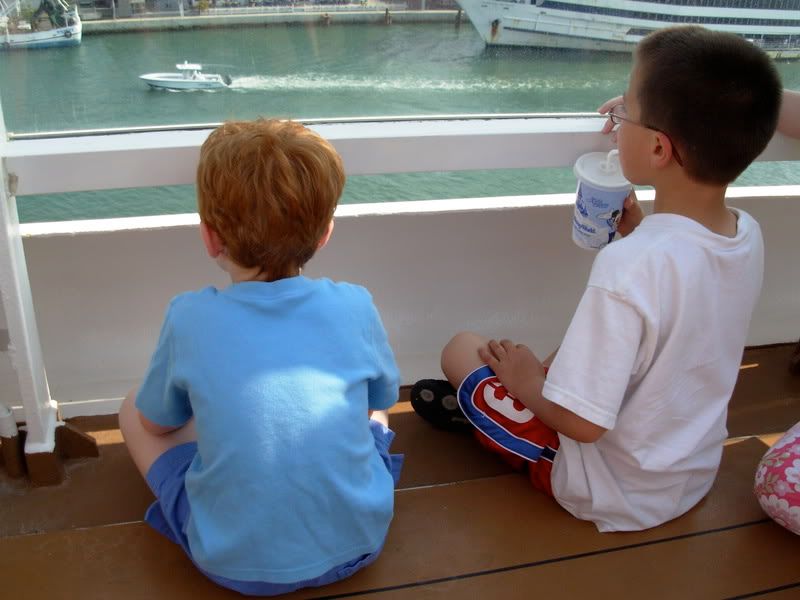
That evening we had our first go at the dining experience that is the heart of the cruise. We met the three servers who would be with us throughout the cruise, and learned what really great food was all about. I’m pretty middle-class in my tastes when it comes to cuisine, so it was a distinct pleasure to learn that, yes indeed, some food really is better than others. (Rumor has it that the adults-only restaurant on board, for which an extra charge is required, has even more superior food. Something to keep in mind for next time.) As our dinner was scheduled for 8 pm every night and lasted nearly two hours, we found ourselves without sufficient energy to take advantage of all the activities for both kids and adults that carry on deep into the night. Instead, as the ship rushed toward Nassau across light seas at up to 19 knots, we settled in for a pleasant night’s sleep, the TV tuned to the station that plays nothing but classic Disney animated movies to help us on our way.
In the meantime, we gathered with sixty other gaily dressed families in the expansive hotel lobby, where we were met by Disney Cruise representatives who checked our papers, nodded sagely and guided us en masse to the busses. Like a bunch of overgrown kindergartners, we traipsed though the Orlando airport traffic to an unused part of the baggage claim, where we were left in one line of several to await boarding of the bus that would take us to the ship (Orlando is about 40 miles inland, after all).
In the course of our 45 minute wait, we saw an astonishing number of Disney busses, some painted as resort-bound, others Cruise-bound with painted faux portholes, endlessly stopping outside the makeshift depot to pick up another shipment of revelers. Predictably enough, the bus came complete with a DVD system that played a film that introduced the entire embarkation procedure in a smile-it’s-Disney sort of way. The film, of course, lasted precisely the amount of time it took to get from the airport to the ship.
We waited an agreeably brief time in the terminal prior to boarding the ship:
Following a personalized welcome on board that was met with many huzzahs by the ever-cheerful crew, our first task was to get lunch at the 9th deck aft buffet. Here we first encountered the occasional frustration of the elevators, which could be easily overwhelmed by moderate use. Following lunch, we got to know our cabin (or “stateroom,” in the grand language of cruise ships). Regardless of the perceived frivolity that may attend the Disney-fication of a cruise experience, I found myself impressed by the boat itself. Admittedly, I had no basis for comparison, but I was very pleasantly surprised by the convenience and efficiency of our stateroom.
[Michael took that last one]The front part of the room was the closet and split bathroom (tub/shower with sink in one, toilet and sink in adjacent), which led to the queen size bed. The rest of the cabin, which had a couch, desk with TV, large trunk and chair, could be divided from the front portion by a curtain. The sofa converted to a bed, with a bunk dropping from the ceiling above it, with yet another bed pulling out, Murphy-bed style, beyond those. On top of it all, we had a veranda, as did about half of the cabins on the ship. This is the way to go.
We pulled away from Port Canaveral around 5 pm after a raucous party at the Goofy Pool (amidships).
That evening we had our first go at the dining experience that is the heart of the cruise. We met the three servers who would be with us throughout the cruise, and learned what really great food was all about. I’m pretty middle-class in my tastes when it comes to cuisine, so it was a distinct pleasure to learn that, yes indeed, some food really is better than others. (Rumor has it that the adults-only restaurant on board, for which an extra charge is required, has even more superior food. Something to keep in mind for next time.) As our dinner was scheduled for 8 pm every night and lasted nearly two hours, we found ourselves without sufficient energy to take advantage of all the activities for both kids and adults that carry on deep into the night. Instead, as the ship rushed toward Nassau across light seas at up to 19 knots, we settled in for a pleasant night’s sleep, the TV tuned to the station that plays nothing but classic Disney animated movies to help us on our way.
Thursday, May 17, 2007
Bahamas 2007, Day 1
Our (unexpectedly) second annual trip to the Bahamas began in pre-dawn darkness that felt little removed from post-dusk darkness. I, in particular, had barreled headlong into the trip on the heels of a ridiculously busy week that kept me occupied until midnight the morning we were to leave. After scrambling to finish a trial brief into Friday evening for the trial that had threatened to prevent me from going on the trip, but which was scheduled to begin as early as Monday anyway, I dashed up to a camp above Lake Castaic to give a kickoff speech for a leadership retreat. The trip includes 30 miles of lightly traveled backwoods twisties, which are particularly entertaining in the dark. Fortunately, I’ve made the trip before and had a passing familiarity with the road. I managed to pull into a parking space outside the camp hall at about 8:42, just in time for my 8:45 speaking engagement. Of course, I had to make myself nearly carsick to get there in time, but that’s what Porsches are for, right?
After the speech and a little socializing, I dashed back into the night. We were due to leave for the airport in five hours, I was an hour from home, and I hadn’t packed for the trip yet. Thankfully, Cheryl had taken care of 95% of the packing, including much of my own, so after throwing a bunch of brightly colored shirts and bathing suits in my bag, I was pretty well done. Lights out at 1, lights on again at 3. It’s vacation, kids, get a move on!
We caravanned with Cheryl’s parents down to LAX, arriving about half an hour ahead of the beginning of the Saturday travel rush.
 Check in and all of the security measures were easy and quick at that hour, made much easier by the fact that we no longer have to travel with either a stroller or car seat.
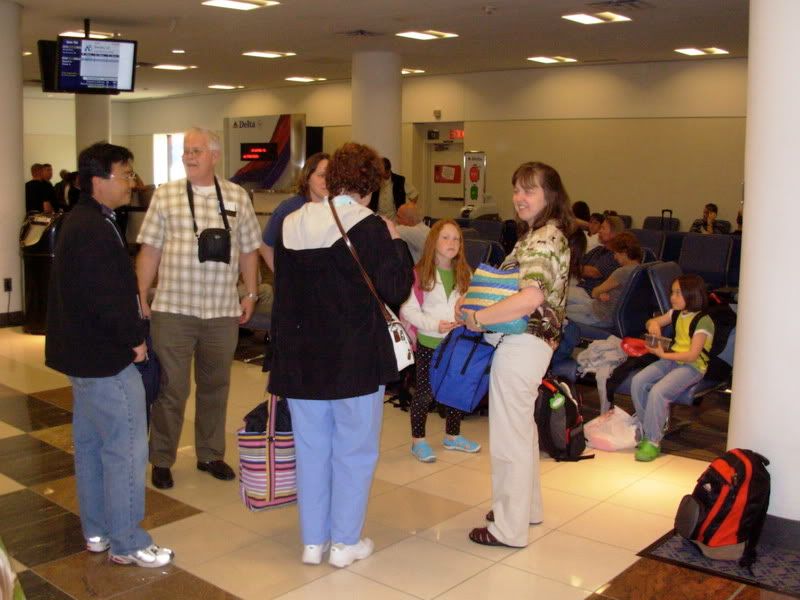
The last time we made this trip, we traveled on Delta’s Song subsidiary, their answer to JetBlue. That means one thing: in-flight TV. Flying on Delta itself, we had no such luck this time. Michael was quite disappointed, which made Daddy quite disappointed, too. Still, the flight was uneventful, and we landed on time in Atlanta, where we were to meet up with Cheryl’s sister and her family, who had flown in from San Francisco just minutes ahead of us. The cousins enjoyed their reunion:

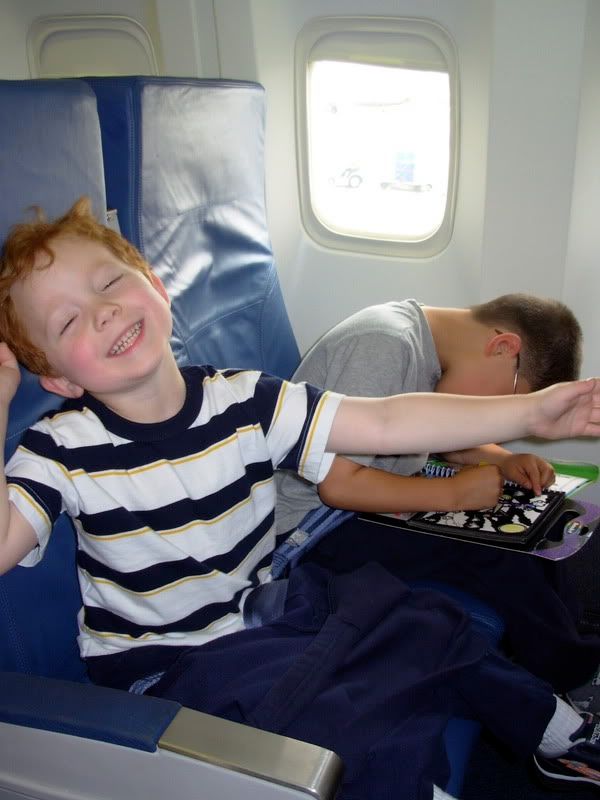
Our next flight, aboard the same airplane that delivered the San Francisco crew, took us to Orlando, where we would spend the night. I can only imagine that Orlando has a unique and feared reputation among flight attendants. Upon boarding the (substantially overbooked) flight, it became obvious that this was the Disney milk run. Adults and children populated the airplane in about equal number, and the preflight din was unusually loud and high pitched. Much to the delight of all, the seating was perfect. Cheryl’s parents had two seats to themselves on one side of the plane, Cheryl’s sister and her husband had two seats together on the other side of the plane, Cheryl and I were in the middle section roughly between them, the three girl cousins took up the middle section behind us, and the two boy cousins sat together across the aisle from them:
The Orlando airport comes complete with a Hyatt right in the middle of the facility.
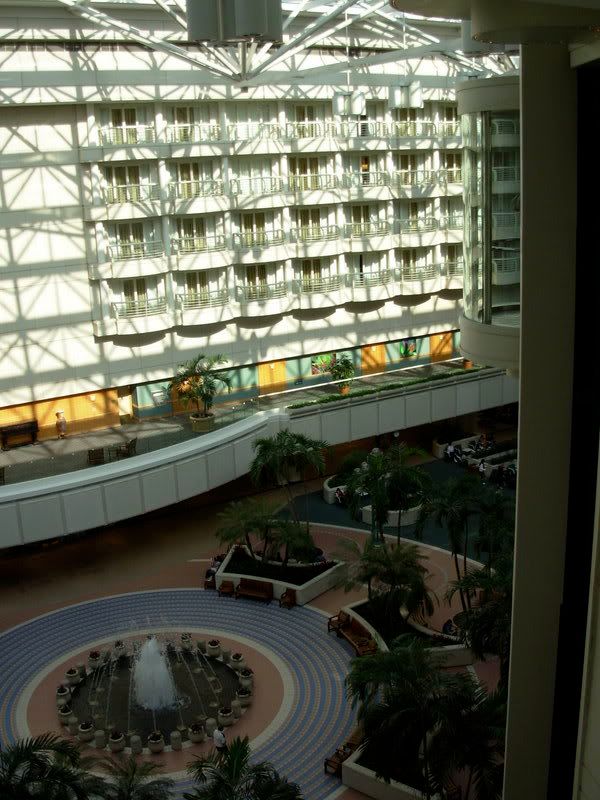
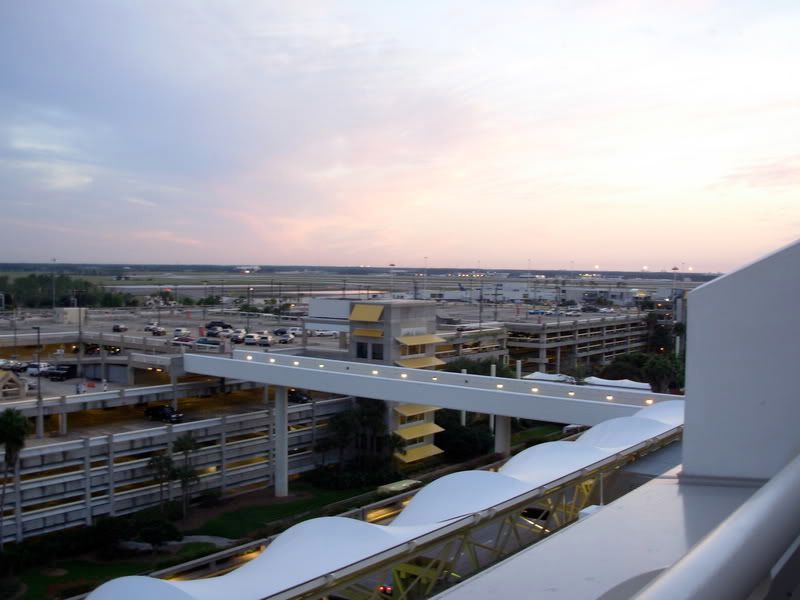
The airport is so immense, spread out over 23 square miles (I looked it up), that there is little more jet noise in the hotel than you would find just living in the general vicinity of a regional airport. The Hyatt is quite a nice hotel, and we got a room with a balcony overlooking the runways (my request).
After a very nice dinner in a hotel restaurant, we finally got some needed sleep in preparation for the start of the cruise the next day.
After the speech and a little socializing, I dashed back into the night. We were due to leave for the airport in five hours, I was an hour from home, and I hadn’t packed for the trip yet. Thankfully, Cheryl had taken care of 95% of the packing, including much of my own, so after throwing a bunch of brightly colored shirts and bathing suits in my bag, I was pretty well done. Lights out at 1, lights on again at 3. It’s vacation, kids, get a move on!
We caravanned with Cheryl’s parents down to LAX, arriving about half an hour ahead of the beginning of the Saturday travel rush.
Check in and all of the security measures were easy and quick at that hour, made much easier by the fact that we no longer have to travel with either a stroller or car seat. The last time we made this trip, we traveled on Delta’s Song subsidiary, their answer to JetBlue. That means one thing: in-flight TV. Flying on Delta itself, we had no such luck this time. Michael was quite disappointed, which made Daddy quite disappointed, too. Still, the flight was uneventful, and we landed on time in Atlanta, where we were to meet up with Cheryl’s sister and her family, who had flown in from San Francisco just minutes ahead of us. The cousins enjoyed their reunion:
Our next flight, aboard the same airplane that delivered the San Francisco crew, took us to Orlando, where we would spend the night. I can only imagine that Orlando has a unique and feared reputation among flight attendants. Upon boarding the (substantially overbooked) flight, it became obvious that this was the Disney milk run. Adults and children populated the airplane in about equal number, and the preflight din was unusually loud and high pitched. Much to the delight of all, the seating was perfect. Cheryl’s parents had two seats to themselves on one side of the plane, Cheryl’s sister and her husband had two seats together on the other side of the plane, Cheryl and I were in the middle section roughly between them, the three girl cousins took up the middle section behind us, and the two boy cousins sat together across the aisle from them:
The Orlando airport comes complete with a Hyatt right in the middle of the facility.
The airport is so immense, spread out over 23 square miles (I looked it up), that there is little more jet noise in the hotel than you would find just living in the general vicinity of a regional airport. The Hyatt is quite a nice hotel, and we got a room with a balcony overlooking the runways (my request).
After a very nice dinner in a hotel restaurant, we finally got some needed sleep in preparation for the start of the cruise the next day.
Wednesday, May 16, 2007
Good Times
Sorry for the dearth of posts recently, especially since a couple of you may be waiting to see happy snaps of our recent vacation. Those will be coming shortly, I promise.
However, I've been a bit distracted recently. Professionally, this is about how I feel these days:

(if you don't get the reference, Google "Peter Finch" and "Network".)
I hope to resume normal programming within the next three months or so. Stay tuned.
However, I've been a bit distracted recently. Professionally, this is about how I feel these days:
(if you don't get the reference, Google "Peter Finch" and "Network".)
I hope to resume normal programming within the next three months or so. Stay tuned.
Wednesday, May 09, 2007
Cool Views in Hot City
Twice in the past month I have watched the hillside hear my office erupt in flames, the most recent occasion being yesterday. The office is at about fire height, so we get a great view of the spectacular work performed by the LA City Fire helicopter pilots as they drop water and fire retardants on the hillsides. Unfortunately, because I use Griffith Park for part of my commute, I've been forced to contend with LA traffic a little more often than I would prefer because of the fires.
A friend of mine who lives directly up the hill from us took this picture last night of the Griffith Park fire, showing both the Los Feliz section (to the left) that has received most of the publicity because of the danger to homes, and the main Park element of the fire (to the right):

Before the place totally goes up in flames, take a look at this interesting "photograph" of the park. There are other similar works available at the artist's site. (Incidentally, the artist happens to be the guy who played Lurch in the "Addams Family" movie and the Giant in Twin Peaks, among many others.) I haven't taken the time to investigate the technology that yields these images, but the result is interesting and beautiful, and uniquely computer-based. You really could not view these images in a gallery, unless the gallery included computer screens and a few basic controls. Neat stuff.
Yes, vacation pictures will be coming soon!
A friend of mine who lives directly up the hill from us took this picture last night of the Griffith Park fire, showing both the Los Feliz section (to the left) that has received most of the publicity because of the danger to homes, and the main Park element of the fire (to the right):
Before the place totally goes up in flames, take a look at this interesting "photograph" of the park. There are other similar works available at the artist's site. (Incidentally, the artist happens to be the guy who played Lurch in the "Addams Family" movie and the Giant in Twin Peaks, among many others.) I haven't taken the time to investigate the technology that yields these images, but the result is interesting and beautiful, and uniquely computer-based. You really could not view these images in a gallery, unless the gallery included computer screens and a few basic controls. Neat stuff.
Yes, vacation pictures will be coming soon!
Tuesday, April 24, 2007
Now Departing from Dock 1 ...
It has been touch and go for weeks now, with a trial standing in the way. However, I'm relieved to be able to now look forward to this:

and this:

and this:

If that scene seems vaguely familiar, that's because it is.
Grandma and Grandpa are taking all the grandkids and their parents on one of those trips that we will all remember forever. And I came this close to missing it.
and this:
and this:
If that scene seems vaguely familiar, that's because it is.
Grandma and Grandpa are taking all the grandkids and their parents on one of those trips that we will all remember forever. And I came this close to missing it.
Friday, April 20, 2007
Hybrids are Great -- Ow!
A new section is currently being written in the Law of Unintended Consequences. Automobiles using a so-called “hybrid” powertrain, which combine a conventional internal combustion engine with a battery-powered electric motor, are all the rage these days. There are a select few systems on the market, principally offered by Honda and Toyota (which licenses its technology to Ford and Nissan). The Toyota system’s unique feature is that, unlike the Honda, under the proper conditions it can run on the electric motor alone.
Toyota’s unique engine/motor management system is good for fuel conservation, at least around town, but not so good for pedestrian safety. Have you ever been near a Prius as it was driven into or out of a parking space? Absolutely dead silent. That’s quite an achievement, until you realize that one of the senses we use when walking about in the presence of cars is the sense of hearing. Without thinking about it, we are attuned to be wary of what we hear in parking lots, knowing instinctively that cars can approach without us seeing them.
The Prius and its kin render this sense of self-preservation useless. I was recently startled by a Prius backing up in the small parking lot of Michael’s preschool. It had pulled almost completely out of its parking space as I walked nearby before I noticed it, because it made no sound. I hate to sound like a nanny-state advocate (whose adherents have succeeded in adding weight, complexity and ugliness to cars the world over – another post), but these things really should have some sort of warning beeper when they are operating in reverse, at which time the driver’s outward vision is more limited. After all, even golf carts, which are louder but much lighter than a Prius, typically emit a raucus beep or buzz whenever reverse is engaged.
I have a tangential connection to a major development in this area. Surely you have been awakened by the obnoxious bleating of a garbage truck or other heavy vehicle as it reversed. That noise is prescribed by law in California in no small part due to a tragedy that befell a schoolmate of mine. When I was in junior high, the older brother of one of my classmates was killed by a garbage truck that was driving in reverse, without audible backup warnings, on the wrong side of the road. I recall an assembly at which his death was announced and explained to the students; a scholarship was created shortly thereafter, of which someone in my class was the first recipient. More importantly, my classmate’s mother lobbied the California state legislature until the vehicle code was amended to require garbage trucks to be equipped with audible backup warnings. Vehicle Code section 27000(b) exists because of her efforts.
While a Prius does not have the mass of a garbage truck, a small child is in just as much danger, and would be difficult for a driver to see. I don’t ordinarily push for government-mandated devices on cars, but unless Toyota and other hybrid or electric car makers voluntarily install audible warning systems, a tragedy that would have been simple to prevent is going to result in just such legislation.
Toyota’s unique engine/motor management system is good for fuel conservation, at least around town, but not so good for pedestrian safety. Have you ever been near a Prius as it was driven into or out of a parking space? Absolutely dead silent. That’s quite an achievement, until you realize that one of the senses we use when walking about in the presence of cars is the sense of hearing. Without thinking about it, we are attuned to be wary of what we hear in parking lots, knowing instinctively that cars can approach without us seeing them.
The Prius and its kin render this sense of self-preservation useless. I was recently startled by a Prius backing up in the small parking lot of Michael’s preschool. It had pulled almost completely out of its parking space as I walked nearby before I noticed it, because it made no sound. I hate to sound like a nanny-state advocate (whose adherents have succeeded in adding weight, complexity and ugliness to cars the world over – another post), but these things really should have some sort of warning beeper when they are operating in reverse, at which time the driver’s outward vision is more limited. After all, even golf carts, which are louder but much lighter than a Prius, typically emit a raucus beep or buzz whenever reverse is engaged.
I have a tangential connection to a major development in this area. Surely you have been awakened by the obnoxious bleating of a garbage truck or other heavy vehicle as it reversed. That noise is prescribed by law in California in no small part due to a tragedy that befell a schoolmate of mine. When I was in junior high, the older brother of one of my classmates was killed by a garbage truck that was driving in reverse, without audible backup warnings, on the wrong side of the road. I recall an assembly at which his death was announced and explained to the students; a scholarship was created shortly thereafter, of which someone in my class was the first recipient. More importantly, my classmate’s mother lobbied the California state legislature until the vehicle code was amended to require garbage trucks to be equipped with audible backup warnings. Vehicle Code section 27000(b) exists because of her efforts.
While a Prius does not have the mass of a garbage truck, a small child is in just as much danger, and would be difficult for a driver to see. I don’t ordinarily push for government-mandated devices on cars, but unless Toyota and other hybrid or electric car makers voluntarily install audible warning systems, a tragedy that would have been simple to prevent is going to result in just such legislation.
Monday, April 16, 2007
Book Review: Cormac McCarthy’s “The Road”
Cormac McCarthy has long been described as this generation’s William Faulkner (it is not accidental that McCarthy’s first major editor had been Faulkner’s). In simple terms, that means he eschews conventional rules of grammar, and is difficult to read. In a broader sense, however, while McCarthy’s writing carries some of the same brutal weight of Faulkner’s best work, McCarthy is a unique voice in American literature, a true living classic. His recent novel, “The Road,” has a chance to be one of the most discussed and dissected novels of our day, although perhaps not for the usual reasons.
I have read a couple of McCarthy’s breakthrough novels, “All the Pretty Horses” and “The Crossing.” In both novels, the desolation of the bleak south Texas/northern Mexico landscape is matched by the spare yet richly textured prose and thin dialog. McCarthy has been fairly described as a most masculine writer, chronicling the exploits of dusty, hard men in fraught circumstances, who communicate in fragments of sentences. “The Road” follows in this vein, following the journey of “the man” and “his son” through a landscape for which the term “bleak” would bestow a sense of joy and comfort the setting does not deserve.
“The Road” has come to the attention of the average reader in part due to its somewhat inexplicable inclusion recently in Oprah’s Book Club, and as of today because it won the Pulitzer Prize for fiction. Ironically, I found the book on a rack in an airport last week, and, knowing nothing about it, bought it because of the author and before I noticed the Oprah seal of approval (which might have put me off buying the book, snob that I am). Oprah viewers, I’m sure, and others drawn to the novel because of its awards and the author’s pedigree are likely to be in for a shock. While ultimately deeply affecting, “The Road” is not an easy read. Oh, it is a fast read, as it is actually relatively short (I managed to get through it in about four hours), but rather than tricks of grammar, it is the subject matter that troubles the reader.
“The Road” takes place in somewhere in the southeastern United States at an indeterminate time following a nonspecified holocaust. Just about everything living thing on or in the earth has been annihilated. Those humans that remain (as it does not appear that any other form of life survived, save one dog glimpsed from afar for a moment) are reduced to terrifying bands of cannibalistic savages who roam the still-smoldering roads, or terrified individuals who stay in hiding away from the roads and who must go to scarcely imaginable measures to survive. Into this searing, seared landscape of endless ash and unrelenting gloom, the man and his son travel to the unnamed coast in search of … what? In the end, all that matters is that they cannot stay where they are, wherever it is they happen to be.
The author has stripped the land completely bare. Every place the reader would hope that the man and his boy would find something with life, something that represents hope, McCarthy takes it all away. The man of the story must be clever, determined and downright lucky at times in his efforts to provide food, shelter and clothing for himself and the boy, who constantly hover on the edge of starvation. McCarthy is also not above shocking the reader, in the brief glimpses one would take upon unexpectedly encountering the detritus of a car crash, with imagery that man, boy and reader all wish could be unseen immediately thereafter. The oppressiveness of the falling ashes, the cold, grey skies, the endless, hopeless hunt for food, and the constant fear of exposure to any other person eats away at the reader. Against this hideous tableau, a father lovingly looks after his son. Here is a sample from the first part of the book, starting with the very first words:
Remember “bleak?”
And yet the relationship between the father and son redeems both them and the story. The tender yet murderous determination the man shows in caring and providing for his son tugs every bit as firmly on the heartstrings as the richest, most lush Dickensian serial. The boy struggles to come to terms with his father’s fierce loyalty to him that includes a aggressive dismissal of any and all other beings that place themselves in his path. The boy, who cannot share his father’s memories of the world we know, innocently implores his father to intercede on behalf of the few others they encounter, and must learn to understand how the man, who will do anything for his son’s sake, will exhibit the worst forms of self-preservation when faced with other lonely stragglers.
It is too simple to label “The Road” as merely a fine novelist’s foray into science fiction, with a chilling view of what happens when man allows his inhumanity to rule. The barren world is too vividly conjured, the relationship too preciously rendered, for that analysis to hold. The richness of “The Road” is in how life is to be lived in the small, desperate spaces of a father’s heart, in the expression of the universal longing of every father to see his son grow and succeed. That the man’s quest to see his son survive is under circumstances blessedly far removed from anything we know, and hope never to know, only heightens the intensity of McCarthy's portrayal.
Notwithstanding Oprah’s pedigree and the approbation of the Pulitzer committee, “The Road” really is not for everyone. This is not a feel-good story unless the meter with which you evaluate human existence can be calibrated to find joy and hope in minute discoveries and victories that are usually undetectable in our everyday experience. The depth of the love between the man and his son, however, is undiminished by the death of the earth around them, and will linger profoundly even as the reader seeks out the real sun to escape the sadness and waste of so much of McCarthy's goulish, fallen world. Ultimately, although death is visited upon a horrifyingly large portion of the human race in "The Road," it cannot kill humanity.
I have read a couple of McCarthy’s breakthrough novels, “All the Pretty Horses” and “The Crossing.” In both novels, the desolation of the bleak south Texas/northern Mexico landscape is matched by the spare yet richly textured prose and thin dialog. McCarthy has been fairly described as a most masculine writer, chronicling the exploits of dusty, hard men in fraught circumstances, who communicate in fragments of sentences. “The Road” follows in this vein, following the journey of “the man” and “his son” through a landscape for which the term “bleak” would bestow a sense of joy and comfort the setting does not deserve.
“The Road” has come to the attention of the average reader in part due to its somewhat inexplicable inclusion recently in Oprah’s Book Club, and as of today because it won the Pulitzer Prize for fiction. Ironically, I found the book on a rack in an airport last week, and, knowing nothing about it, bought it because of the author and before I noticed the Oprah seal of approval (which might have put me off buying the book, snob that I am). Oprah viewers, I’m sure, and others drawn to the novel because of its awards and the author’s pedigree are likely to be in for a shock. While ultimately deeply affecting, “The Road” is not an easy read. Oh, it is a fast read, as it is actually relatively short (I managed to get through it in about four hours), but rather than tricks of grammar, it is the subject matter that troubles the reader.
“The Road” takes place in somewhere in the southeastern United States at an indeterminate time following a nonspecified holocaust. Just about everything living thing on or in the earth has been annihilated. Those humans that remain (as it does not appear that any other form of life survived, save one dog glimpsed from afar for a moment) are reduced to terrifying bands of cannibalistic savages who roam the still-smoldering roads, or terrified individuals who stay in hiding away from the roads and who must go to scarcely imaginable measures to survive. Into this searing, seared landscape of endless ash and unrelenting gloom, the man and his son travel to the unnamed coast in search of … what? In the end, all that matters is that they cannot stay where they are, wherever it is they happen to be.
The author has stripped the land completely bare. Every place the reader would hope that the man and his boy would find something with life, something that represents hope, McCarthy takes it all away. The man of the story must be clever, determined and downright lucky at times in his efforts to provide food, shelter and clothing for himself and the boy, who constantly hover on the edge of starvation. McCarthy is also not above shocking the reader, in the brief glimpses one would take upon unexpectedly encountering the detritus of a car crash, with imagery that man, boy and reader all wish could be unseen immediately thereafter. The oppressiveness of the falling ashes, the cold, grey skies, the endless, hopeless hunt for food, and the constant fear of exposure to any other person eats away at the reader. Against this hideous tableau, a father lovingly looks after his son. Here is a sample from the first part of the book, starting with the very first words:
When he woke in the woods in the dark and the cold of the night he'd reach out to touch the child sleeping beside him. Nights dark beyond darkness and the days more gray each one than what had gone before. Like the onset of some cold glaucoma dimming away the world. His hand rose and fell softly with each precious breath. ...
When it was light enough to use the binoculars he glassed the valley blow. Everything paling away into the murk. The soft ash blowing in loose swirls over the blacktop. He studied what he could see. The segments of road down there among the dead trees. Looking for anything of color. Any movement. Any trace of standing smoke. He lowered the glasses and pulled down the cotton mask from his face and wiped his nose on the back of his wrist and then glassed the country again. Then he just sat there holding the binoculars and watching the ashen daylight congeal over the land. He knew only that the child was his warrant. He said: If he is not the word of God God never spoke.
When he got back the boy was still asleep. He pulled the blue plastic tarp off of him and folded it and carried it out to the grocery cart and packed it and came back with their plates and some cornmeal cakes in a plastic bag and a plastic bottle of syrup. He spread the small tarp they used for a table on the ground and laid everything out and he took the pistol from his belt and laid it on the cloth and then he just sat watching the boy sleep. He'd pulled away his mask in the night and it was buried somewhere in the blankets. He watched the boy and he looked out through the trees toward the road. This was not a safe place. They could be seen from the road now it was day. The boy turned in the blankets. Then he opened his eyes. Hi, Papa, he said.
I'm right here.
I know.
Remember “bleak?”
And yet the relationship between the father and son redeems both them and the story. The tender yet murderous determination the man shows in caring and providing for his son tugs every bit as firmly on the heartstrings as the richest, most lush Dickensian serial. The boy struggles to come to terms with his father’s fierce loyalty to him that includes a aggressive dismissal of any and all other beings that place themselves in his path. The boy, who cannot share his father’s memories of the world we know, innocently implores his father to intercede on behalf of the few others they encounter, and must learn to understand how the man, who will do anything for his son’s sake, will exhibit the worst forms of self-preservation when faced with other lonely stragglers.
It is too simple to label “The Road” as merely a fine novelist’s foray into science fiction, with a chilling view of what happens when man allows his inhumanity to rule. The barren world is too vividly conjured, the relationship too preciously rendered, for that analysis to hold. The richness of “The Road” is in how life is to be lived in the small, desperate spaces of a father’s heart, in the expression of the universal longing of every father to see his son grow and succeed. That the man’s quest to see his son survive is under circumstances blessedly far removed from anything we know, and hope never to know, only heightens the intensity of McCarthy's portrayal.
Notwithstanding Oprah’s pedigree and the approbation of the Pulitzer committee, “The Road” really is not for everyone. This is not a feel-good story unless the meter with which you evaluate human existence can be calibrated to find joy and hope in minute discoveries and victories that are usually undetectable in our everyday experience. The depth of the love between the man and his son, however, is undiminished by the death of the earth around them, and will linger profoundly even as the reader seeks out the real sun to escape the sadness and waste of so much of McCarthy's goulish, fallen world. Ultimately, although death is visited upon a horrifyingly large portion of the human race in "The Road," it cannot kill humanity.
Thursday, April 12, 2007
The Romance of Language
I spent much of yesterday in the company of a business associate who was in town (that town being San Francisco, incidentally) from Florida for a meeting. As we chatted genially about e-mails, time zones and cross country flights, it occurred to me that, even in the midst of our post-modern, 21st Century digital lives, the questing, adventurous spirit that is uniquely American lives on, embedded in our very language.
Those of us who have spent most of our lives on the West Coast speak of going "back East" when traveling to the East Coast. Conversely, travel in the other direction is usually expressed in terms of going "out West." Have you ever spoken of flying "out East" or "back West?" There is something inherent in our language, it seems to me, that preserves the sense that the East Coast is the starting place, the home and the root, and that all else West is the destination, out there somewhere. I even edited the first sentence of this post to take out my original construction, describing my collegue as having "flown out" to California. Even us Westerners (or at least this one) acknowledge by our language that this is still the outpost, to which others journey from the well-established settlements in the East.
As reduced in size and time as we believe our world has become over the recent decades, there is something in this unconcious mapping of our syntax that comforts me, that there is still a cultural memory of journey, adventure and hope.
Those of us who have spent most of our lives on the West Coast speak of going "back East" when traveling to the East Coast. Conversely, travel in the other direction is usually expressed in terms of going "out West." Have you ever spoken of flying "out East" or "back West?" There is something inherent in our language, it seems to me, that preserves the sense that the East Coast is the starting place, the home and the root, and that all else West is the destination, out there somewhere. I even edited the first sentence of this post to take out my original construction, describing my collegue as having "flown out" to California. Even us Westerners (or at least this one) acknowledge by our language that this is still the outpost, to which others journey from the well-established settlements in the East.
As reduced in size and time as we believe our world has become over the recent decades, there is something in this unconcious mapping of our syntax that comforts me, that there is still a cultural memory of journey, adventure and hope.
Wednesday, April 04, 2007
A Melodious Reunion
This past weekend I had the opportunity to take part in a reunion of the Schubertians, the men's chamber choir of which I was a part while at UCSB. The group was in existence from 1964 to 1995, and had just over 200 total members in the course of its history. We have had a few formal reunions in the past, which now take on greater significance since the group is no longer active and Carl Zytowski, the director, is in his mid-80s (but still going strong).
The reunion was great fun. I knew very few of the men, some of them older than my parents, but the sensation of picking up a song that even the youngest of the group last sang regularly more than ten years ago and being able to hit every note and clip every cutoff was extraordinary. Thirty years worth of singers with a common thread in the music and director can yield a uniquely unified group of people that spans generations. I had the opportunity to be a part of a sub-group of Southern California Schubertians that sang two songs, plus one in combination with a Northern California sub-group that itself sang two extra songs. The one rehearsal we had at one of our members' homes in Santa Monica was the very definition of what these songs were all about: a group of musicians enjoying a fine afternoon of great music and friendship.
The reunion concert itself was great fun, a mixture of hard work, nostalgia, and sentimentality. It was a sweet thing to have wives and children fill the auditorium seats that were once occupied by girlfriends and (extraordinarily loyal) roommates back in our student days. The concert was dedicated to one of the forces behind the reunion, who is dying of cancer and wanted to have another chance to hear the songs before his time was up. Thankfully, he rallied over the last couple of months and was able to participate in the concert. He was even able to set aside his oxygen line and rise from his wheelchair to sing a solo verse in the last song. I think most of us had difficulty seeing our music to sing the last chorus after he was done.
The local Santa Barbara News Press published a very nice review of the concert that accurately captured the feel of the event. Ordinarily I would link to an article, but because the News Press has an annoying registration requirement, please indulge me while I republish the whole thing here:
Indeed.
The reunion was great fun. I knew very few of the men, some of them older than my parents, but the sensation of picking up a song that even the youngest of the group last sang regularly more than ten years ago and being able to hit every note and clip every cutoff was extraordinary. Thirty years worth of singers with a common thread in the music and director can yield a uniquely unified group of people that spans generations. I had the opportunity to be a part of a sub-group of Southern California Schubertians that sang two songs, plus one in combination with a Northern California sub-group that itself sang two extra songs. The one rehearsal we had at one of our members' homes in Santa Monica was the very definition of what these songs were all about: a group of musicians enjoying a fine afternoon of great music and friendship.
The reunion concert itself was great fun, a mixture of hard work, nostalgia, and sentimentality. It was a sweet thing to have wives and children fill the auditorium seats that were once occupied by girlfriends and (extraordinarily loyal) roommates back in our student days. The concert was dedicated to one of the forces behind the reunion, who is dying of cancer and wanted to have another chance to hear the songs before his time was up. Thankfully, he rallied over the last couple of months and was able to participate in the concert. He was even able to set aside his oxygen line and rise from his wheelchair to sing a solo verse in the last song. I think most of us had difficulty seeing our music to sing the last chorus after he was done.
The local Santa Barbara News Press published a very nice review of the concert that accurately captured the feel of the event. Ordinarily I would link to an article, but because the News Press has an annoying registration requirement, please indulge me while I republish the whole thing here:
IN CONCERT: Schubert never sounded sweeter
GEORGE GELLES, NEWS-PRESS CORRESPONDENT
April 3, 2007 9:02 AM
Among his peers in the pantheon of great composers, Franz Schubert holds a special place. Bach and Haydn might be known for all-embracing industry, Mozart for dogged determination, Beethoven for innovations that swept away all before him, but Schubert was utterly unique in a different way: he was an archetype of sociability. He lived his life in a tight circle of colleagues, and his music welled from a source that, above all, valued intimacy of expression and companionship.
Listening to Schubert draws you into his circle. He is at his best when emotions are shared one-to-one, as in his more than 600 songs, and it is no surprise that he flops at forms, like opera, where a premium is placed on public spectacle. Though his later compositions are visionary in shape and substance (works such as the late piano sonatas and the final two symphonies), most of his output celebrates the amity of friendship.
The quintessential get-together for the composer and his friends was known as a Schubertiad, a word that referred to informal performances of Schubert's music at the home of a fellow musician or patron. These events got started in 1816 and found full flower during the following dozen years. We got a fine idea what such an occasion might have felt like on Saturday afternoon in UCSB's Lotte Lehmann Hall, when a Schubertiad was presented, logically enough, by the Schubertians.
The Schubertians, as we learned this weekend, were an enterprising group of UCSB vocalists who banded together to explore the wonderful repertory of Schubert's songs for men's voices. Carl Zytowski, who joined the music faculty in 1951 and set enviably high standards for all things vocal, was the group's founder and director. Established in 1964 and disbanded in 1995, when Professor Zytowski retired, the Schubertians included more than 200 singers during their impressive history. Approximately 70 alums from California and beyond participated in Saturday's performance, which was the ensemble's fourth major reunion in the past dozen years. With almost all of them active in professions other than music, they gave amateurism a good name.
Schubert composed for men's voices throughout his career, first as a teenage student in 1812 and finally as an acknowledged master facing a far-too-early death in 1828, and the songs span the gamut of emotions.
At the Schubertiad, we heard the light Italianate composition "La Pastorella" (The Shepardess), convivial drinking songs ("Bruder, unser Erdenwallen" and, even better, "Edit Nonna, Edit Clerus, A 16th Century Drinking Song," wrongly attributed to the 14th century in the Schubert Complete Edition and in Saturday's program), and works that pushed contemporary boundaries of temperament and technique: "Der Gondelfahrer" (The Gondolier), "Grab und Mond" (Grave and Moon) and "Der Entfernten" (To an Absent Lover), where the classically steeped Schubert defines the atmospherics of a new Romantic era.
Schubert was neither the first nor the only composer to write songs in praise of music, but far more than others, Schubert's wrench at your gut. They have immense evocative powers, and the two works of this sort that we heard, "Zur Guten Nacht" and "An die Musik," were prime. "An die Musik," in fact, which was sung by bass-baritone Michael Dean -- it's a solo song and not a choral work -- should be the national anthem for everyone who toils in music's fields.
"Nachthelle" (Brilliance of Night) was another masterpiece heard Saturday, exceptional even for Schubert, and it got a fine performance from tenor soloist Scott Whitaker, with the men's chorus led by guest conductor Jameson Marvin, UCSB alum and former Schubertian, who now is director of the Harvard Glee Club.
Conducting his choristers in the other compositions was Carl Zytowski, who, with a discreet gesture here, a telling nod there, was the picture of efficiency, leading his singers in winning performances. Their Schubertiad is one that Schubert himself surely would have enjoyed.
Indeed.
Subscribe to:
Comments (Atom)