While I may not be a Birkenstock-and-hemp-shawl-wearing Greenie, I have a basic appreciation for conservation and recycling. Curbside recycling began when I was a kid, and I think it makes a lot of sense. Just about everywhere I have worked, the company or building has had a recycling program in place. I feel a twinge of guilt every time I put a piece of paper in the trash instead of a recycling container. Most people of my generation and younger now view recycling as a usual and ordinary part of life. We have adapted well to the new paradigm.
Our conservation practices, however, are voluntary. The local government has made recycling opportunities available, and by and large, we have taken advantage of them. The state has put a bounty on soda cans and an incentive to recycle, and we respond.
What I have difficulty accepting, however, is a governmental mandate to achieve the same result. In the spirit of our former Governor Moonbeam, a local politician has authored a bill outlawing incandescent lightbulbs. Just because someone reported on the Today show that compact fluorescent bulbs are starting to sell in greater numbers does not make it a good idea to require their use exclusively. Fluorescent bulbs do not come close to matching the variety in size and wattages available in incandescents (good luck with those little bulbs you find in cars, flashlights and other small application). Fluorescent bulbs can have a mild-to-serious effect on health (everything from eyestrain and headaches to seizures in those prone to such things). And speaking of recycling, have you ever tried to dispose of a fluorescent bulb? That's right, you can't. You can't even recycle them in a normal manner. Why? Because they contain a nasty little beastie called mercury. A typical fluorescent bult contains about 20 milligrams of mercury; 1 gram is sufficient to contaminate a 2-acre pond. Currently, about 800 million fluorescent bulbs are discarded each year, yielding enough loose mercury to potentially contaminate 20 million acres of water.
None of this is to say that reducing energy consumption is a bad thing. Also, recycling works for fluorescent lights. Unfortunately, to prevent a much more serious environmental problem than the downstream effects of the extra energy required to power incandescent lights, careful and costly recycling programs must be used. The better policy, it seems to me, would be to provide incentives to use more energy-efficient devices (appliances, including Toyota Priuses, have enjoyed this advantage for years), rather than to compel the use of one particular technology. The best result, of course, would be for manufacturers to develop and sell more efficient products that are attractive to the consumer for that reason in particular. In recent years, this has started to happen on a broad scale (again, see the Prius). Before long, we may have LED flashlights and fluorescent chandeliers, but I would hope it is because people want them, not because they will have no choice.
Wednesday, January 31, 2007


Friday, January 26, 2007
Legomania
Michael received a bunch of Lego kits for his birthday and Christmas. Whether he was ready or not, he had graduated from the hamster-sized pieces of Duplos down to the ladybug-sized pieces of the real Lego kits. I thought it was all pretty neat, since I had always wanted Legos when I was a kid (and never got any ... no long term issues there, nope), but I was reluctant to open Michael's kits, since I imagined a multicolored blizzard of tiny plastic pieces stewn across several rooms and ingested into the bowels of the vacuum cleaners.
Michael insisted however, in that gentle wheedling that turns your thoughts immediately to "Cat's in the Cradle." I didn't want to be that Dad, so I relented. For the first Star Wars kits, I located the right pieces and did most of the construction, following the plans provided. The plans are not the easiest directions in the world, as they essentially force the builder to play the childhood game of "figure out how this drawing differs from the one just before it." If you can figure out what pieces have been added in the new drawing, and where they go, you're doing well.
We built the Star Wars ships without much trouble. Then came the House. Michael received a 600+ piece kit that came with directions to build three different kinds of houses. With this kit, we found a good rhythm in which I would locate the pieces for a building step, and while Michael figured out how to put them together, I would gather the next set of pieces. It took us all of an afternoon to build the first, largest house. It took somewhat less time to build the next house a few days later.
The surprise came last weekend when Michael pulled out yet another new set of Legos, this one of a variety of cars and trucks. Unlike the house, this kit was nothing but small, intricate pieces and design. He never even came to me; Michael built all of the cars completely on his own, and even designed a couple of new ones. Then he rebuilt the house into the third of its designs, again without anybody's help. I can't help but be proud of his work:

Michael insisted however, in that gentle wheedling that turns your thoughts immediately to "Cat's in the Cradle." I didn't want to be that Dad, so I relented. For the first Star Wars kits, I located the right pieces and did most of the construction, following the plans provided. The plans are not the easiest directions in the world, as they essentially force the builder to play the childhood game of "figure out how this drawing differs from the one just before it." If you can figure out what pieces have been added in the new drawing, and where they go, you're doing well.
We built the Star Wars ships without much trouble. Then came the House. Michael received a 600+ piece kit that came with directions to build three different kinds of houses. With this kit, we found a good rhythm in which I would locate the pieces for a building step, and while Michael figured out how to put them together, I would gather the next set of pieces. It took us all of an afternoon to build the first, largest house. It took somewhat less time to build the next house a few days later.
The surprise came last weekend when Michael pulled out yet another new set of Legos, this one of a variety of cars and trucks. Unlike the house, this kit was nothing but small, intricate pieces and design. He never even came to me; Michael built all of the cars completely on his own, and even designed a couple of new ones. Then he rebuilt the house into the third of its designs, again without anybody's help. I can't help but be proud of his work:

Tuesday, January 23, 2007
Good Neighbor?
State Farm has finally seen the light. Hundreds of Mississippi policyholders sued State Farm after the insurer partially or fully refused to pay claims following hurricane Katrina. Two weeks ago, one of those policyholders won his case in federal court, and was awarded $2.5 million on top of the funds required to pay for the destroyed house.
Today, State Farm entered into an agreement with the attorney general of Mississippi to resolve the many outstanding claims. The Reuters article linked here is somewhat misleading, however. The writer says that State Farm has agreed to "resolve" the hundreds of pending claims. In this instance, "resolve" does not mean that State Farm is going to pay every claim. Those insureds that have already sued will receive settlements averaging about $125,000 per claimant. However, for those insureds who have not already sued, it appears that under the terms of the agreement, State Farm will re-examine each claim, and if the policyholders disagree with State Farm's conclusions, they may submit the matter to binding arbitration.
Although State Farm will surely hear about the lawsuit victory from every insured, the effect of that judgment has been significantly blunted. State Farm gains at least one very important concession by this agreement: no claim may be brought into court, which is an inherent characteristic of binding arbitration (absent very unusual circumstances). Also, although I am not privy to the terms of the agreement, I suspect that the only issues that may be arbitrated are those pertaining to the substance of the claim itself, and that State Farm's claims handling practices are no longer part of the equation. If this is so, State Farm has also now insulated itself from claims of bad faith claims handling, which is the foundation for punitive damages awards. That's a good day for State Farm, for both PR and the bottom line.
Today, State Farm entered into an agreement with the attorney general of Mississippi to resolve the many outstanding claims. The Reuters article linked here is somewhat misleading, however. The writer says that State Farm has agreed to "resolve" the hundreds of pending claims. In this instance, "resolve" does not mean that State Farm is going to pay every claim. Those insureds that have already sued will receive settlements averaging about $125,000 per claimant. However, for those insureds who have not already sued, it appears that under the terms of the agreement, State Farm will re-examine each claim, and if the policyholders disagree with State Farm's conclusions, they may submit the matter to binding arbitration.
Although State Farm will surely hear about the lawsuit victory from every insured, the effect of that judgment has been significantly blunted. State Farm gains at least one very important concession by this agreement: no claim may be brought into court, which is an inherent characteristic of binding arbitration (absent very unusual circumstances). Also, although I am not privy to the terms of the agreement, I suspect that the only issues that may be arbitrated are those pertaining to the substance of the claim itself, and that State Farm's claims handling practices are no longer part of the equation. If this is so, State Farm has also now insulated itself from claims of bad faith claims handling, which is the foundation for punitive damages awards. That's a good day for State Farm, for both PR and the bottom line.
Monday, January 22, 2007
My Life As A Recording Artist
As a favor to a good friend, I had the opportunity to record some backing vocals to a couple of songs he wrote for an album he is producing. These days, I have a pretty regular singing gig as a part of a team of about six people and as part of the church choir. I have had plenty of experience with choral and small ensemble singing, and I've recently spent a lot of time singing with a microphone as part of the vocal team. However, little of that experience prepared me for the unique demands of a recording studio.
Singing in large rooms is nothing like singing in a small, sonically dead recording studio. Freedom of movement (a big issue for me, as I tend to be a bit physically active when singing) is inhibited, because the microphone does not move. Interaction with other singers, something I depend upon, is almost eliminated due to the amount of space (if the room is small), the need to sing at a microphone rather than each other, and the strictly controlled access to sound (i.e., you only hear what comes through the headphones). Finally, the microphone takes away the buffer for imprecision that one imagines exists in a live environment. The studio microphones capture every subtle nuance, which, for someone of my talent level, must be read as "every glaring error." Those errors may be things only I or others with highly critical ears can hear, but there is no hiding from them.
The end result, for the singer inexperienced with studio work, is a very inhibited feeling that takes some time to shrug off. It is axiomatic, however, that time is money in a studio, and lots of it. In our case, time was simply time, but the effect was the same. Every moment in the studio costs something -- usually it is lots of money; in our case, it was a limited budget of time to get everything done. Consequently, the singer does not have the luxury of extended rehearsal. We were sufficiently rehearsed musically, but I felt that I was not rehearsed sufficiently under the technical conditions that existed. I recall feeling the same way some years ago when I began to sing more often on microphones. I have adapted since then, and I am sure that I would learn to cope with the unique challenges presented by the studio environment, but it is surprisingly difficult to jump right in and do one's best work. Thankfully, I think we all eventually produced some pretty good sound in the end. And the buzz of being in a recording studio provided enough incentive and adrenaline to push to do the job right, no matter how uncomfortable I was initially.
The thrill of being in a recording studio applied even though it was actually a converted residential garage ... it had all the equipment, sound deadening, computers and microphones. That's the way things are around here. People in other parts of the country store boats, Christmas decorations and lawmowers in their garages. Burbank folks build astonishingly complete recording studios in theirs.
Singing in large rooms is nothing like singing in a small, sonically dead recording studio. Freedom of movement (a big issue for me, as I tend to be a bit physically active when singing) is inhibited, because the microphone does not move. Interaction with other singers, something I depend upon, is almost eliminated due to the amount of space (if the room is small), the need to sing at a microphone rather than each other, and the strictly controlled access to sound (i.e., you only hear what comes through the headphones). Finally, the microphone takes away the buffer for imprecision that one imagines exists in a live environment. The studio microphones capture every subtle nuance, which, for someone of my talent level, must be read as "every glaring error." Those errors may be things only I or others with highly critical ears can hear, but there is no hiding from them.
The end result, for the singer inexperienced with studio work, is a very inhibited feeling that takes some time to shrug off. It is axiomatic, however, that time is money in a studio, and lots of it. In our case, time was simply time, but the effect was the same. Every moment in the studio costs something -- usually it is lots of money; in our case, it was a limited budget of time to get everything done. Consequently, the singer does not have the luxury of extended rehearsal. We were sufficiently rehearsed musically, but I felt that I was not rehearsed sufficiently under the technical conditions that existed. I recall feeling the same way some years ago when I began to sing more often on microphones. I have adapted since then, and I am sure that I would learn to cope with the unique challenges presented by the studio environment, but it is surprisingly difficult to jump right in and do one's best work. Thankfully, I think we all eventually produced some pretty good sound in the end. And the buzz of being in a recording studio provided enough incentive and adrenaline to push to do the job right, no matter how uncomfortable I was initially.
The thrill of being in a recording studio applied even though it was actually a converted residential garage ... it had all the equipment, sound deadening, computers and microphones. That's the way things are around here. People in other parts of the country store boats, Christmas decorations and lawmowers in their garages. Burbank folks build astonishingly complete recording studios in theirs.
Wednesday, January 17, 2007
Warm Globally, Freeze Locally
Freezing temperatures are all across the news these days, and Southern California has not escaped it. We have not had to suffer freezing rain, but we have had extraordinarily cold conditions. For instance, it was 27 degrees on our way to church this Sunday -- that's cold enough to have some bite, especially for us SoCal denizens for whom a winter jacket is the windbreaker that has the hood. Another sign of unusual cold: snow in LA:

I love this. My oft-stated lament is that SoCal doesn't get cold enough to really give the sensation that winter has arrived. I feel this most profoundly at Thanksgiving and Christmas, which I associate with sweaters, cold cheeks and warm fireplaces. I can't remember how many times I've worn shorts and thrown a football in the yard on those days in the time I've lived here. So this cold stuff is great for my sense of seasonal propriety, although our plants, like so many across the country, aren't enjoying this nearly as much as I am.
I love this. My oft-stated lament is that SoCal doesn't get cold enough to really give the sensation that winter has arrived. I feel this most profoundly at Thanksgiving and Christmas, which I associate with sweaters, cold cheeks and warm fireplaces. I can't remember how many times I've worn shorts and thrown a football in the yard on those days in the time I've lived here. So this cold stuff is great for my sense of seasonal propriety, although our plants, like so many across the country, aren't enjoying this nearly as much as I am.
Saturday, January 13, 2007
December on the California Coast
After spending a few days in San Francisco for Christmas, we took the opportunity to drive back home down 101 through Santa Barbara. We planned to have dinner at our favorite haunt, the Beachside Cafe at Goleta Beach. We timed the trip perfectly, arriving in town to give the kids a quick auto tour of Isla Vista and the UCSB campus in the late afternoon, then heading out to the Goleta pier just before sundown.


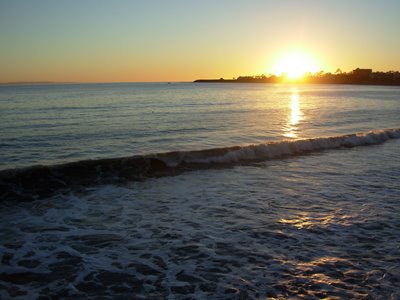
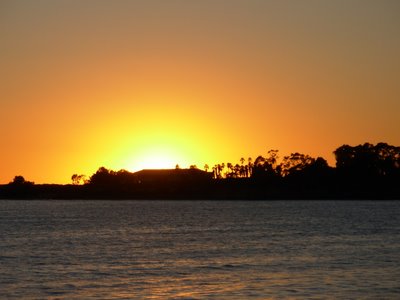

After that spectacular display, we went to the restaurant, where we were told that the wait would be an hour and a half. The hostess then looked at us again, said, "just a minute," and disappeared for a few moments. When she came back, she had menus in her hand, and seated us in a side area at a table marked "Reserved." It was just meant to be.
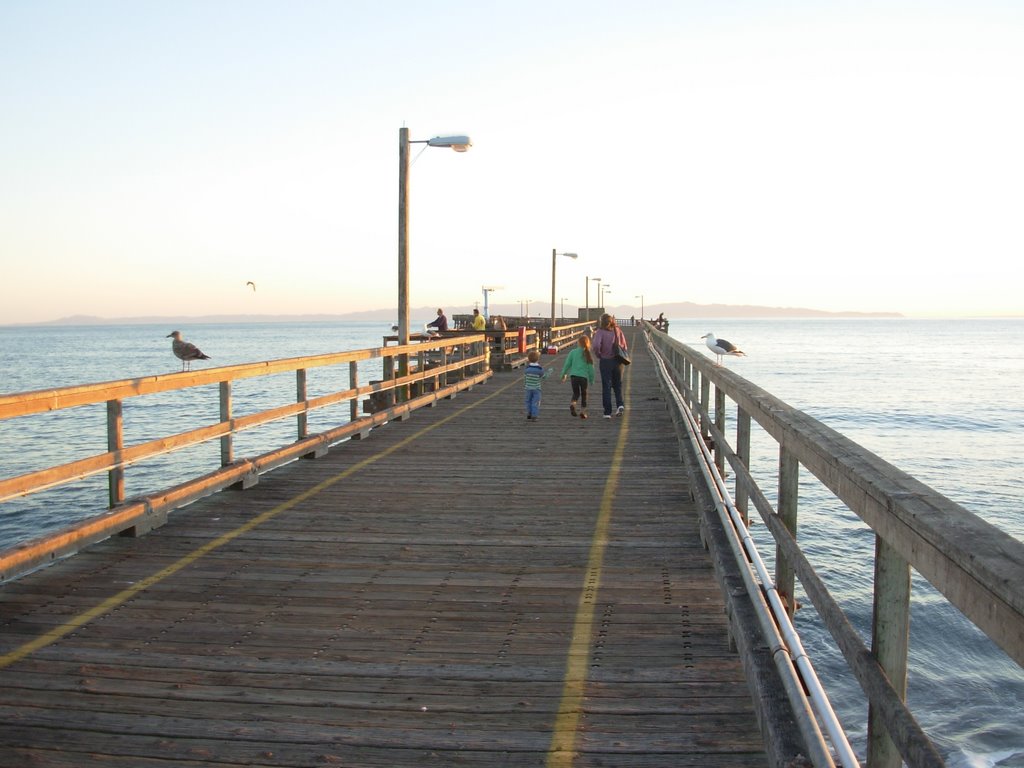




After that spectacular display, we went to the restaurant, where we were told that the wait would be an hour and a half. The hostess then looked at us again, said, "just a minute," and disappeared for a few moments. When she came back, she had menus in her hand, and seated us in a side area at a table marked "Reserved." It was just meant to be.
Friday, January 12, 2007
The Honey-do Project
Since I had a few days off over the New Year's holiday, Cheryl brightly said, "hey, since you have some time, why don't you paint the living room like you've always said you wanted to!" Unassailable logic, that.
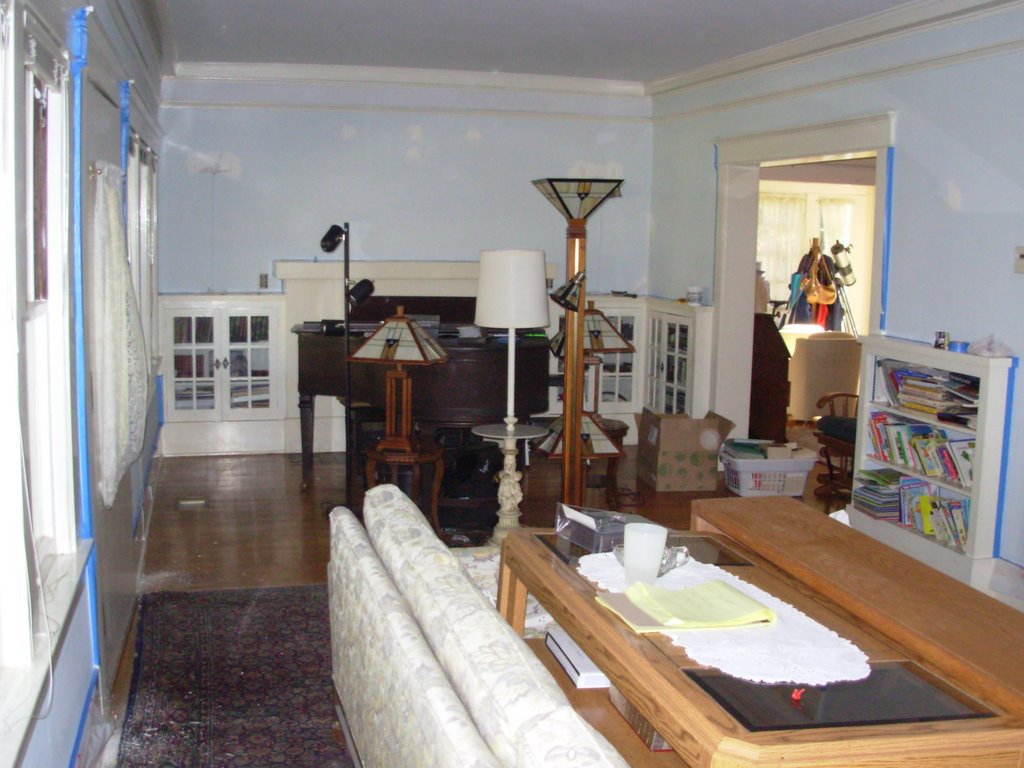
The long delayed painting of the living room was in part because the room is thick with window, baseboard and crown moldings. In fact, not one crown molding, but two, just to increase the degree of difficulty.
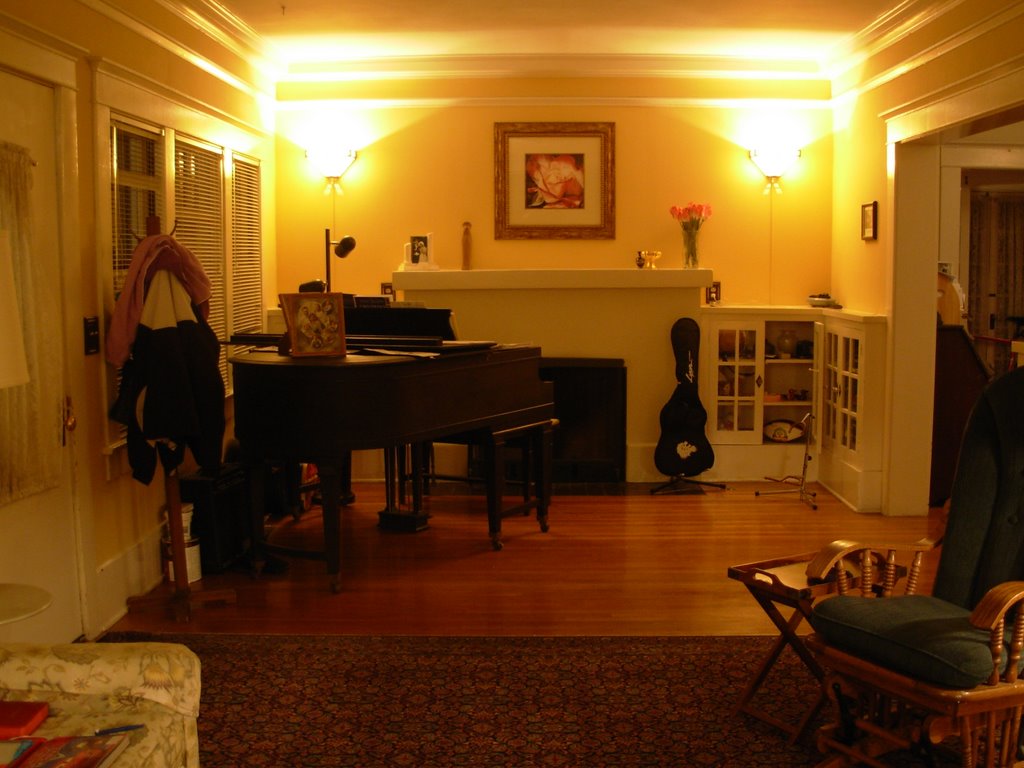
We picked a color that was part of an Arts & Crafts collection put together by Sherwin-Williams in an effort to stay true to the architectural style of the house. Using more saturated colors, as we have begun to do, is a dicey proposition. If it is wrong, it is really wrong. However, the Hubbard Squash came out just right, we think.
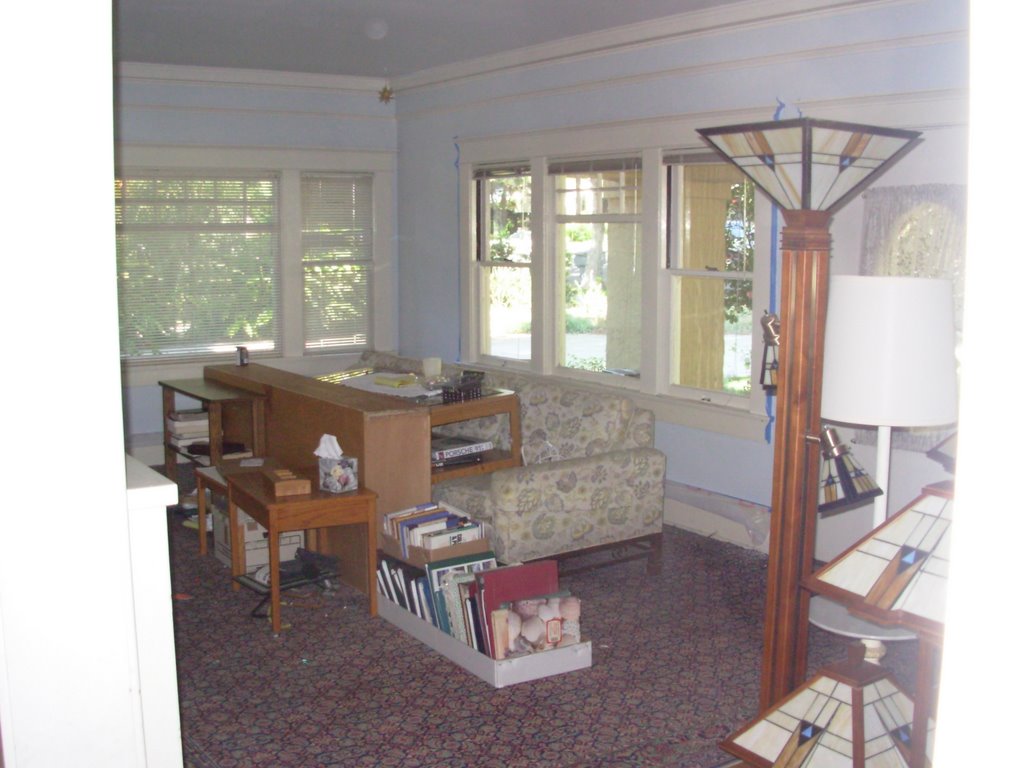
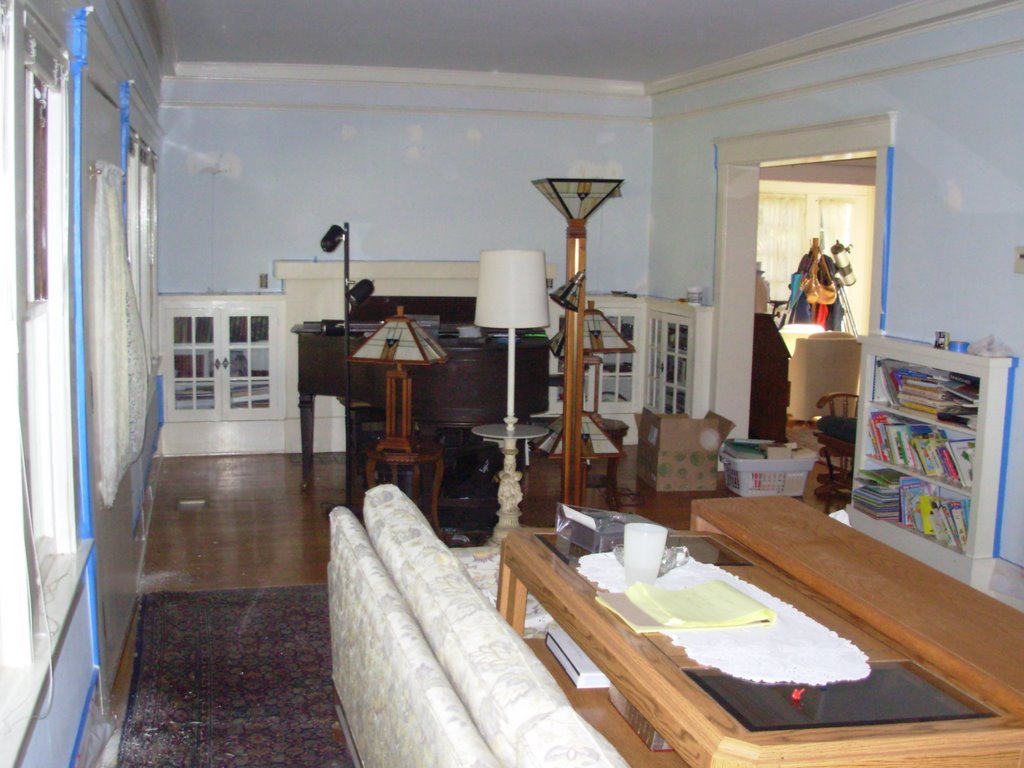
Moving everything to the middle of the room:

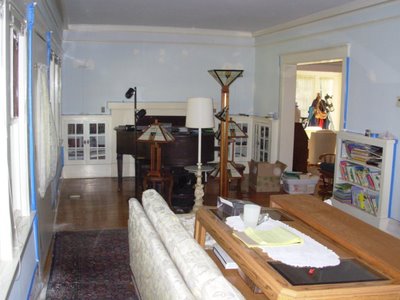
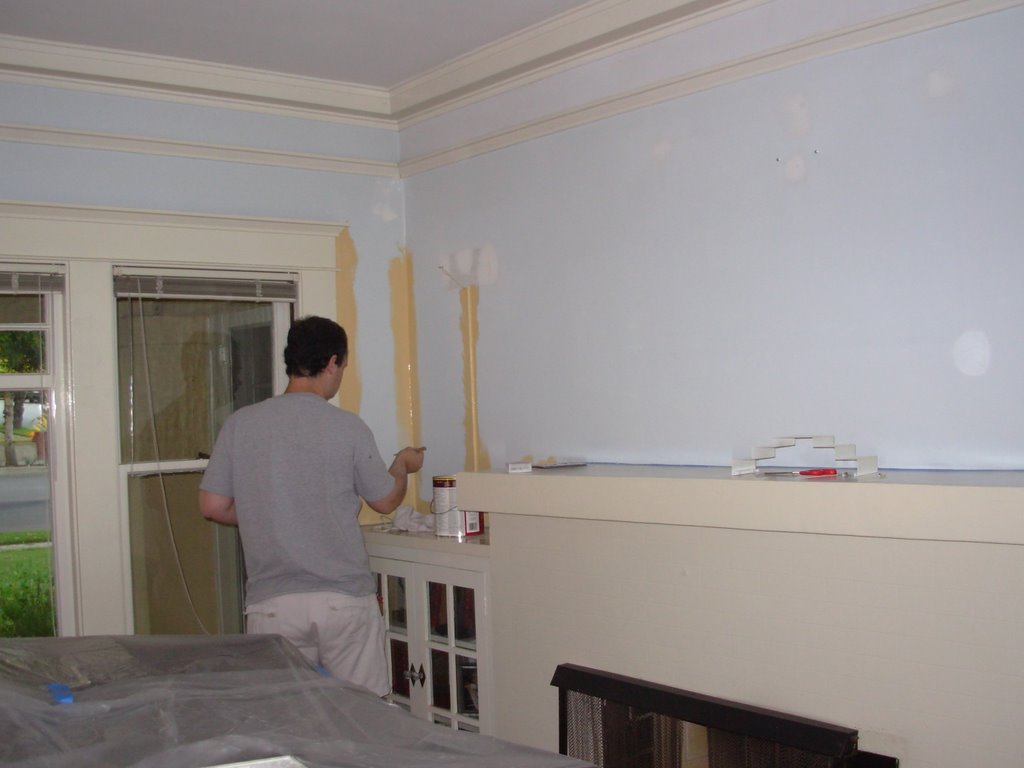
Lots of brushwork in this job:
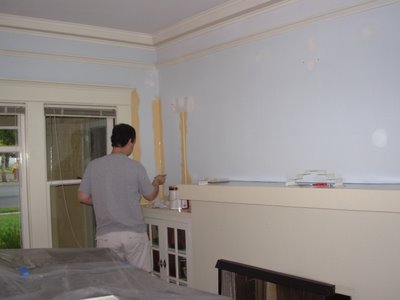
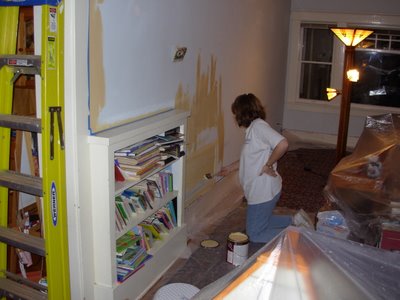

Before:
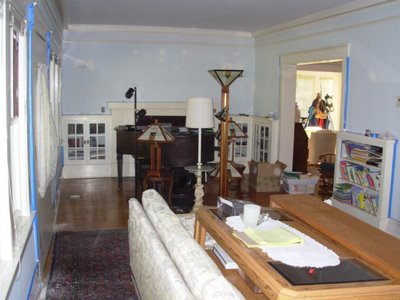
And after:
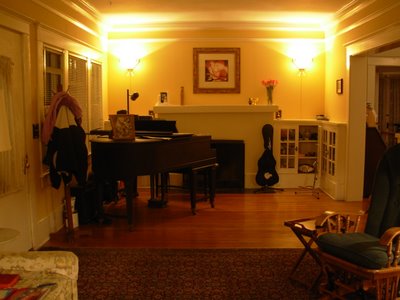
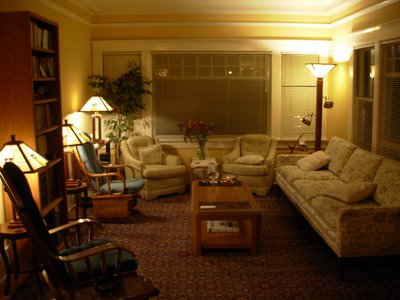
A couple of new sconces to match the style completed the transformation:

That ought to take care of the honey-do projects. At least until the next four day weekend.
The long delayed painting of the living room was in part because the room is thick with window, baseboard and crown moldings. In fact, not one crown molding, but two, just to increase the degree of difficulty.
We picked a color that was part of an Arts & Crafts collection put together by Sherwin-Williams in an effort to stay true to the architectural style of the house. Using more saturated colors, as we have begun to do, is a dicey proposition. If it is wrong, it is really wrong. However, the Hubbard Squash came out just right, we think.
Moving everything to the middle of the room:
Lots of brushwork in this job:


Before:
And after:
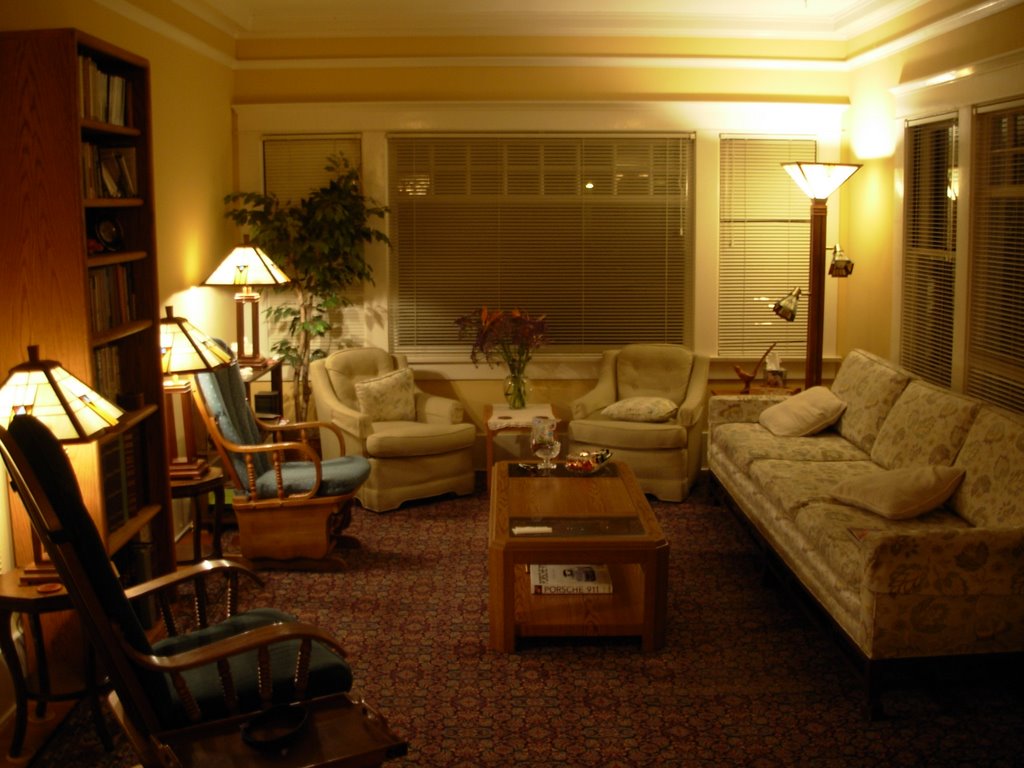
A couple of new sconces to match the style completed the transformation:

That ought to take care of the honey-do projects. At least until the next four day weekend.
Thursday, January 11, 2007
Why Is There So Much Soccer In My News?
Stay with me, friends, and I will lead you to cultural trends before they hit the big time. Remember all that soccer blather from last month? It ain't just me...
Yes, even mainstream news outlets such as MSNBC carried front page stories today of soccer player/marketing icon David Beckham coming to ply his trade in the United States. And if US news organizations are merely taking note, their European counterparts are keeping the story in the sweet spot of the news cycle. Even the august Guardian still has the Beckham story on the front page of its website into early Friday morning in London. Why so much commotion?
It is the same old story: soccer has never really taken off in the US, depite the millions of Americans who have played it as children over the last 30 years. The powers that be in US soccer, in the two eras when soccer had a noticable professional presence in this country, have always sought to bring in the most recognizable foreign players. It is brand recognition, plain and simple. In the 1970's, the New York Cosmos became a white-hot ticket for a brief moment in time by bringing the legendary Pele. Not only did Pele draw the curious to his games, but he drew other past-their-prime international stars to the US as well (Franz Beckenbauer being the most prominent).
The MLS is trying to pull off a similar stunt with Beckham. Critics would argue, with justification, that Beckham is hardly the greatest player in the world, at least not at this stage of his career. Beckham, now 31, rarely plays for his current team, the former powerhouse Real Madrid, and was unceremoniously dumped from the English national team following the World Cup this summer. However, Beckham has the most precious commodity for this day and age: name recognition. His Q rating, as they say, is stratospheric. The fact that a reasonably successful movie named him in its title and involved a young player’s desire to play like him (the enjoyable “Bend It Like Beckham”) certainly helped widen his already wide fame. Most Americans pressed to name a soccer player, if they can name any at all, are likely to identify Pele, perhaps Mia Hamm, and Beckham. If the MLS had its pick of the one player in the world it could bring in to generate interest in its league, Beckham is the guy, without question.
The backlash has already begun in the close-knit locker room that is the American sports fraternity. One of the local sports radio guys, a former NFL player who has never met a generalization he couldn’t embrace, dismissed Beckham as the Anna Kournikova of soccer, referring to the tennis player known equally well for her looks as for her complete lack of professional accomplishments. On this point, sports radio jocks could not be more wrong. Beckham is a pretty boy, certainly, who indulges in all of the trappings of modern fame, and yes, he is married to a former Spice Girl. However, he also earned his fame on the soccer pitch. He played for ten years for arguably the most important English professional team, Manchester United, for whom he played a vital role in six league championships, two all-England championships, and one European championship. As the movie title suggests, his ability to move the ball in the air is legendary, and is the one area of his game that remains at the pinnacle of the sport. Without him, England likely would have been shut out entirely at this summer’s World Cup.
Beckham should bring immediate interest in LA Galaxy games. A lesser halo effect should result for the league as a whole as some of the spectators new to the sport stay interested. An unknown factor is whether he will draw other world-class players (such as the Brazilian superstar Ronaldo) to the MLS as well. It is unlikely that any foreign player at the top of his game will come here, but the fact that a US league is even a topic of conversation in the worldwide soccer community is a giant leap forward.
Ironically, the best American players are making their away out of the country with greater regularity. The English Premier League team Fulham signed Clint Dempsey this week, an exceptional young player just coming into his prime. He will join 13 other players in the Premiership, including two others at Fulham. Until MLS can be seen as a true premier league in its own right, the best players will always play outside this country. The excitement and attention wrought by bringing Beckham in, however, is a first step in that process.
One more thing: Beckham signed for $250,000,000. Yes, a quarter of a billion dollars, over five years. That figure is mostly endorsement money, and reflects the company-town structure of the MLS. Yet, the MLS views this deal as a moneymaker for itself, such is the marketing power than a huge name (think Tiger, Jordan) can weild.
If the Galaxy play a game at the Rose Bowl next season, we’ll be there.
Yes, even mainstream news outlets such as MSNBC carried front page stories today of soccer player/marketing icon David Beckham coming to ply his trade in the United States. And if US news organizations are merely taking note, their European counterparts are keeping the story in the sweet spot of the news cycle. Even the august Guardian still has the Beckham story on the front page of its website into early Friday morning in London. Why so much commotion?
It is the same old story: soccer has never really taken off in the US, depite the millions of Americans who have played it as children over the last 30 years. The powers that be in US soccer, in the two eras when soccer had a noticable professional presence in this country, have always sought to bring in the most recognizable foreign players. It is brand recognition, plain and simple. In the 1970's, the New York Cosmos became a white-hot ticket for a brief moment in time by bringing the legendary Pele. Not only did Pele draw the curious to his games, but he drew other past-their-prime international stars to the US as well (Franz Beckenbauer being the most prominent).
The MLS is trying to pull off a similar stunt with Beckham. Critics would argue, with justification, that Beckham is hardly the greatest player in the world, at least not at this stage of his career. Beckham, now 31, rarely plays for his current team, the former powerhouse Real Madrid, and was unceremoniously dumped from the English national team following the World Cup this summer. However, Beckham has the most precious commodity for this day and age: name recognition. His Q rating, as they say, is stratospheric. The fact that a reasonably successful movie named him in its title and involved a young player’s desire to play like him (the enjoyable “Bend It Like Beckham”) certainly helped widen his already wide fame. Most Americans pressed to name a soccer player, if they can name any at all, are likely to identify Pele, perhaps Mia Hamm, and Beckham. If the MLS had its pick of the one player in the world it could bring in to generate interest in its league, Beckham is the guy, without question.
The backlash has already begun in the close-knit locker room that is the American sports fraternity. One of the local sports radio guys, a former NFL player who has never met a generalization he couldn’t embrace, dismissed Beckham as the Anna Kournikova of soccer, referring to the tennis player known equally well for her looks as for her complete lack of professional accomplishments. On this point, sports radio jocks could not be more wrong. Beckham is a pretty boy, certainly, who indulges in all of the trappings of modern fame, and yes, he is married to a former Spice Girl. However, he also earned his fame on the soccer pitch. He played for ten years for arguably the most important English professional team, Manchester United, for whom he played a vital role in six league championships, two all-England championships, and one European championship. As the movie title suggests, his ability to move the ball in the air is legendary, and is the one area of his game that remains at the pinnacle of the sport. Without him, England likely would have been shut out entirely at this summer’s World Cup.
Beckham should bring immediate interest in LA Galaxy games. A lesser halo effect should result for the league as a whole as some of the spectators new to the sport stay interested. An unknown factor is whether he will draw other world-class players (such as the Brazilian superstar Ronaldo) to the MLS as well. It is unlikely that any foreign player at the top of his game will come here, but the fact that a US league is even a topic of conversation in the worldwide soccer community is a giant leap forward.
Ironically, the best American players are making their away out of the country with greater regularity. The English Premier League team Fulham signed Clint Dempsey this week, an exceptional young player just coming into his prime. He will join 13 other players in the Premiership, including two others at Fulham. Until MLS can be seen as a true premier league in its own right, the best players will always play outside this country. The excitement and attention wrought by bringing Beckham in, however, is a first step in that process.
One more thing: Beckham signed for $250,000,000. Yes, a quarter of a billion dollars, over five years. That figure is mostly endorsement money, and reflects the company-town structure of the MLS. Yet, the MLS views this deal as a moneymaker for itself, such is the marketing power than a huge name (think Tiger, Jordan) can weild.
If the Galaxy play a game at the Rose Bowl next season, we’ll be there.
Wednesday, January 10, 2007
It's About Time
It appears that I picked up a new cell phone too soon. One of the worst-kept secrets in the tech world was finally revealed yesterday, when Apple, Inc. (no longer Apple Computer) announced the iPhone. Ooh, pretty:

It is not ready for prime time yet, as the FCC has not approved it on a technical basis, and Cisco has not yet relinquished its rights to the "iPhone" name. However, expect everything to be in order by the June release date.
Excitement and skepticism abound whenever Apple makes a big product announcement. There is plenty of enthusiasm for Apple's all-in-one methodologies, incorporating telephone, web surfer, PDA and music capabilities into one small package. Critics raise questions about durability, battery life, and the ease of typing on a touch-screen keyboard instead of little buttons that provide tactile feedback as on competitive products such as Blackberry or Treo. As an iMac owner, though, this is a very attractive proposition, because I use the iCal and other PDA-type functions of the computer far more than I used to and the integration between platforms ought to be seamless.
The downside for me is the price ($500) and the exclusive deal with Cingular (we've been with Verizon for years and have managed to hold on to a relatively attractive services package that is no longer offered). As with any such device, it is almost impossible to tell how good it is until it is actually put to use. I was very pleased with the Motorola RAZR I recently acquired, as its telephone capabilities were light years ahead of the several-year-old LG I had been using, although I couldn't know that for sure until I bought the phone. I'm sure the gizmos will be great on the iPhone, but if it doesn't work well as a telephone, it is pointless. Thankfully, I guess, I'll still have several months to go on my Verizon contract when the iPhone is released, so for once I'll let everyone else be the early adopters and work out the kinks.
UPDATE: within half an hour of posting this item, the news came down the wire that Cisco filed suit against Apple over the iPhone name. The two companies had been in negotiations over the name, but had not concluded a resolution prior to Steve Jobs' MacWorld announcement. Oops. A deal will undoubtedly be done, but Cisco has all the leverage in the world now, since Apple has now announced the product with that name and consumer expectations have been set. I think Cisco has engaged in some shenanigans by releasing a product bearing the name iPhone that nobody has heard of just three weeks before MacWorld (the key element of perfecting the registration of a trademark is to use it in commerce). Nevertheless, expect Cisco to pick up a sweet per-unit license deal before this is over.
It is not ready for prime time yet, as the FCC has not approved it on a technical basis, and Cisco has not yet relinquished its rights to the "iPhone" name. However, expect everything to be in order by the June release date.
Excitement and skepticism abound whenever Apple makes a big product announcement. There is plenty of enthusiasm for Apple's all-in-one methodologies, incorporating telephone, web surfer, PDA and music capabilities into one small package. Critics raise questions about durability, battery life, and the ease of typing on a touch-screen keyboard instead of little buttons that provide tactile feedback as on competitive products such as Blackberry or Treo. As an iMac owner, though, this is a very attractive proposition, because I use the iCal and other PDA-type functions of the computer far more than I used to and the integration between platforms ought to be seamless.
The downside for me is the price ($500) and the exclusive deal with Cingular (we've been with Verizon for years and have managed to hold on to a relatively attractive services package that is no longer offered). As with any such device, it is almost impossible to tell how good it is until it is actually put to use. I was very pleased with the Motorola RAZR I recently acquired, as its telephone capabilities were light years ahead of the several-year-old LG I had been using, although I couldn't know that for sure until I bought the phone. I'm sure the gizmos will be great on the iPhone, but if it doesn't work well as a telephone, it is pointless. Thankfully, I guess, I'll still have several months to go on my Verizon contract when the iPhone is released, so for once I'll let everyone else be the early adopters and work out the kinks.
UPDATE: within half an hour of posting this item, the news came down the wire that Cisco filed suit against Apple over the iPhone name. The two companies had been in negotiations over the name, but had not concluded a resolution prior to Steve Jobs' MacWorld announcement. Oops. A deal will undoubtedly be done, but Cisco has all the leverage in the world now, since Apple has now announced the product with that name and consumer expectations have been set. I think Cisco has engaged in some shenanigans by releasing a product bearing the name iPhone that nobody has heard of just three weeks before MacWorld (the key element of perfecting the registration of a trademark is to use it in commerce). Nevertheless, expect Cisco to pick up a sweet per-unit license deal before this is over.
Tuesday, January 09, 2007
You, Too, Can Take A Guess
As of today, we are exactly two months away from the anniversary of a momentous day in pop culture history. Expect to see a few magazine articles and a fawning retrospective from the LA Times' Robert Hilburn.
Monday, January 08, 2007
A Really Memorable Way to Die
This one's for Dad, the ex-ultralight pilot. The ingenuity of the human mind and the boldness of the human spirit have seldom been exercised in such spectacular disregard of the innate frailty of the human body as shown in this video. This guy flies for five minutes with a gen-u-wine jet pack (wings included!) strapped to his back. Genius that he is, he launched from another airplane (sure hope this thing starts), and apparently decided that a great place to ride a jet engine would be a narrow alpine valley with lots of photogenic (i.e., splat-inducing) mountains in close proximity.
Nevertheless, the sheer audacity of the whole venture, and the seeming ease with which the guy zips around, is inspiring, albeit in a "better-him-than-me" sort of way.
Don't get any ideas, Dad.
Nevertheless, the sheer audacity of the whole venture, and the seeming ease with which the guy zips around, is inspiring, albeit in a "better-him-than-me" sort of way.
Don't get any ideas, Dad.
Friday, December 22, 2006
When Adpeople Attack
You have to enjoy the joie de vivre exhibited by the ad agencies in these spots:


Shuttle Landing Day ... Where?
The Space Shuttle is supposed to come home today, but nobody knows where. As I type this, the flight director just informed the crew that rain is expected in the vicinity of the shuttle landing area in Florida, with a deorbit burn for that landing site required in less than an hour. Ordinarily, this would fill me with joy, because the shuttle would be diverted to Edwards, giving us a shot at going out there to watch it land (as we have done before). However, Edwards is currently experiencing windy conditions that could interfere with a landing. As a result, the White Sands area of New Mexico is getting ready for only the second shuttle landing there, the first in 24 years.
The NASA bosses haven't given up hope on Florida or California yet, as each site would allow for a far more efficient post-landing turnaround of the orbiter. Plus, it sounds like New Mexico has little more than a guy with a Handicam and a toothless old codger at a broken down gas pump ready to receive the shuttle. Nevertheless, the weather at White Sands is stable, making it a secure backup site if the others cannot be used today.
Right now, NASA is still aiming for a landing at Kennedy on orbit 202, landing at about 3 pm CST. The first set of backups would be on orbit 203: landing at Edwards at about 4:27 CST; landing at New Mexico at almost exactly the same time; or landing at Kennedy at about 4:32 CST. The second set of backup landing plans would be on Orbit 204, landing at Edwards at 6:00 CST or New Mexico at 6:02 CST. The final backup landing plan for today would be on orbit 205 at Edwards at 7:36 CST. NASA must commit to any landing plan it chooses more than an hour prior to the actual landing, as the de-orbit maneuvers take that much time.
There are final landing options for Saturday, but only as a last resort. Because of an extra day spent fixing the ISS, the shuttle has less resources in reserve than usual. In short, it will run out of gas on Saturday, so NASA needs to get it on the ground soon. Ordinarily, NASA would take any extra time it could to wait for a landing window to open up at either Kennedy or Edwards. In this case, though, because of the smaller margin for error, there is a strong likelihood that the shuttle will end up on the ground in New Mexico today.
UPDATE, 11:03 PST: the first landing opportunity at Florida has been waved off, with the parenthetical remark that the next opportunity at Florida will likely also not be a "go" due to weather. Edwards is on the clock.
UPDATE, 12:15 PST: Winds at Edwards are "somewhat more favorable." Weather is also trending more favorable, although it is not clear like California. The order has been given for fluid loading, in which the astronauts begin consumption of liquids to help them readjust to life on the ground (the body sheds liquid in space because in a zero gravity environment bodily fluids shift toward the head, leading the body to believe it is retaining too much fluid). This means they are committing to come down on this orbit.
UPDATE, 12:25 PST: NASA is now providing the shuttle commander de-orbit information for an Edwards landing. We may not be able to get out there in time, but we'll stand by for the sonic booms at 2:22 PST. Houston is still debating landing sites, though. They really want to come back to Florida.
UPDATE, 12:50 PST: Shuttle support vehicles are rolling out at Edwards.
UPDATE, 12:57 PST: Winds have picked up at Edwards, with too much unpredicable crosswind behavior. They are now loading computer targets for Florida. Drat!
UPDATE, 1:22 PST: with only about 5 minutes remaining prior to the scheduled de-orbit burn, Houston has given the go-ahead for landing in Florida. The weather looks pretty gloomy, but flight controllers believe that the shuttle will be able to avoid any showers. The shuttle commander was very happy to get the approval.
UPDATE, 2:35 PST: Discovery is home. The flight director should get something nice in his stocking this year; he saved the American taxpayers millions of dollars by pushing through pretty ugly weather to land in Florida anyway.

The NASA bosses haven't given up hope on Florida or California yet, as each site would allow for a far more efficient post-landing turnaround of the orbiter. Plus, it sounds like New Mexico has little more than a guy with a Handicam and a toothless old codger at a broken down gas pump ready to receive the shuttle. Nevertheless, the weather at White Sands is stable, making it a secure backup site if the others cannot be used today.
Right now, NASA is still aiming for a landing at Kennedy on orbit 202, landing at about 3 pm CST. The first set of backups would be on orbit 203: landing at Edwards at about 4:27 CST; landing at New Mexico at almost exactly the same time; or landing at Kennedy at about 4:32 CST. The second set of backup landing plans would be on Orbit 204, landing at Edwards at 6:00 CST or New Mexico at 6:02 CST. The final backup landing plan for today would be on orbit 205 at Edwards at 7:36 CST. NASA must commit to any landing plan it chooses more than an hour prior to the actual landing, as the de-orbit maneuvers take that much time.
There are final landing options for Saturday, but only as a last resort. Because of an extra day spent fixing the ISS, the shuttle has less resources in reserve than usual. In short, it will run out of gas on Saturday, so NASA needs to get it on the ground soon. Ordinarily, NASA would take any extra time it could to wait for a landing window to open up at either Kennedy or Edwards. In this case, though, because of the smaller margin for error, there is a strong likelihood that the shuttle will end up on the ground in New Mexico today.
UPDATE, 11:03 PST: the first landing opportunity at Florida has been waved off, with the parenthetical remark that the next opportunity at Florida will likely also not be a "go" due to weather. Edwards is on the clock.
UPDATE, 12:15 PST: Winds at Edwards are "somewhat more favorable." Weather is also trending more favorable, although it is not clear like California. The order has been given for fluid loading, in which the astronauts begin consumption of liquids to help them readjust to life on the ground (the body sheds liquid in space because in a zero gravity environment bodily fluids shift toward the head, leading the body to believe it is retaining too much fluid). This means they are committing to come down on this orbit.
UPDATE, 12:25 PST: NASA is now providing the shuttle commander de-orbit information for an Edwards landing. We may not be able to get out there in time, but we'll stand by for the sonic booms at 2:22 PST. Houston is still debating landing sites, though. They really want to come back to Florida.
UPDATE, 12:50 PST: Shuttle support vehicles are rolling out at Edwards.
UPDATE, 12:57 PST: Winds have picked up at Edwards, with too much unpredicable crosswind behavior. They are now loading computer targets for Florida. Drat!
UPDATE, 1:22 PST: with only about 5 minutes remaining prior to the scheduled de-orbit burn, Houston has given the go-ahead for landing in Florida. The weather looks pretty gloomy, but flight controllers believe that the shuttle will be able to avoid any showers. The shuttle commander was very happy to get the approval.
UPDATE, 2:35 PST: Discovery is home. The flight director should get something nice in his stocking this year; he saved the American taxpayers millions of dollars by pushing through pretty ugly weather to land in Florida anyway.
Wednesday, December 20, 2006
Auto Repair Scam
I have resisted posting or linking to YouTube clips, partly because I can't vouch for all of the garbage that may be on the YouTube site, and partly because it's just too easy to post amusing little clips. I look for a higher degree of difficulty with my blogging.
I'll make an exception now, however. One of the local television stations ran an expose on Jiffy Lube over the last few months that was pretty revealing, especially since it involved a Jiffy Lube that I used to use. It's a pretty sobering story for all of us who secretly (or not so secretly) think that we're always getting ripped off by auto mechanics. For once, the proud little (literally) consumer crusader doesn't overshadow the story itself.
As an added bonus, for those who know the SoCal news scene, you get Paul Moyer!
I'll make an exception now, however. One of the local television stations ran an expose on Jiffy Lube over the last few months that was pretty revealing, especially since it involved a Jiffy Lube that I used to use. It's a pretty sobering story for all of us who secretly (or not so secretly) think that we're always getting ripped off by auto mechanics. For once, the proud little (literally) consumer crusader doesn't overshadow the story itself.
As an added bonus, for those who know the SoCal news scene, you get Paul Moyer!
Monday, December 18, 2006
My Greatest Aspirations, Almost Realized
As I hinted a while ago, I had an opportunity to do another driving event this fall. This time, it was put on by Road & Track and Car and Driver. At least, the banners said so.

In reality, it was a Cadillac event, only slightly less manufacturer-centric as the Mazda events I've attended.
The gimmick is that the attendees are "editors for a day." The lucky ones get their pictures and brief comments in a Cadillac ad in the two magazines. We were given clipboards and open-ended questionnaires to complete about the four vehicles we would drive:
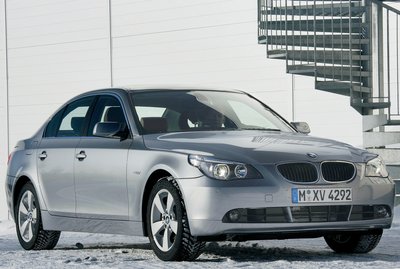
a BMW 530xi
a Cadillac STS

a Lexus RX350

and a Cadillac SRX

The event was extremely well organized. Each group of drivers numbered about 48, split into two groups, SUV drivers and sedan drivers. Two examples of each vehicle were available, and all of them would be driven on the same short autocross course at the same time (with adequate spacing from each other, of course). Each driving group would be split in half further, with one set of drivers out on the course while the remainder poked and prodded parked examples of the cars that we were driving.


The structure of the event allowed us to drive the course a total of eight times, which dramatically improved my ability to evaluate each car on its merits rather than spend all of my time trying to sort out the course. The impressions were numerous and, in some respects, surprising. In my opinion, the BMW had the best driving feel and response to control inputs, although it felt heavy and understeered substantially (a function of the all-wheel drive setup mandated to match the STS). The back seat, unlike 5-series in the recent past, was amply capacious in all dimensions. The iDrive, unfortunately, was every bit the disaster that it has been made out to be. Not only was it difficult to figure out how to find certain control menus, some of the menus did not make sense once you found them. The Cadillac STS was a very agreeable sedan, with an attractive interior and strong driving dynamics. Unfortunately, it is just a bit too small, particularly in the back seat, to be a serious exective transport. Its equipment level and general level of quality fell just a bit behind the BMW, as well.
The Lexus had, in my opinion, the most attractive interior, although like most suburban SUVs, its cargo capacity was somewhat less than that of our Passat wagon. The touchscreen control panel was well-situated high on the dash, was organized in a manner that would be intuitive to anyone reasonably well versed in operating a modern home computer, and provided easy access to all of its features, while most of the usual functions (radio, climate control) also had redundant analog controls on the dash, marked in clear, large Lexus style. The Lexus also had the most power. Unfortunately, the touchscreen washed out completely in the sun, and the nannyish transmission prevented me from getting all of that power to the ground. I had the opportunity to drive the Lexus on three laps, and the transmission refused to give me a lower gear when I asked for it coming hard out of a corner at the same point on the course every time.
The Cadillac SRX is basically a high-riding wagon. I was not favorably inclined to the dark interior, which had control switches scatted about a bit more than it should. The control screen was also too low in the dash and was not as easy to use as the Lexus (but light years better than the BMW). The SRX had room for a third row of seats, which were suitable for children only. For those who need the flexibility of being able to carry five or six people, that can be a critical issue. The SRX may have been the most fun to drive of all of the vehicles. It was more prone to rotation than any of the others, which may not be as safe, but is a lot more entertaining.
In the end, all of these cars were thoroughly modern and comfortable, with sufficient, albeit not overwhelming, power. Given the opportunity to drive them somewhat harder than one would in the usual test drive, while also being given an extended amount of time to thoroughly evaluate the accommodations and features, we had the chance to learn some things that might not have otherwise revealed themselves. Plus, it was a heck of a lot of fun.

Wanna see? Click here to see me driving the STS. I never did get that hairpin right, and no, I did not knock down any cones. What you are seeing is superior driving skill on display. How strange that Roger Penske hasn't called yet.
In reality, it was a Cadillac event, only slightly less manufacturer-centric as the Mazda events I've attended.
The gimmick is that the attendees are "editors for a day." The lucky ones get their pictures and brief comments in a Cadillac ad in the two magazines. We were given clipboards and open-ended questionnaires to complete about the four vehicles we would drive:
a BMW 530xi
a Cadillac STS
a Lexus RX350
and a Cadillac SRX
The event was extremely well organized. Each group of drivers numbered about 48, split into two groups, SUV drivers and sedan drivers. Two examples of each vehicle were available, and all of them would be driven on the same short autocross course at the same time (with adequate spacing from each other, of course). Each driving group would be split in half further, with one set of drivers out on the course while the remainder poked and prodded parked examples of the cars that we were driving.
The structure of the event allowed us to drive the course a total of eight times, which dramatically improved my ability to evaluate each car on its merits rather than spend all of my time trying to sort out the course. The impressions were numerous and, in some respects, surprising. In my opinion, the BMW had the best driving feel and response to control inputs, although it felt heavy and understeered substantially (a function of the all-wheel drive setup mandated to match the STS). The back seat, unlike 5-series in the recent past, was amply capacious in all dimensions. The iDrive, unfortunately, was every bit the disaster that it has been made out to be. Not only was it difficult to figure out how to find certain control menus, some of the menus did not make sense once you found them. The Cadillac STS was a very agreeable sedan, with an attractive interior and strong driving dynamics. Unfortunately, it is just a bit too small, particularly in the back seat, to be a serious exective transport. Its equipment level and general level of quality fell just a bit behind the BMW, as well.
The Lexus had, in my opinion, the most attractive interior, although like most suburban SUVs, its cargo capacity was somewhat less than that of our Passat wagon. The touchscreen control panel was well-situated high on the dash, was organized in a manner that would be intuitive to anyone reasonably well versed in operating a modern home computer, and provided easy access to all of its features, while most of the usual functions (radio, climate control) also had redundant analog controls on the dash, marked in clear, large Lexus style. The Lexus also had the most power. Unfortunately, the touchscreen washed out completely in the sun, and the nannyish transmission prevented me from getting all of that power to the ground. I had the opportunity to drive the Lexus on three laps, and the transmission refused to give me a lower gear when I asked for it coming hard out of a corner at the same point on the course every time.
The Cadillac SRX is basically a high-riding wagon. I was not favorably inclined to the dark interior, which had control switches scatted about a bit more than it should. The control screen was also too low in the dash and was not as easy to use as the Lexus (but light years better than the BMW). The SRX had room for a third row of seats, which were suitable for children only. For those who need the flexibility of being able to carry five or six people, that can be a critical issue. The SRX may have been the most fun to drive of all of the vehicles. It was more prone to rotation than any of the others, which may not be as safe, but is a lot more entertaining.
In the end, all of these cars were thoroughly modern and comfortable, with sufficient, albeit not overwhelming, power. Given the opportunity to drive them somewhat harder than one would in the usual test drive, while also being given an extended amount of time to thoroughly evaluate the accommodations and features, we had the chance to learn some things that might not have otherwise revealed themselves. Plus, it was a heck of a lot of fun.
Wanna see? Click here to see me driving the STS. I never did get that hairpin right, and no, I did not knock down any cones. What you are seeing is superior driving skill on display. How strange that Roger Penske hasn't called yet.
What Could Possibly Go Wrong?
Let's see: guy owns a snake. A 13-foot boa constrictor, whose sole function in life is to encircle and squeeze other living things until they are no longer unwilling to be snake food. Guy gets into the cage to play with the snake.
Suffice it to say, there wasn't much left for the cops to do once they got to the guy's house.
Suffice it to say, there wasn't much left for the cops to do once they got to the guy's house.
Saturday, December 16, 2006
Thursday, December 14, 2006
Dr. Wingspan, I Presume
Here in the West, we have pioneered all sorts of marvelous medical techniques and equipment that have enabled doctors to perform feats of healing that would have seemed utterly miraculous a generation or two ago. Everthing from arthoscopic surgery to MRIs and countless other advances in medicine have vastly improved the standard of our lives by enabling doctors to diagnose and treat ever more diseases and injuries with less and less adverse consequences to the patients.
In China, for all of its astonishingly swift emergence as a modern society, still does a few things the old fashioned way. Or, at least, the hands-on way. In the same week that it was announced that a species of dolphin indigeonous to the Yangtze river has, it appears, passed into extinction, China's finest veterinarians pulled out all the stops to extract pieces of plastic from the stomach of two dolphins in a Bejing aquarium. When the tools of the trade failed them, they made the leap in logic any of us would have followed: use your local resources. Fortunately, the local resources included the tallest man in the world:

So what can the world's tallest man add to the effort to save the life of the dolphins? Why, the world's longest arms, of course. As CNN reported it:

As if this fellow's life wasn't weird enough already.
In China, for all of its astonishingly swift emergence as a modern society, still does a few things the old fashioned way. Or, at least, the hands-on way. In the same week that it was announced that a species of dolphin indigeonous to the Yangtze river has, it appears, passed into extinction, China's finest veterinarians pulled out all the stops to extract pieces of plastic from the stomach of two dolphins in a Bejing aquarium. When the tools of the trade failed them, they made the leap in logic any of us would have followed: use your local resources. Fortunately, the local resources included the tallest man in the world:
So what can the world's tallest man add to the effort to save the life of the dolphins? Why, the world's longest arms, of course. As CNN reported it:
Chen Lujun, the manager of the Royal Jidi Ocean World aquarium, told The Associated Press that the shape of the dolphins' stomachs made it difficult to push an instrument very far in without hurting the animals.
People with shorter arms could not reach the plastic, he said.
"When we failed to get the objects out we sought the help of Bao Xishun from Inner Mongolia and he did it successfully yesterday," Chen said. "The two dolphins are in very good condition now."
Photographs showed the jaws of one of the dolphins being held back by towels so Bao could reach inside the animal without being bitten.
As if this fellow's life wasn't weird enough already.
Tuesday, December 12, 2006
Least Surprising Endorsement Announcement of the Year
It seems that Tiger Woods, who almost single-handedly turned Nike's golf division from nothing into a major player, has renewed his endorsement deal with the Beaverton, Oregon-based sporting goods colossus. Tiger entered the professional golf world at the age of 20 in 1996 under Nike's banner and the tag line, "Hello, world." That deal was worth $40 million over five years. In 2001, Tiger renewed the deal for another five years and $100 million.
The terms of the current arrangement have not been disclosed. It is speculated that Tiger will receive Oregon's Willamette Valley and title to some of the nicer neighborhoods in Portland in the deal, as well as the University of Oregon's athletic department.
The terms of the current arrangement have not been disclosed. It is speculated that Tiger will receive Oregon's Willamette Valley and title to some of the nicer neighborhoods in Portland in the deal, as well as the University of Oregon's athletic department.
Wednesday, December 06, 2006
Sad News About Someone I Never Met
The worst fears of friends and family have been confirmed. The body of James Kim, the man who became lost in the Oregon backwoods with his family after Thanksgiving, has been found. Having passed through that area at the very same time that the family was huddled in their car for about the fifth straight day trying to stay alive, this story hits home to me. All the pretty pictures of snow in the posts below take on a darker tone, knowing that the snowfall that Monday night made a bad situation much worse. Unfortuately, the hard lesson is that unless you know the country well, you are far better off staying on well-traveled roads.
And just like we have tried to teach our kids, if you think you are lost, don't move. Someone will come looking for you, so give yourself a chance to be found. Our opportunity for that object lesson came one afternoon in a Best Buy with Kelly, and lasted about five minutes. That's more than enough for me.
And just like we have tried to teach our kids, if you think you are lost, don't move. Someone will come looking for you, so give yourself a chance to be found. Our opportunity for that object lesson came one afternoon in a Best Buy with Kelly, and lasted about five minutes. That's more than enough for me.
Subscribe to:
Comments (Atom)