At long last, after 12 contentious years, the IRL and Champ Car have finally agreed to unify their series. The IRL came into existence 12 years ago when the owner of the Indianapolis Motor Speedway, Tony George, came to the conclusion that the premier open-wheel racing series of the day, CART, featured too many road courses and foreign drivers. Rather than a merger, the IRL has essentially swallowed Champ Car, only keeping a few of the old Champ Car venues, including the one jewel in the crown, the Long Beach Grand Prix in April.
The split in the open wheel racing world all but killed off open wheel racing in North America, as NASCAR rushed in to fill the void, even taking with it open wheel stars from the IRL, Champ Car and Formula One in recent years. CART, and USAC before it, was once the unquestioned pinnacle of racing of any kind in this country. A.J. Foyt, Rick Mears, Mario Andretti, all the Unsers, Parnelli Jones, Bobby Rahal ... the list of drivers whose fame arose from open wheel racing is long and rich. While it will be far better for auto racing fans (and sponsors) to have only one major series to follow, the damage caused by Tony George's hissy fit will take at least as long to repair as the division in the racing world itself lasted.
Saturday, February 23, 2008


Thursday, February 21, 2008
Book Corner
Although I consider myself a big reader, I have not found time for much more than magazines and online content since I got out of school, with novels or other books reserved for vacations. Due to my unusual living circumstances of the last six months, however (away from family during the week, less accessible TV, many airplane flights), I have resumed reading books with a vengeance. In fact, it is possible that I have never ready books as vigorously as I have recently. In view of the Professor's call for a book list, I provide below a brief commentary on some of the 33 books I have read over the last 25 weeks.
Get a cup of coffee; this is a long post.
I have bought some of the books I have read, but my sister-in-law (and current weekday landlord) belongs to a book club, so I have been the primary beneficiary of her participation in the club. It may just be the way of recent fiction, the proportion of female authors and/or female-centric stories in my sister-in-law's collection seems to be very high. Perhaps the facts that the club is based in San Francisco and, I think, involves mostly women have influenced the reading list. In any event, I have had the opportunity to sample a wide array of stories and storytelling talent.
By far the best book I have read is "In the Fall" by Jeffrey Lent. Lent is described as a successor to the stylistic traditions of Faulkner and Cormac McCarthy. He certainly writes in a dense, oblique style that brings those writers to mind. Run-on sentences and a vast vocabulary do not necessarily a superior author make, but Lent has the storytelling talent to go with the sophisticated technique. "In the Fall" is an epic tale expertly told. It is one of those books that so vividly conjures up its world that it allows me to forget that I am reading a book. I was so taken with "In the Fall" that I bought Lent's two other books, "Lost Nation" and "A Peculiar Grace." The latter, though still strong, was the most shallow of the three, the one that I could envision being made into a movie even as I read it. "Lost Nation" took a long time to hook me, but its brutal brilliance was something unique and powerful.
Speaking of McCarthy, I read "No Country for Old Men" before seeing the movie. Both are excellent, and if the movie is inscrutable, it is because it hews faithfully to the book. The book did not affect me as deeply as "The Road," but it an interesting and usually fast-paced book (for McCarthy, anyway).
"Songs in Ordinary Time," by Mary McGarry Morris, is a difficult book to recommend, even though it is ultimately rewarding to read for the sheer challenge of staying with it. I was tempted to put this book away many times over the course of reading it. It is well-written in that it creates a fully realized world, but it is inhabited almost entirely by unlikeable characters. Even the "good" people fail in ways that strip away the reader's sympathies. But Oprah said to read it, so what do I know.
"The Rule of Four," by Ian Caldwell and Dustin Thomason, was an interesting puzzle book in the manner of "The DaVinci Code," but its tone was that of a competent but not particularly gifted grad student. Actually, this is almost precisely what it was. The authors of the book, childhood friends, wrote it just after they graduated from their Ivy League schools. The book has little in the way of authorial craftsmanship, and amounts to a gauzy-focused love letter to Princeton. That's not to say that I didn't enjoy the yarn, though. "The Piano Tuner," by Daniel Mason, is another book that suffers from being the first effort of a recent college graduate. It is an interesting tale that, in places, is written with style, but the book ultimately is less fulfilling than the promise of its beginning.
Ironically, and unbeknownst to me when I started it, the core of the puzzle in "The Rule of Four" is also at the center of "The Birth of Venus," by Sarah Dunant, a much more elegantly crafted work. Both of these books concern Renaissance Florence and the actions of the Dominican priest Girolamo Savonarola, who introduced the world to the Bonfire of the Vanities.
"Body and Soul" by Frank Conroy is a book that I felt should have been just a bit better. It is another book that brings a period and its inhabitants to life, but somehow it lacked the dramatic tension that would have made it great. Much of the developments in the story were simply too easy. It is as good a portrayal of the inner workings of a musician as you will find anywhere, however. "The Time Traveler's Wife," by Audrey Niffenegger, suffers the same fate. It has a very interesting premise, of a man unstuck in time who returns again and again to the same woman as she grows up in a normal chronological manner. Although the book is enjoyable to read, I felt that this one, too, should have gone to another level in the last third. Interestingly, both of these authors are university professors. Perhaps as a direct result, both books are competently written, but seem to lack that essential spark of genius that differentiates the truly gifted from the merely talented.
I read a couple of Nick Hornby books ("High Fidelity," "About a Boy"), which are always a reliably enjoyable read. I cleansed my palate with conventional Stephen King thrillers, whom I have always liked, as well as a Michael Crichton book ("State of Fear") that was interesting but somewhat less fulfilling.
I have read some non-fiction as well, my usual non-magazine standby. The estate of Alistair Cooke recently released a collection of previously unpublished essays from a trip around America he took in the early part of World War II. "The American Home Front: 1941-1942" is a time capsule of American attitudes and habits that is fascinating for its lack of the filters and revisionist interpretations that are usually attached to what would now be considered a work of historical investigation. John Krakauer's "Into the Wild" is another of his reliably well-written man-versus-nature stories, about a tragically self-absorbed (although some would describe him as merely an idealist) recent college graduate, whose impressive improvisational survival skills ultimately cannot hold nature at bay. "The Devil in the White City," by Erik Larson, was a very interesting account of the Chicago World's Fair of 1893, which captures much that characterized the beginning of the modern era in America.
These, and two dozen others, have made for very enriching evenings. Since we also read "To Kill a Mockingbird" with Kelly last fall, and are currently working our way through Jane Austen's "Persuasion," I am getting my fill of both current and past literature.
There has not been much scholarly reading among my selections, in contrast to the Professor, but as an English major, I find that connecting with literature is perfectly acceptable. It is also enlightening to get a feel for what novelists who aspire to create literature are doing with their talent. In contrast to what the collegiate world was telling us when we were in school, modern literature does not begin and end with Toni Morrison after all.
Get a cup of coffee; this is a long post.
I have bought some of the books I have read, but my sister-in-law (and current weekday landlord) belongs to a book club, so I have been the primary beneficiary of her participation in the club. It may just be the way of recent fiction, the proportion of female authors and/or female-centric stories in my sister-in-law's collection seems to be very high. Perhaps the facts that the club is based in San Francisco and, I think, involves mostly women have influenced the reading list. In any event, I have had the opportunity to sample a wide array of stories and storytelling talent.
By far the best book I have read is "In the Fall" by Jeffrey Lent. Lent is described as a successor to the stylistic traditions of Faulkner and Cormac McCarthy. He certainly writes in a dense, oblique style that brings those writers to mind. Run-on sentences and a vast vocabulary do not necessarily a superior author make, but Lent has the storytelling talent to go with the sophisticated technique. "In the Fall" is an epic tale expertly told. It is one of those books that so vividly conjures up its world that it allows me to forget that I am reading a book. I was so taken with "In the Fall" that I bought Lent's two other books, "Lost Nation" and "A Peculiar Grace." The latter, though still strong, was the most shallow of the three, the one that I could envision being made into a movie even as I read it. "Lost Nation" took a long time to hook me, but its brutal brilliance was something unique and powerful.
Speaking of McCarthy, I read "No Country for Old Men" before seeing the movie. Both are excellent, and if the movie is inscrutable, it is because it hews faithfully to the book. The book did not affect me as deeply as "The Road," but it an interesting and usually fast-paced book (for McCarthy, anyway).
"Songs in Ordinary Time," by Mary McGarry Morris, is a difficult book to recommend, even though it is ultimately rewarding to read for the sheer challenge of staying with it. I was tempted to put this book away many times over the course of reading it. It is well-written in that it creates a fully realized world, but it is inhabited almost entirely by unlikeable characters. Even the "good" people fail in ways that strip away the reader's sympathies. But Oprah said to read it, so what do I know.
"The Rule of Four," by Ian Caldwell and Dustin Thomason, was an interesting puzzle book in the manner of "The DaVinci Code," but its tone was that of a competent but not particularly gifted grad student. Actually, this is almost precisely what it was. The authors of the book, childhood friends, wrote it just after they graduated from their Ivy League schools. The book has little in the way of authorial craftsmanship, and amounts to a gauzy-focused love letter to Princeton. That's not to say that I didn't enjoy the yarn, though. "The Piano Tuner," by Daniel Mason, is another book that suffers from being the first effort of a recent college graduate. It is an interesting tale that, in places, is written with style, but the book ultimately is less fulfilling than the promise of its beginning.
Ironically, and unbeknownst to me when I started it, the core of the puzzle in "The Rule of Four" is also at the center of "The Birth of Venus," by Sarah Dunant, a much more elegantly crafted work. Both of these books concern Renaissance Florence and the actions of the Dominican priest Girolamo Savonarola, who introduced the world to the Bonfire of the Vanities.
"Body and Soul" by Frank Conroy is a book that I felt should have been just a bit better. It is another book that brings a period and its inhabitants to life, but somehow it lacked the dramatic tension that would have made it great. Much of the developments in the story were simply too easy. It is as good a portrayal of the inner workings of a musician as you will find anywhere, however. "The Time Traveler's Wife," by Audrey Niffenegger, suffers the same fate. It has a very interesting premise, of a man unstuck in time who returns again and again to the same woman as she grows up in a normal chronological manner. Although the book is enjoyable to read, I felt that this one, too, should have gone to another level in the last third. Interestingly, both of these authors are university professors. Perhaps as a direct result, both books are competently written, but seem to lack that essential spark of genius that differentiates the truly gifted from the merely talented.
I read a couple of Nick Hornby books ("High Fidelity," "About a Boy"), which are always a reliably enjoyable read. I cleansed my palate with conventional Stephen King thrillers, whom I have always liked, as well as a Michael Crichton book ("State of Fear") that was interesting but somewhat less fulfilling.
I have read some non-fiction as well, my usual non-magazine standby. The estate of Alistair Cooke recently released a collection of previously unpublished essays from a trip around America he took in the early part of World War II. "The American Home Front: 1941-1942" is a time capsule of American attitudes and habits that is fascinating for its lack of the filters and revisionist interpretations that are usually attached to what would now be considered a work of historical investigation. John Krakauer's "Into the Wild" is another of his reliably well-written man-versus-nature stories, about a tragically self-absorbed (although some would describe him as merely an idealist) recent college graduate, whose impressive improvisational survival skills ultimately cannot hold nature at bay. "The Devil in the White City," by Erik Larson, was a very interesting account of the Chicago World's Fair of 1893, which captures much that characterized the beginning of the modern era in America.
These, and two dozen others, have made for very enriching evenings. Since we also read "To Kill a Mockingbird" with Kelly last fall, and are currently working our way through Jane Austen's "Persuasion," I am getting my fill of both current and past literature.
There has not been much scholarly reading among my selections, in contrast to the Professor, but as an English major, I find that connecting with literature is perfectly acceptable. It is also enlightening to get a feel for what novelists who aspire to create literature are doing with their talent. In contrast to what the collegiate world was telling us when we were in school, modern literature does not begin and end with Toni Morrison after all.
Come to Buffalo for the Wings, Stay for the Hospital Care
The fine upstate New York city of Buffalo has a national profile that is unusually prominent for a town of less than 300,000 people. Buffalo, like many cities in the Rust Belt, has witnessed a steady population decline over the last 40 years as steel production and manufacturing work dried up. Buffalo is somewhat notorious for its brutal winters, brought about by its proximity to Lake Erie and Lake Ontario. Of course, where would dinner parties be without Buffalo Wings? In the sporting world, Buffalo is the lovable loser. Four straight appearances in the Super Bowl by the Buffalo Bills, and four straight losses, have secured Buffalo's place in the American sporting world hall of shame for all time Let's not forget that everyone's favorite non-guilty-but-legally-liable defendant, O.J. Simpson, hit his greatest heights while wearing a Bills uniform.
Lately, however, Buffalo, and more specifically its doctors, have given the sports world two of its best medical stories. Last fall, Buffalo doctors acted swiftly and decisively, using relatively untested techniques, to save Bills player Kevin Everett from almost certain paralysis. The emergency care Everett received in the first hours after the on-field hit that rendered him unable to move his limbs is widely credited with Everett's remarkable recovery.
Buffalo doctors are now being given their due credit for saving the life of hockey player Richard Zednik, whose carotid artery was accidentally severed by the skate of one of his teammates. In a lurid but courageous effort, Zednik managed to skate back to his bench, his neck spewing blood all the way. Zednik credits the doctors who treated him in Buffalo with saving his life.
Life-threatening injuries are not too common in sports, but if you have to have one, Buffalo seems to be a place that will give you a pretty good shot at recovery.
Lately, however, Buffalo, and more specifically its doctors, have given the sports world two of its best medical stories. Last fall, Buffalo doctors acted swiftly and decisively, using relatively untested techniques, to save Bills player Kevin Everett from almost certain paralysis. The emergency care Everett received in the first hours after the on-field hit that rendered him unable to move his limbs is widely credited with Everett's remarkable recovery.
Buffalo doctors are now being given their due credit for saving the life of hockey player Richard Zednik, whose carotid artery was accidentally severed by the skate of one of his teammates. In a lurid but courageous effort, Zednik managed to skate back to his bench, his neck spewing blood all the way. Zednik credits the doctors who treated him in Buffalo with saving his life.
Life-threatening injuries are not too common in sports, but if you have to have one, Buffalo seems to be a place that will give you a pretty good shot at recovery.
Friday, February 15, 2008
Google Street View
Google has an interesting feature called "Street View" that it has been rolling out in selected communities around the country. Using pictures captured with 360-cameras mounted on the top of cars, Google makes it possible to now not only view a map in standard and satellite formats, but also see exactly what the area looks like from the street.
Say hello to my office building:
View Larger Map
Feel free to walk around my neighborhood. It's definitely safer to do it this way.
Here's my old building:
View Larger Map
Say hello to my office building:
View Larger Map
Feel free to walk around my neighborhood. It's definitely safer to do it this way.
Here's my old building:
View Larger Map
Wednesday, February 13, 2008
The Ultimate "Oops"
The next time you stumble over the rug in the dining room, sending a glass of milk to its sudden demise, just take comfort in the fact that you're not David Garrett. The 26 year old virtuoso concert violinist recently tripped and fell down a flight of stairs, landing on his violin. That is unfortunate enough, but the magnitude of the accident is increased immeasurably because the violin was, inevitably, a nearly priceless Stradivarius.
"Don't worry, kid, we'll just get another one," doesn't quite apply here.
"Don't worry, kid, we'll just get another one," doesn't quite apply here.
Wednesday, February 06, 2008
This Is Not a Good Sign
If you know someone who demonstrates poor attention to detail and exercises poor judgment, do you put much stock in that person's decisions or opinions? Probably not.
So, I fear for our Republic.
In yesterday's election, California had a ballot proposition that dealt with the allocation of funds nominally dedicated to transportation needs. The proposition sought to put into place safeguards against the state using those funds for other purposes. However, in the overlap in time between the introduction of the proposition and the finalization of the ballot, the state enacted legislation that made the proposition moot. Hence, in the "arguments for" section of the voter pamphlet, the people who came up with the proposition in the first place instructed the voters of California to vote "no" on their own proposition.
We joked in the office at lunch yesterday about how many people would mistakenly vote for the unnecessary proposition anyway. We set the over/under line at 25%. We were way off.
The percentage of voting Californians who approved the proposition that was rejcted by its own backers? 42%.
When 42% of the voters ignore a direct instruction from the authors of a ballot initiative to reject their own proposition, what can that mean for propositions that actually have some meaning and consequence? It is not possible to dumb down the process more than the authors of Proposition 91 did yesterday, and 42% of voters still blew it.
All this tells me is that in order to get a ballot measure to succeed, you do not need to win 50% of the vote. You only need 8%, because themoronic illiterates fine people of the state of California will spot you the first 42%.
So, I fear for our Republic.
In yesterday's election, California had a ballot proposition that dealt with the allocation of funds nominally dedicated to transportation needs. The proposition sought to put into place safeguards against the state using those funds for other purposes. However, in the overlap in time between the introduction of the proposition and the finalization of the ballot, the state enacted legislation that made the proposition moot. Hence, in the "arguments for" section of the voter pamphlet, the people who came up with the proposition in the first place instructed the voters of California to vote "no" on their own proposition.
We joked in the office at lunch yesterday about how many people would mistakenly vote for the unnecessary proposition anyway. We set the over/under line at 25%. We were way off.
The percentage of voting Californians who approved the proposition that was rejcted by its own backers? 42%.
When 42% of the voters ignore a direct instruction from the authors of a ballot initiative to reject their own proposition, what can that mean for propositions that actually have some meaning and consequence? It is not possible to dumb down the process more than the authors of Proposition 91 did yesterday, and 42% of voters still blew it.
All this tells me is that in order to get a ballot measure to succeed, you do not need to win 50% of the vote. You only need 8%, because the
Tuesday, February 05, 2008
The iPhone Improves
I love the idea of the iPhone, but the original model seemed better in theory or potential than in actual execution. I've played with it, and I love the interface, but for my purposes, it fell short in several critical ways.
Now, in its usual style, Apple is paying out the upgrade line on the iPhone inch by inch. The original iPhone team loaded with Google maps, but had no GPS capability. Apple recently introduced a workaround solution in which the device locates itself by triangulating off of cell phone towers rather than satellites. As long as the user saves close to urban areas, this should be enough to turn the iPhone into a useful guidance device.
Another odd compromise inherent in the original iPhone was the relative lack of storage space. In an era in which Apple produces 80 GB iPods, and is promoting the sale of movies over iTunes for viewing on iPods and high phones, the idea that the iPhone could get by with 4 GB or 8 GB is laughable. In a half step in the right direction, Apple has now introduced a 16 GB iPhone. This would now be enough to hold my entire music collection, although it would not leave much left over for video content. With judicious editing of my iTunes library, however (do I really need a compendium of Star Wars themes with me at all times?), we 16 GB storage would be adequate for just about any purpose I can imagine. If I had one now, it would be perfect for my frequent airline trips, which allow for about 40 minutes of the use of electronic devices.
One remaining limitation is Apple's reliance on an older, slower Internet protocol. Once Apple upgrades the iPhone to 3G technology, all of my basic objections will have been answered. There will always be other technological wishes that the fanboys will have (stereo Bluetooth, cut and paste), but for my purposes, the iPhone is very close to being the one-stop, fully functional 21st-century personal assistant/entertainment device that I want it to be.
Now, if Apple would just do something about the high price.
No, that's one thing I know will never change.
Now, in its usual style, Apple is paying out the upgrade line on the iPhone inch by inch. The original iPhone team loaded with Google maps, but had no GPS capability. Apple recently introduced a workaround solution in which the device locates itself by triangulating off of cell phone towers rather than satellites. As long as the user saves close to urban areas, this should be enough to turn the iPhone into a useful guidance device.
Another odd compromise inherent in the original iPhone was the relative lack of storage space. In an era in which Apple produces 80 GB iPods, and is promoting the sale of movies over iTunes for viewing on iPods and high phones, the idea that the iPhone could get by with 4 GB or 8 GB is laughable. In a half step in the right direction, Apple has now introduced a 16 GB iPhone. This would now be enough to hold my entire music collection, although it would not leave much left over for video content. With judicious editing of my iTunes library, however (do I really need a compendium of Star Wars themes with me at all times?), we 16 GB storage would be adequate for just about any purpose I can imagine. If I had one now, it would be perfect for my frequent airline trips, which allow for about 40 minutes of the use of electronic devices.
One remaining limitation is Apple's reliance on an older, slower Internet protocol. Once Apple upgrades the iPhone to 3G technology, all of my basic objections will have been answered. There will always be other technological wishes that the fanboys will have (stereo Bluetooth, cut and paste), but for my purposes, the iPhone is very close to being the one-stop, fully functional 21st-century personal assistant/entertainment device that I want it to be.
Now, if Apple would just do something about the high price.
No, that's one thing I know will never change.
It's Showtime!
At long last, after months of after-school rehearsals, the curtain goes up on Kelly's school's production of Oliver Twist this week. Kelly has a speaking role and a solo. I'll have to miss opening night, unfortunately, but I'll be there for the second performance on Thursday. Break a leg!
[The girl in the picture in the linked article is one of Kelly's best friends, who, as it turns out, has a beautiful singing voice.]
[The girl in the picture in the linked article is one of Kelly's best friends, who, as it turns out, has a beautiful singing voice.]
Thursday, January 31, 2008
Waiting on Congress
It is not often that I feel that I am so directly affected by Congress that I check news updates all day long to see if a vote has been taken. I know that is just a way of life for those who live inside the Beltway, but those of us generally apolitical types living way out on the Left Coast, the actions of Congress, if they are felt at all, are generally sensed in a trickle-down way.
The much-hyped economic stimulus package that has been passed by the House and is under debate (and porkification) in the Senate is one of those rare pieces of legislation that will have a direct impact on us, within hours of its passage. Lost in the hubub about how much cash the government will borrow from our future selves to stuff into our spendthrift hands is an adjustment to the limits on conforming loans. Currently, Fannie Mae and Freddie Mac purchase mortgages up to $417,000 (interestingly, the limit is $625,000 in Hawaii, Alaska and Guam). Because the risk is underwritten by the federal government, the rates on so-called "conforming" loans are substantially lower than non-conforming "jumbo" loans, usually by more than a percentage point. When interest rates are below seven percent, the difference between the two types of loans can amount to an effective spread of fifteen percent or more.
Unfortunately, people who live in many highly populated areas in the US are stuck with higher interest rates due to extraordinarily high property values, even though the standard of living in such places is no better than in other areas whose property values allow for buyers to take advantage of conforming loans. For instance, a perfectly middle class $400,000 home in Ohio would be a two-bedroom fixer-upper on a 6000 square foot lot in Burbank; the equivalent "middle class" class home would be upwards of $900,000. Unless the California family is fortunate enough to have brought a lot of equity to the purchase, or bought long ago, that family must pay higher rates, simply because the non-conforming loan line is neither indexed to location nor adjusted regularly to account for rising (and widespread) property values.
The new legislation under debate in Washington includes a substantial adjustment in the conforming loan line. Information has been hard to come by, as it is drowned out by the debate over the cash distribution. However, according the the text of H.R. 5140, the bill that passed in the House, the jumbo line will now be indexed to local property values, at least for this year. The House bill states that, for loan originated between July 1, 2007 and December 31, 2008, the limitation on the value of a loan that may be purchased by the government agencies will be "125 percent of the area median price for a residence of applicable size," subject to a maximum of what works out to be just over $729,000. There is a lot of play in the language; what is the "area," how is the "median price" determined, and what is "applicable" size? Functionally, however, many areas, the Bay Area and much of Los Angeles included, will shoot straight to the maximum without much need for debate. It could be argued that this kind of indexing to local value is long overdue and easily justified. (See the different standards for Hawaii and Alaska, noted above.)
Happily, we find ourselves right in the crosshairs of this legislation. We have neither sold our house nor bought a new one yet. Had we done so, we would not have been able to take advantage of this new standard. We believe that the increased buying power conferred by the adjustment of the conforming loan line could make it possible for more potential buyers to purchase our house. On our part, the new limit would fit perfectly for us (almost as if it were meant to be), and would provide us with a monthly payment reduced by about twelve percent.
All we need now is for Congress to stop dithering and get on with presenting a complete bill to the President. I am not all that enthusiastic about the cash payment, but the changes to the loan laws can't get here fast enough.
The much-hyped economic stimulus package that has been passed by the House and is under debate (and porkification) in the Senate is one of those rare pieces of legislation that will have a direct impact on us, within hours of its passage. Lost in the hubub about how much cash the government will borrow from our future selves to stuff into our spendthrift hands is an adjustment to the limits on conforming loans. Currently, Fannie Mae and Freddie Mac purchase mortgages up to $417,000 (interestingly, the limit is $625,000 in Hawaii, Alaska and Guam). Because the risk is underwritten by the federal government, the rates on so-called "conforming" loans are substantially lower than non-conforming "jumbo" loans, usually by more than a percentage point. When interest rates are below seven percent, the difference between the two types of loans can amount to an effective spread of fifteen percent or more.
Unfortunately, people who live in many highly populated areas in the US are stuck with higher interest rates due to extraordinarily high property values, even though the standard of living in such places is no better than in other areas whose property values allow for buyers to take advantage of conforming loans. For instance, a perfectly middle class $400,000 home in Ohio would be a two-bedroom fixer-upper on a 6000 square foot lot in Burbank; the equivalent "middle class" class home would be upwards of $900,000. Unless the California family is fortunate enough to have brought a lot of equity to the purchase, or bought long ago, that family must pay higher rates, simply because the non-conforming loan line is neither indexed to location nor adjusted regularly to account for rising (and widespread) property values.
The new legislation under debate in Washington includes a substantial adjustment in the conforming loan line. Information has been hard to come by, as it is drowned out by the debate over the cash distribution. However, according the the text of H.R. 5140, the bill that passed in the House, the jumbo line will now be indexed to local property values, at least for this year. The House bill states that, for loan originated between July 1, 2007 and December 31, 2008, the limitation on the value of a loan that may be purchased by the government agencies will be "125 percent of the area median price for a residence of applicable size," subject to a maximum of what works out to be just over $729,000. There is a lot of play in the language; what is the "area," how is the "median price" determined, and what is "applicable" size? Functionally, however, many areas, the Bay Area and much of Los Angeles included, will shoot straight to the maximum without much need for debate. It could be argued that this kind of indexing to local value is long overdue and easily justified. (See the different standards for Hawaii and Alaska, noted above.)
Happily, we find ourselves right in the crosshairs of this legislation. We have neither sold our house nor bought a new one yet. Had we done so, we would not have been able to take advantage of this new standard. We believe that the increased buying power conferred by the adjustment of the conforming loan line could make it possible for more potential buyers to purchase our house. On our part, the new limit would fit perfectly for us (almost as if it were meant to be), and would provide us with a monthly payment reduced by about twelve percent.
All we need now is for Congress to stop dithering and get on with presenting a complete bill to the President. I am not all that enthusiastic about the cash payment, but the changes to the loan laws can't get here fast enough.
Wednesday, January 30, 2008
Airplanes on Treadmills
The internet has been abuzz for quite some time about the question of whether an airplane running on a conveyor belt can take off. There are countless websites and forums that have attempted to provide an answer to this question. The usual result, as with so many internet boards, is a lot of shouting and little definitive science.
The world awaits expectantly, then, for tonight's Mythbusters episode (9 pm on The Discovery Channel), in which the intrepid urban myth examiners tackle this problem. Based on the chatter I have seen in just a cursory glance at numerous forums, it would not surprise me if this became the highest rated Mythbusters to date.
(Interest in this question is so high that when the network mistakenly aired a prior Mythbusters episode with a broadcast guide description that included the airplane-on-a-conveyor-belt problem, the producers had to issue a formal online apology to stave off the high intensity outrage pouring in.)
Be sure to tune in, just so that you can say you were there when this question was finally put to the test.
The world awaits expectantly, then, for tonight's Mythbusters episode (9 pm on The Discovery Channel), in which the intrepid urban myth examiners tackle this problem. Based on the chatter I have seen in just a cursory glance at numerous forums, it would not surprise me if this became the highest rated Mythbusters to date.
(Interest in this question is so high that when the network mistakenly aired a prior Mythbusters episode with a broadcast guide description that included the airplane-on-a-conveyor-belt problem, the producers had to issue a formal online apology to stave off the high intensity outrage pouring in.)
Be sure to tune in, just so that you can say you were there when this question was finally put to the test.
The Brilliance of the Ancients
The Parthenon in Athens has always been considered one of the most amazing achievements in architecture. Not only is the building stunning in its enormity, especially considering the technology available at the time, but the precision with which it was made is a bit mind-boggling. The structure is intentionally full of right angles that aren't, straight columns that are not, and hidden mathematical relationships that, some believe, reveal the builders' attempts to bestow upon the temple human ideals of perfection and beauty.
Last night's Nova on PBS gave a very good account of this remarkable building. If you can't find a replay of the broadcast, it appears that the episode can be viewed online. It is well worth the time to do so.
Last night's Nova on PBS gave a very good account of this remarkable building. If you can't find a replay of the broadcast, it appears that the episode can be viewed online. It is well worth the time to do so.
Wednesday, January 16, 2008
Local History, Good and Bad
There is a series of thin paperback history books, Images of America, that has become very popular in the past couple of years. The books, written by people familiar with the subject matter, genially examine the history of various communities through archival photographs and other documents. Each book is the equivalent of the summary of a local library's historical records department. The reach of the series, however, is impressive. I have enjoyed a volume about the founding and early development of Glendale, which includes a picture from about 1915 that, I contend, shows our then-newly-built house.
Last night at a local bookstore, I found an entire shelf dedicated to these books. Of particular interest to me was a book on the history of Cupertino, a town that has come into greater prominence since the days of my youth with the rise of Apple. What I found most interesting, however, and the fact that brought a sadistic smirk to my face, was discovering that the author was none other than Mary Lou Lyon.
(That thud you heard was my sister falling off of her chair.)
Mrs. Lyon was rumored to be a history teacher at my high school. Unfortunately, by the time we came along, she had fallen into the "showing slides of my vacation trips" phase of her career. I may be recalling this incorrectly, but I believe I remember hearing that my sister, a serious-minded student, did not take kindly to this mode of instruction, to put it mildly.
Hey Meg, you're both published now ... You should get together and chat!
Last night at a local bookstore, I found an entire shelf dedicated to these books. Of particular interest to me was a book on the history of Cupertino, a town that has come into greater prominence since the days of my youth with the rise of Apple. What I found most interesting, however, and the fact that brought a sadistic smirk to my face, was discovering that the author was none other than Mary Lou Lyon.
(That thud you heard was my sister falling off of her chair.)
Mrs. Lyon was rumored to be a history teacher at my high school. Unfortunately, by the time we came along, she had fallen into the "showing slides of my vacation trips" phase of her career. I may be recalling this incorrectly, but I believe I remember hearing that my sister, a serious-minded student, did not take kindly to this mode of instruction, to put it mildly.
Hey Meg, you're both published now ... You should get together and chat!
I Am Very, Very Special
I have now earned the privilege of sitting in my cramped airline seat longer than just about anybody else on any Southwest flight I take for the next year.

Southwest has added a promotion, in connection with its new numerical boarding procedures, that allows very frequent fliers to automatically receive early boarding numbers. The benefit is not just the ability to get on early to pick a good seat, but also the fact that the boarding position is conferred automatically, so I can check in any time I like, including just before the flight. I no longer have to watch the clock 24 hours prior to the flight, refreshing the browser every ten seconds trying to be the first to check in to ensure a good boarding number (don't laugh; I'm clearly not the only person who does this). This will be most helpful on my early Monday morning flights, which are full of business travellers who have earned the low boarding numbers themselves and shunt the rest of the lesser travellers to higher numbers.
And all the honey roasted peanuts I can eat!
Southwest has added a promotion, in connection with its new numerical boarding procedures, that allows very frequent fliers to automatically receive early boarding numbers. The benefit is not just the ability to get on early to pick a good seat, but also the fact that the boarding position is conferred automatically, so I can check in any time I like, including just before the flight. I no longer have to watch the clock 24 hours prior to the flight, refreshing the browser every ten seconds trying to be the first to check in to ensure a good boarding number (don't laugh; I'm clearly not the only person who does this). This will be most helpful on my early Monday morning flights, which are full of business travellers who have earned the low boarding numbers themselves and shunt the rest of the lesser travellers to higher numbers.
And all the honey roasted peanuts I can eat!
Tuesday, January 15, 2008
A Reliable Measure of Inflation?
I believe I have stumbled upon a reliable indicator of inflation, as tied to consumer spending. I opened my first bank account with Bank of America when ATMs were starting to gain widespread acceptance. BofA ATMs (which BofA used to call "Versatellers") have always had a "Fast Cash" option that allowed the user to skip screens that required the user to key in the amount of the withdrawal and manually select the account number from which the withdrawal would be made. In the old days, the fast cash button would automatically dispense $40. Over time, pressing the Fast Cash button led to an intermediate screen that would allow the user to select from several preset dollar amounts, ranging from $20-$100 or so. However, these selections on the screen always lined up with the soft keys to the side of the screen in such a way that $40 was the selection associated with the button that the user had just pressed to get to that screen. In other words, by the placement of the selections on the screen, the software enforced an assumption that the most likely selection would be $40.
Recently, I have noticed that the software now associates that same button with a withdrawal of $60. I do not think this is an accident. I suspect that someone in the bank discovered that most users now opt for a $60 withdrawal, which caused the bank to change the software so that a withdrawal in that amount would be the most obvious selection for the user. I assume that the increase in the "default" withdrawal amount is a reflection of the fact that $40 does not go as far now as it did 25 years ago.
Recently, I have noticed that the software now associates that same button with a withdrawal of $60. I do not think this is an accident. I suspect that someone in the bank discovered that most users now opt for a $60 withdrawal, which caused the bank to change the software so that a withdrawal in that amount would be the most obvious selection for the user. I assume that the increase in the "default" withdrawal amount is a reflection of the fact that $40 does not go as far now as it did 25 years ago.
Saturday, January 12, 2008
Play Ball!
It seems that mid-January, at least in California, is the beginning of baseball season. Kelly and Michael have played soccer for four years now, I played for six years, and I never played baseball as a kid, so my rhythms are set to the soccer rather than baseball. But Michael had expressed a strong desire to play baseball, so when Little League signups came around last week, Michael looked heavenward and declared, "my dream has come true!"
Tryouts for the T-Ball kids were this morning. There is something great about showing up at a baseball field, mitt and ball in hand, tossing the ball back and forth with a bunch of other little boys and girls and their parents. The diversity in skill was broad, as could be expected. There were kids who shied away from the ball and threw it like a shot put. Inevitably, there was also the kid who showed up in proper uniform pants, with a big glove, big arm and big dad. Just as inevitably, the same kid could hardly get the ball off the tee. (Okay, I'm going to try real hard not to be a typical Little League parent, but that gave me a little satisfaction.)
The tryout was pretty simple. Hit the ball three or four times off the tee, run to first, then field a rolled ball from a coach and throw it back. I worked with Michael on the throwing and catching, and his Grandpa has been working on his hitting for weeks. Grandpa wins the prize. There were several kids who struck the ball with authority, and Michael was one of those. He hit the ball very well, fielded well, and threw the ball accurately to the coach. (Trying to remember that bit about not being the typical Little League parent...)
We stayed around a while for more throwing, which gave me a chance to show Michael where all the positions were from the perspective of the field level. It was a very fun morning for father and son.
Some pictures:
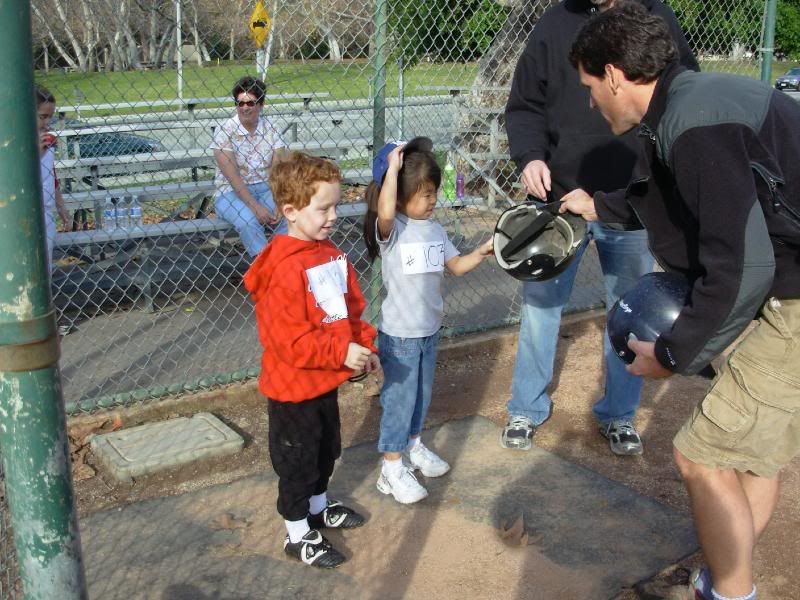
After waiting nervously on the dugout bench, Michael is on deck, getting his helmet:
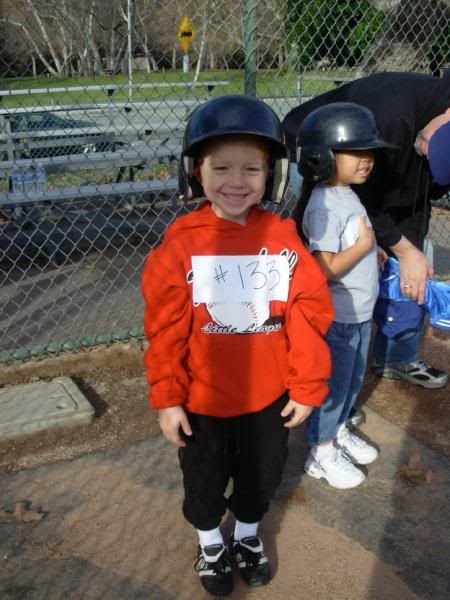
Ready to step to the plate:
Now batting, Michael!

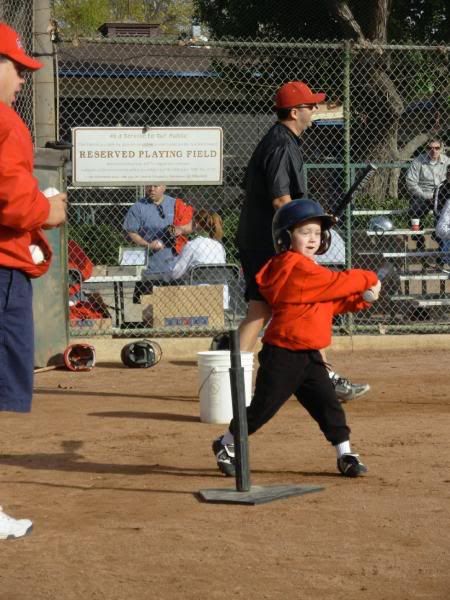
A couple of action shots. Good follow through:
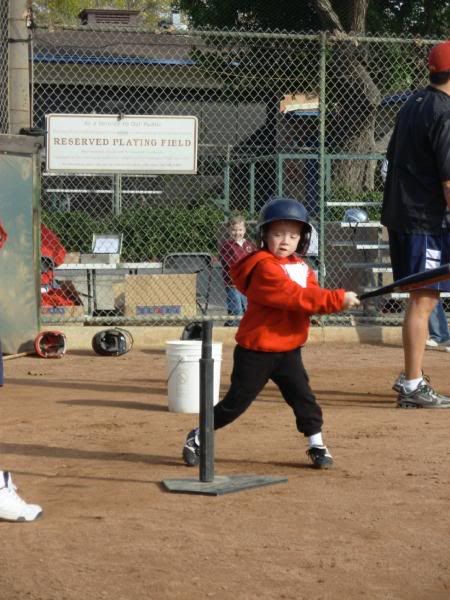
Keeping an eye on the ball (or where it just was):
Running to first:
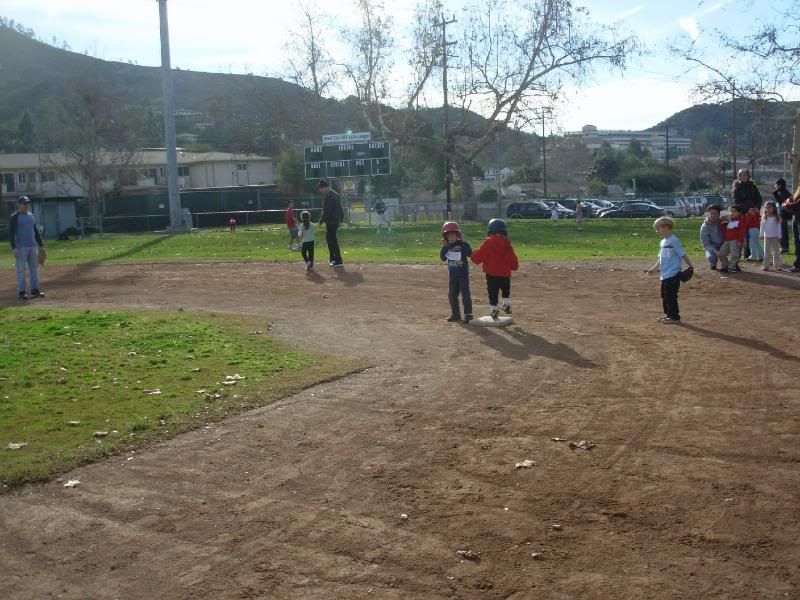
Getting into fielding position:
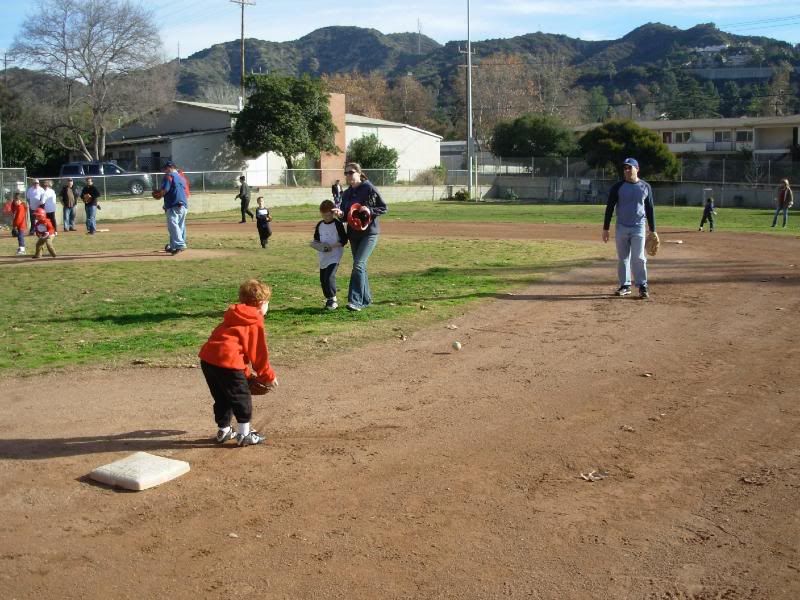
Playing catch:
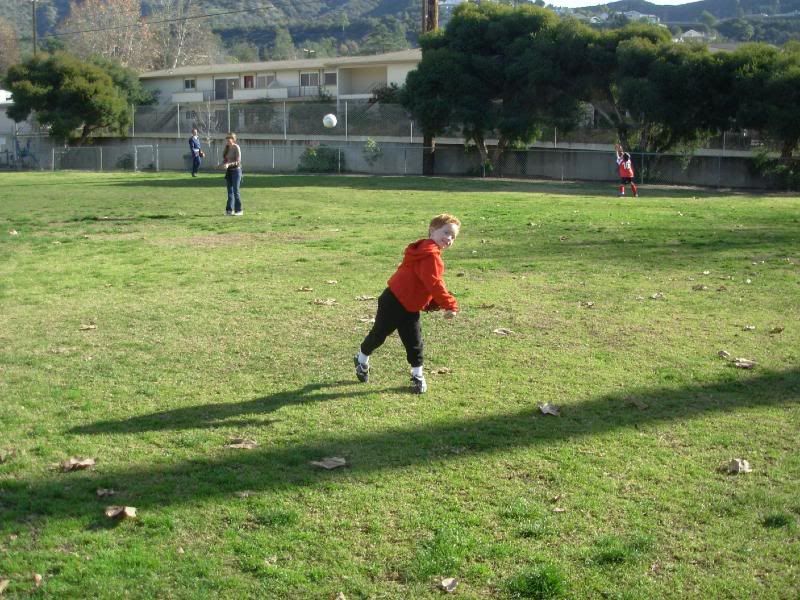
Tryouts for the T-Ball kids were this morning. There is something great about showing up at a baseball field, mitt and ball in hand, tossing the ball back and forth with a bunch of other little boys and girls and their parents. The diversity in skill was broad, as could be expected. There were kids who shied away from the ball and threw it like a shot put. Inevitably, there was also the kid who showed up in proper uniform pants, with a big glove, big arm and big dad. Just as inevitably, the same kid could hardly get the ball off the tee. (Okay, I'm going to try real hard not to be a typical Little League parent, but that gave me a little satisfaction.)
The tryout was pretty simple. Hit the ball three or four times off the tee, run to first, then field a rolled ball from a coach and throw it back. I worked with Michael on the throwing and catching, and his Grandpa has been working on his hitting for weeks. Grandpa wins the prize. There were several kids who struck the ball with authority, and Michael was one of those. He hit the ball very well, fielded well, and threw the ball accurately to the coach. (Trying to remember that bit about not being the typical Little League parent...)
We stayed around a while for more throwing, which gave me a chance to show Michael where all the positions were from the perspective of the field level. It was a very fun morning for father and son.
Some pictures:
After waiting nervously on the dugout bench, Michael is on deck, getting his helmet:
Ready to step to the plate:
Now batting, Michael!
A couple of action shots. Good follow through:
Keeping an eye on the ball (or where it just was):
Running to first:
Getting into fielding position:
Playing catch:
Friday, January 11, 2008
Adventures in Flight
You may have heard that those of us out here on the left coast had a bit of a rain shower last week. As it happened, the deluge that blanketed the Bay Area beginning in the early morning hours and extending all day worked its way south down the state by the evening hours. My usual Friday evening travels, unfortunately, tracked precisely the areas of the heaviest impact of the storm.
The daytime hours, such as they were, revealed a very intense, very wet storm with high winds that made for fascinating viewing from the comfort of our office windows. It was as dark at 9:30 in the morning as it had been at seven previous evening. Fortunately, unlike the San Francisco airport, the Oakland airport rarely suffers systematic weather delays. In fact, we boarded our flight on time, although a snafu with baggage handling caused us to push back from the gate unexpectedly late. Nevertheless, we got off the ground with a minimum of hassle. For one of the few times in my many flights over the past four months, the flight was only half full, so the accommodations were not uncomfortable. (And we had honey roasted peanuts! Two packs!)
As expected, and as we had been warned by the pilot, the flight was rough the entire way to Southern California. The flight was generally bumpy, with two major drops in elevation, the kind that will ram you into the overhead bin if you're not wearing your seatbelt. The bucking grew worse as we began our approach for landing, because the focal point of the storm had found its way to the San Fernando Valley, precisely where we were trying to land. Seeing nothing out the window but rain streaming by, as the plane bucked and slewed, the overwhelming sensation was of being in a car that was traveling down a rough road too fast. I could imagine myself saying "hey, slow down, pal.” As soon as those sorts of thoughts enter your head, you begin to really wish that the plane would slow down. Of course, you can't do that when you are 8000 feet in the air, so you somehow have to find a way to resign yourself to the fact that it's just going to be a bumpy and slightly scary ride to the ground.
The lower we got the more unstable our ride became. The most difficult part of landing under these kinds of circumstances is that it is impossible to see anything out the windows. The sensation of flying through a cloud knowing that you are intentionally headed toward the ground, when the sensation of speed is enhanced by the bumpyness of the ride, is not something that even a frequent flyer like me truly enjoys. Nevertheless, it was nearly over.
As we approached the airfield, in an act of whistling past the (aviation) graveyard, I allowed myself to daydream about what could happen if something went wrong with our landing. I cheerfully imagined my blog post about how I've done something none of you have: I've survived an airplane crash! I recalled a Southwest jet that had skidded off the same runway in a similarly torrential storm in March 2000. Back then, however, there was a gas station across the street just past the end of the runway. There also was not a special runaway airplane safety device installed at the end of the runway that has been installed since then and successfully used. I figured that in a worst-case scenario, we would take too long to slow down, hit the safety device (which would do nothing more than simply slow the airplane as if we had driven into sand), then we would all be celebrities on the evening news, and I could have a first hand, eyewitness blog account of the adventure. It was a morbid variation on my usual Walter Mitty fantasy, in which I successfully take over the controls of the aircraft from the mysteriously stricken crew and land the airplane to great acclaim, but it gave me something to think about other than my increasing sense of nausea.
There comes a point in every flight, as the pilot flairs the plane by pulling the nose up and cutting the engines just before touchdown, that everything becomes still. So it was for us last Friday. We finally dropped below the cloud just before the beginning of the runway. Still yawning and rolling a bit, we passed over the yard that houses dozens of yellow school buses, the road that passes just beyond the airfield, and finally caught sight of the little blue lights that outline the runway. Having concluded recently that I don't enjoy watching the landing from the very last row of airplane, I turned my gaze inward and waited for touchdown. As expected, the engines went nearly silent, the nose came up, and calm descended over the cabin that had been bouncing for the past hour.
It was calm.
It stayed calm.
Hold on. Calm is nice, but shouldn't we have been jolted by a heavy touchdown by now? In fact, shouldn't we have connected with the runway couple of seconds ago? The aircraft felt like someone descending a ladder who is feeling with his toes for the ground below the lowest wrong. Reaching, reaching...
... and not touching the ground. Uh oh.
Just as I was processing all of this information, and the sense of panic that I had managed to keep tamped down surged to the surface, the engines roared, the airplane pitched back, and we headed into the sky again. The pilot had executed a perfect aborted landing, which is a small comfort when you are a passenger in an airplane in a heavy rainstorm attempting to land at an airport in a congested urban area that has a very short runway. (Sometimes too much knowledge is a dangerous thing.) Because I was not looking out the window at the time, I do not know how far down the runway we were when we powered back up and pulled out. I'm glad of that. We were also back up into the clouds so fast that I did not have a chance to see how close we were to the various houses, businesses, and mountains that lie off the end of the runway and which are rarely under any flight path. Again, I'm glad of that. The other downside to an aborted landing is that you have to go through the same white knuckle ride all over again, this time with the knowledge that it is possible to fail to land.
The captain advised us that there had been a wind problem at the time we attempted to land. That seems reasonable, and it would not surprise me if they suddenly gust of wind caused the airplane to generate too much lift at exactly the wrong moment, preventing it from touching down. The captain sped us back to the end of the valley and then executed an extremely sharp turn over the beginning of the glide path back into the Burbank Airport. I put the odds on a very hard, very certain landing at nearly 1:1. However, thankfully, we executed what was actually a very normal touchdown, more smooth than many I've had there.
Statistically, given how many flights I've taken over the past four months, I suppose it is inevitable that I would experience a variety of unusual events. I've experienced a flyby before, but that one was in broad daylight at the San Jose Airport, which is much larger than the Burbank Airport. A missed landing at night, in a major rainstorm, and a small airport, after a stormy flight, is one that will leave one's legs weak for quite a while afterwards.
To add insult to injury, of course, it was raining cats and dogs at the airport. Burbank does not afford its customers the luxury of jet waves, so in the twenty second walk from the airplane door to the door of the terminal, I was thoroughly soaked by the rain. Not only did I look like someone who'd had a very bad night as I walked down the terminal, I felt like it, too.
Okay, time to catch my next flight!
The daytime hours, such as they were, revealed a very intense, very wet storm with high winds that made for fascinating viewing from the comfort of our office windows. It was as dark at 9:30 in the morning as it had been at seven previous evening. Fortunately, unlike the San Francisco airport, the Oakland airport rarely suffers systematic weather delays. In fact, we boarded our flight on time, although a snafu with baggage handling caused us to push back from the gate unexpectedly late. Nevertheless, we got off the ground with a minimum of hassle. For one of the few times in my many flights over the past four months, the flight was only half full, so the accommodations were not uncomfortable. (And we had honey roasted peanuts! Two packs!)
As expected, and as we had been warned by the pilot, the flight was rough the entire way to Southern California. The flight was generally bumpy, with two major drops in elevation, the kind that will ram you into the overhead bin if you're not wearing your seatbelt. The bucking grew worse as we began our approach for landing, because the focal point of the storm had found its way to the San Fernando Valley, precisely where we were trying to land. Seeing nothing out the window but rain streaming by, as the plane bucked and slewed, the overwhelming sensation was of being in a car that was traveling down a rough road too fast. I could imagine myself saying "hey, slow down, pal.” As soon as those sorts of thoughts enter your head, you begin to really wish that the plane would slow down. Of course, you can't do that when you are 8000 feet in the air, so you somehow have to find a way to resign yourself to the fact that it's just going to be a bumpy and slightly scary ride to the ground.
The lower we got the more unstable our ride became. The most difficult part of landing under these kinds of circumstances is that it is impossible to see anything out the windows. The sensation of flying through a cloud knowing that you are intentionally headed toward the ground, when the sensation of speed is enhanced by the bumpyness of the ride, is not something that even a frequent flyer like me truly enjoys. Nevertheless, it was nearly over.
As we approached the airfield, in an act of whistling past the (aviation) graveyard, I allowed myself to daydream about what could happen if something went wrong with our landing. I cheerfully imagined my blog post about how I've done something none of you have: I've survived an airplane crash! I recalled a Southwest jet that had skidded off the same runway in a similarly torrential storm in March 2000. Back then, however, there was a gas station across the street just past the end of the runway. There also was not a special runaway airplane safety device installed at the end of the runway that has been installed since then and successfully used. I figured that in a worst-case scenario, we would take too long to slow down, hit the safety device (which would do nothing more than simply slow the airplane as if we had driven into sand), then we would all be celebrities on the evening news, and I could have a first hand, eyewitness blog account of the adventure. It was a morbid variation on my usual Walter Mitty fantasy, in which I successfully take over the controls of the aircraft from the mysteriously stricken crew and land the airplane to great acclaim, but it gave me something to think about other than my increasing sense of nausea.
There comes a point in every flight, as the pilot flairs the plane by pulling the nose up and cutting the engines just before touchdown, that everything becomes still. So it was for us last Friday. We finally dropped below the cloud just before the beginning of the runway. Still yawning and rolling a bit, we passed over the yard that houses dozens of yellow school buses, the road that passes just beyond the airfield, and finally caught sight of the little blue lights that outline the runway. Having concluded recently that I don't enjoy watching the landing from the very last row of airplane, I turned my gaze inward and waited for touchdown. As expected, the engines went nearly silent, the nose came up, and calm descended over the cabin that had been bouncing for the past hour.
It was calm.
It stayed calm.
Hold on. Calm is nice, but shouldn't we have been jolted by a heavy touchdown by now? In fact, shouldn't we have connected with the runway couple of seconds ago? The aircraft felt like someone descending a ladder who is feeling with his toes for the ground below the lowest wrong. Reaching, reaching...
... and not touching the ground. Uh oh.
Just as I was processing all of this information, and the sense of panic that I had managed to keep tamped down surged to the surface, the engines roared, the airplane pitched back, and we headed into the sky again. The pilot had executed a perfect aborted landing, which is a small comfort when you are a passenger in an airplane in a heavy rainstorm attempting to land at an airport in a congested urban area that has a very short runway. (Sometimes too much knowledge is a dangerous thing.) Because I was not looking out the window at the time, I do not know how far down the runway we were when we powered back up and pulled out. I'm glad of that. We were also back up into the clouds so fast that I did not have a chance to see how close we were to the various houses, businesses, and mountains that lie off the end of the runway and which are rarely under any flight path. Again, I'm glad of that. The other downside to an aborted landing is that you have to go through the same white knuckle ride all over again, this time with the knowledge that it is possible to fail to land.
The captain advised us that there had been a wind problem at the time we attempted to land. That seems reasonable, and it would not surprise me if they suddenly gust of wind caused the airplane to generate too much lift at exactly the wrong moment, preventing it from touching down. The captain sped us back to the end of the valley and then executed an extremely sharp turn over the beginning of the glide path back into the Burbank Airport. I put the odds on a very hard, very certain landing at nearly 1:1. However, thankfully, we executed what was actually a very normal touchdown, more smooth than many I've had there.
Statistically, given how many flights I've taken over the past four months, I suppose it is inevitable that I would experience a variety of unusual events. I've experienced a flyby before, but that one was in broad daylight at the San Jose Airport, which is much larger than the Burbank Airport. A missed landing at night, in a major rainstorm, and a small airport, after a stormy flight, is one that will leave one's legs weak for quite a while afterwards.
To add insult to injury, of course, it was raining cats and dogs at the airport. Burbank does not afford its customers the luxury of jet waves, so in the twenty second walk from the airplane door to the door of the terminal, I was thoroughly soaked by the rain. Not only did I look like someone who'd had a very bad night as I walked down the terminal, I felt like it, too.
Okay, time to catch my next flight!
Wednesday, January 09, 2008
Final Jailbreak News
A Tool for the Apathetic
Constitutional law is fascinating. Government is intriguing. But politics leaves me cold. I typically approach big election seasons with dread, because, until I absolutely have to decide, I have little to offer to the "who you gonna vote for" discussion. Get back to me after I've had a chance to study the issues and the candidates' stance on them, which will be about half an hour before I step into the voting booth.
Thanks to the magic of the interwebs, however, even the most campaign-averse among us can discover what we really think without even working hard. USA Today has a handy little 11-step quiz that will tell you exactly who you should vote for (note that the categories can be weighted to match your preferences).
Ah, voting without the messy, tedious necessity of thinking. Every day, technology truly is making our lives better.
Thanks to the magic of the interwebs, however, even the most campaign-averse among us can discover what we really think without even working hard. USA Today has a handy little 11-step quiz that will tell you exactly who you should vote for (note that the categories can be weighted to match your preferences).
Ah, voting without the messy, tedious necessity of thinking. Every day, technology truly is making our lives better.
Wednesday, January 02, 2008
Post-Holiday Wrapup
The blog vacation is over; time to go back to work.
I have had the pleasure of spending nearly the last two weeks at home. I enjoyed two Christmas celebrations and two New Years celebrations (the one on East Coast time being by far the more spirited of the two). We went to two movies. We had lunch at a Japanese restaurant. I watched some football, and a lot of soccer (Boxing Day is a big one for English football). I sang in church for the first time in four months, and assisted in the construction of numerous Lego creations. Pictures will be forthcoming -- this Lego stuff is pretty remarkable.
There is something about working far from home that lends an aimless quality to time spend at home. I can't possibly go into the office, and because we are keeping the house prepped for sale (someday ...), the yardwork and even some of the regular deep cleaning are handled by other people. I am left with not much more to do but play with the kids when they are not otherwise glued to the computer. That's not such a bad deal.
Here's hoping there will be even a tiny bit of positive news about the real estate market at 2008 dawns. December is usually the worst month for home sales anyway, so we hope that sales figures will start to tick upward soon. People are very sensitized to the news reports, so we just need a little good news to get some of the looky-loos off the fence and into negotiations. The sooner we can be done with people who object to the supposed lack of a yard (as if it were our fault), the better.
I have had the pleasure of spending nearly the last two weeks at home. I enjoyed two Christmas celebrations and two New Years celebrations (the one on East Coast time being by far the more spirited of the two). We went to two movies. We had lunch at a Japanese restaurant. I watched some football, and a lot of soccer (Boxing Day is a big one for English football). I sang in church for the first time in four months, and assisted in the construction of numerous Lego creations. Pictures will be forthcoming -- this Lego stuff is pretty remarkable.
There is something about working far from home that lends an aimless quality to time spend at home. I can't possibly go into the office, and because we are keeping the house prepped for sale (someday ...), the yardwork and even some of the regular deep cleaning are handled by other people. I am left with not much more to do but play with the kids when they are not otherwise glued to the computer. That's not such a bad deal.
Here's hoping there will be even a tiny bit of positive news about the real estate market at 2008 dawns. December is usually the worst month for home sales anyway, so we hope that sales figures will start to tick upward soon. People are very sensitized to the news reports, so we just need a little good news to get some of the looky-loos off the fence and into negotiations. The sooner we can be done with people who object to the supposed lack of a yard (as if it were our fault), the better.
Sad Coda to Jailbreak
Following up the last post: the prison guard who received a taunting note from prisoners who escaped by concealing the hole in the wall with posters has killed himself.
Oddly, this development continues the parallels with "The Shawshank Redemption," which also included a suicide by a prison official after the breakout. The motivations were, I presume, different, but the outcome was eerily the same.
Oddly, this development continues the parallels with "The Shawshank Redemption," which also included a suicide by a prison official after the breakout. The motivations were, I presume, different, but the outcome was eerily the same.
Subscribe to:
Comments (Atom)