Tuesday, March 30, 2010
A Job for the Most Interesting Man in the World
If you always wanted to be a pilot but were put off by the bus-driver mentality ... if you always wanted to be an international spy ... if you always wanted to be a thief ... there is a job for you: airliner repo man. I would happily listen to these guys tell war stories all day.


Monday, March 29, 2010
Chinese Volvo
We spent the evening watching a news program on CCTV International, a Chinese-based television network. The perspective on world events was much broader than anything you would see on a domestic US broadcast, or even CNN. The news broadcast, headed by an Englishman but run and reported by Chinese nationals, was followed by a three-man panel discussion show in which the host and his guests discussed the acquisition by Geely Automobile of Volvo. Largely unnoticed in America, Volvo became a Chinese company on Sunday (the deal will close in the third quarter).
If the television host's reaction is any indication, the Chinese view of the takeover of Volvo is that China has stepped up onto the world's automotive stage in a big way. China is now the largest automobile market in the world, and is eager to start making cars that the rest of the world also might want to buy. Chinese designs are famously derivative, to put it politely, and are notoriously poorly designed and built. The acquisition of Volvo, in Chinese view, will go far in raising the stature of the Chinese auto industry. Volvo is viewed as a luxury brand known for safety and quality, even though its products are not very well known yet within China itself. Geely, which is not a very prominent domestic maker, is seen as learning a great deal from Volvo's technology while enjoying the halo effect of the worldly Volvo name.
In fact, commentators believe one of the most important tasks for Geely will be to avoid damaging the Volvo brand. Unfortunately, to Westerners, this may be a nearly impossible task. Many car enthusiasts I am in contact with are deeply suspicious of Chinese carmakers, and believe that Volvo will suffer both in reputation and in actual product development. It will not surprise me at all if Volvo's sales in the U.S. fall precipitously in the next few years. Volvo not only faces the prospect of assuring American customers that Chinese ownership will not adversely affect its design and construction capabilities, but the sale by Ford and business losses over the last couple of years have delayed product development. For instance, the XC90 should have debuted a redesign this year; instead, it has received only minor cosmetic updates. The redesign has been pushed off a few years, which by the time it arrives will be years behind its competitors. This may do as much damage to the Volvo brand as fears about Chinese design and manufacturing prowess.
Even though Volvo will purportedly retain its Swedish management, the Chinese commentators speak of the buying power of the huge Chinese market causing the Volvo product line to change to favor smaller, more economic cars to suit the Chinese market, rather than the larger, luxurious models that have defined the brand for years. In this flexing of the muscle by the Chinese domestic market can be heard not just a potential makeover of the Volvo brand but the coming dominance of the Chinese economy.
If the television host's reaction is any indication, the Chinese view of the takeover of Volvo is that China has stepped up onto the world's automotive stage in a big way. China is now the largest automobile market in the world, and is eager to start making cars that the rest of the world also might want to buy. Chinese designs are famously derivative, to put it politely, and are notoriously poorly designed and built. The acquisition of Volvo, in Chinese view, will go far in raising the stature of the Chinese auto industry. Volvo is viewed as a luxury brand known for safety and quality, even though its products are not very well known yet within China itself. Geely, which is not a very prominent domestic maker, is seen as learning a great deal from Volvo's technology while enjoying the halo effect of the worldly Volvo name.
In fact, commentators believe one of the most important tasks for Geely will be to avoid damaging the Volvo brand. Unfortunately, to Westerners, this may be a nearly impossible task. Many car enthusiasts I am in contact with are deeply suspicious of Chinese carmakers, and believe that Volvo will suffer both in reputation and in actual product development. It will not surprise me at all if Volvo's sales in the U.S. fall precipitously in the next few years. Volvo not only faces the prospect of assuring American customers that Chinese ownership will not adversely affect its design and construction capabilities, but the sale by Ford and business losses over the last couple of years have delayed product development. For instance, the XC90 should have debuted a redesign this year; instead, it has received only minor cosmetic updates. The redesign has been pushed off a few years, which by the time it arrives will be years behind its competitors. This may do as much damage to the Volvo brand as fears about Chinese design and manufacturing prowess.
Even though Volvo will purportedly retain its Swedish management, the Chinese commentators speak of the buying power of the huge Chinese market causing the Volvo product line to change to favor smaller, more economic cars to suit the Chinese market, rather than the larger, luxurious models that have defined the brand for years. In this flexing of the muscle by the Chinese domestic market can be heard not just a potential makeover of the Volvo brand but the coming dominance of the Chinese economy.
Sunday, March 28, 2010
Saturday Sports Highlights
The kids are well into their sports seasons now.
After one practice and one practice game (which her "Penn State" team won), Kelly's volleyball team is now 2-0 for the season. The difference in quality of play between sixth grade and seventh/eighth grade is dramatic. It helps that Kelly's coach drafted a team of girls who all have good basic skills, but throughout the league, bump-set-spike is much closer to reality than it ever was last year. Kelly has proven to be a reliable, contributing member of the team, with a surprisingly effective underhand serve, solid passing skills, and an ability to set the ball wherever it is needed. She also saved a key point this weekend with an outstretched left hand that was pure instinct, coupled with some skill and court awareness.
For the record, Penn State beat St. Mary's 2-1 in the first week, coming from behind to win the first game. This week, Penn State beat USC 2-0, after again falling way behind in the first game only to roar back to win 25-22.
Scenes from the practice game against Pepperdine:


Michael's baseball team is off to a good start. You never know how good you are until you get in the arena with someone else who has the same goal. As an unofficial assistant coach, I have been to most of the practices from the beginning, and have been witness to the many, many drills devoted to the simple act of catching and throwing the ball. That basic skill was a challenge to much of our team in the early practices. The rainy weather that forced us to play on the blacktop probably did us a favor, as all we could do was stick to basic skill practices rather than get ahead of ourselves with baseball drills.
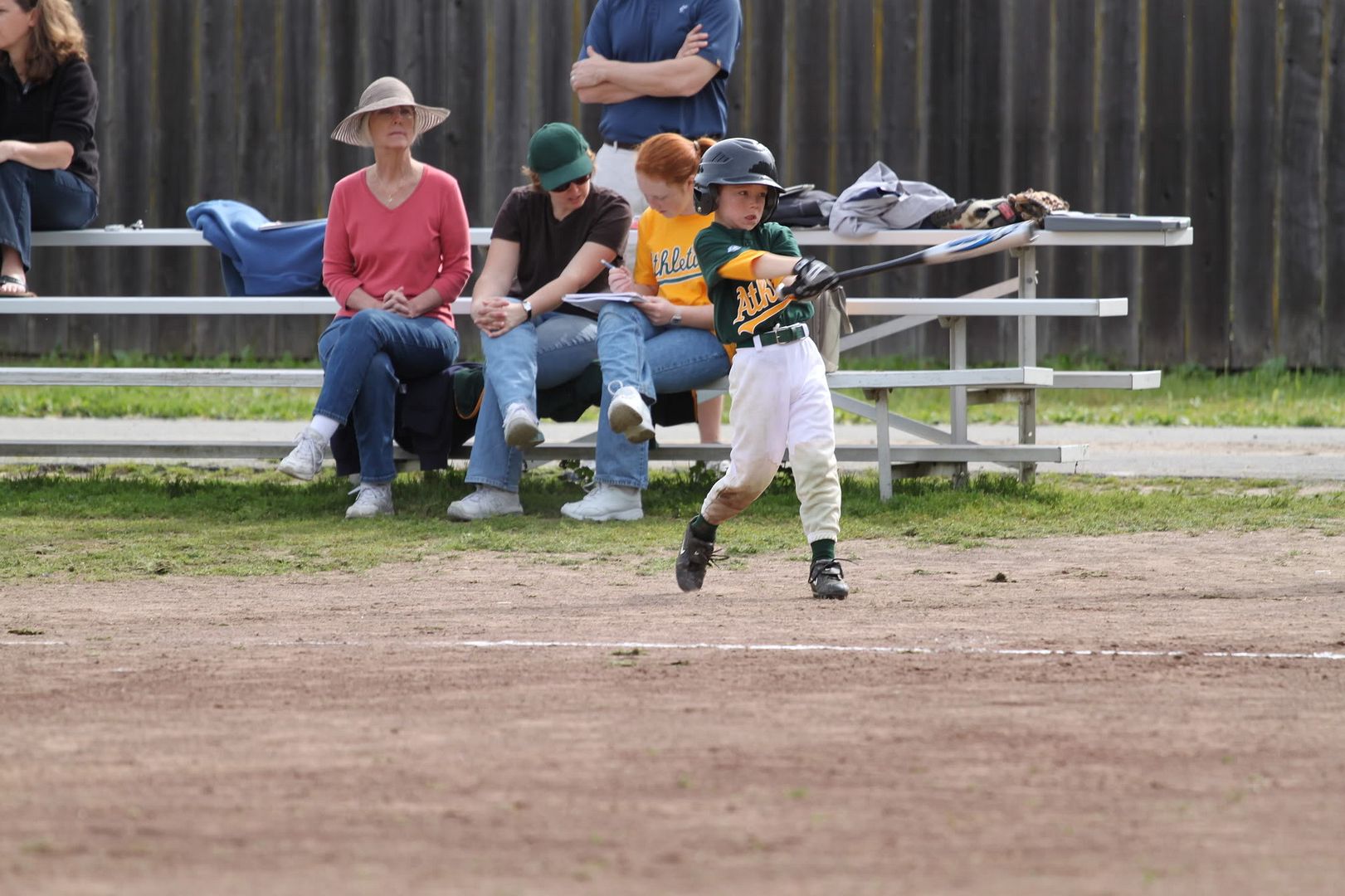
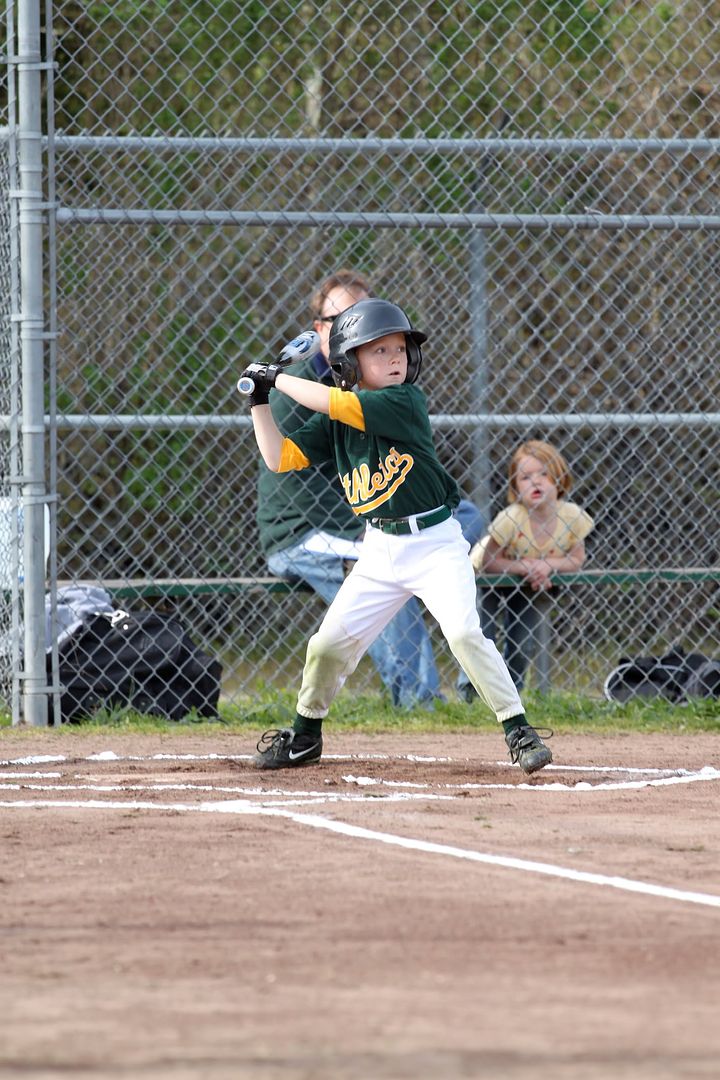
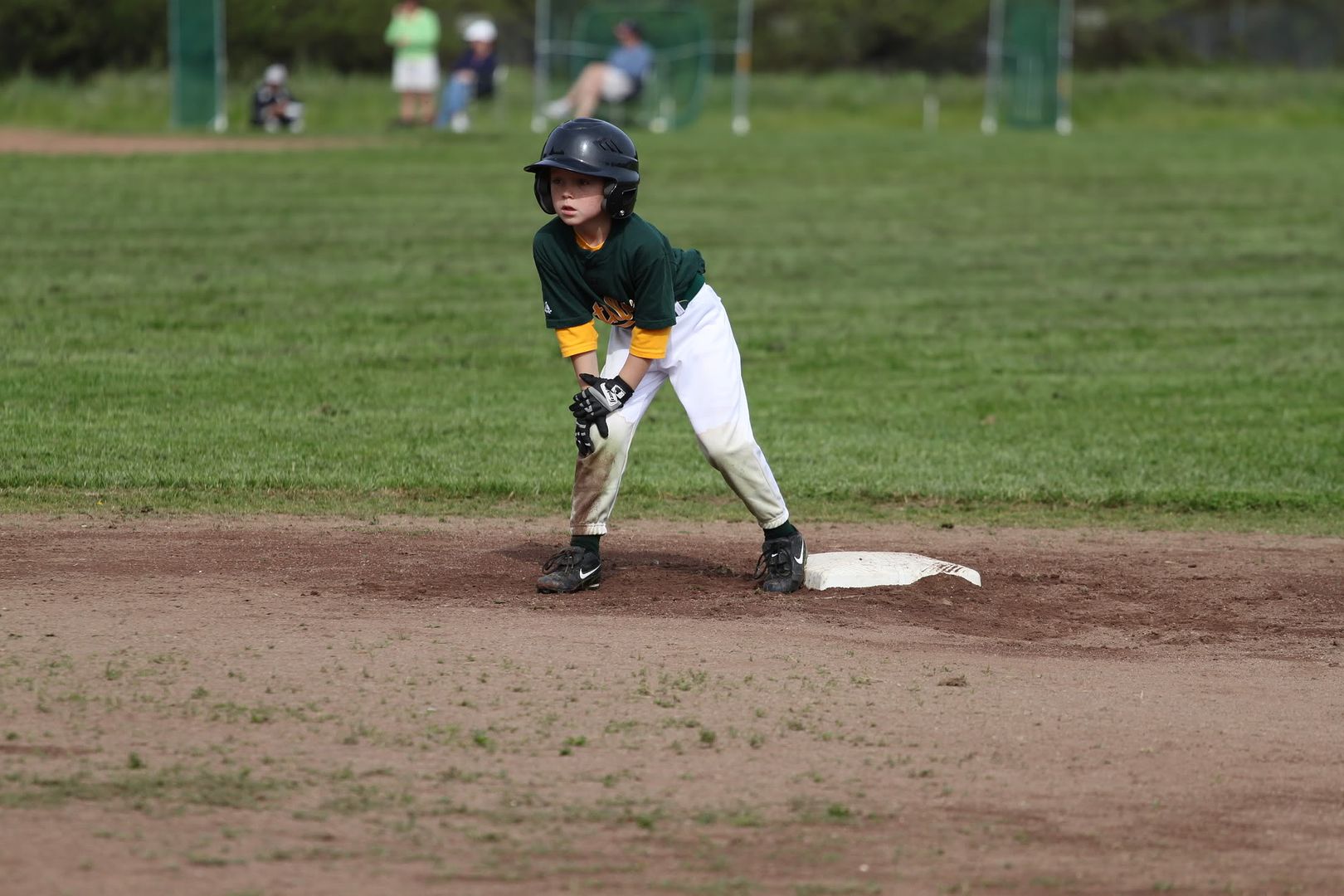
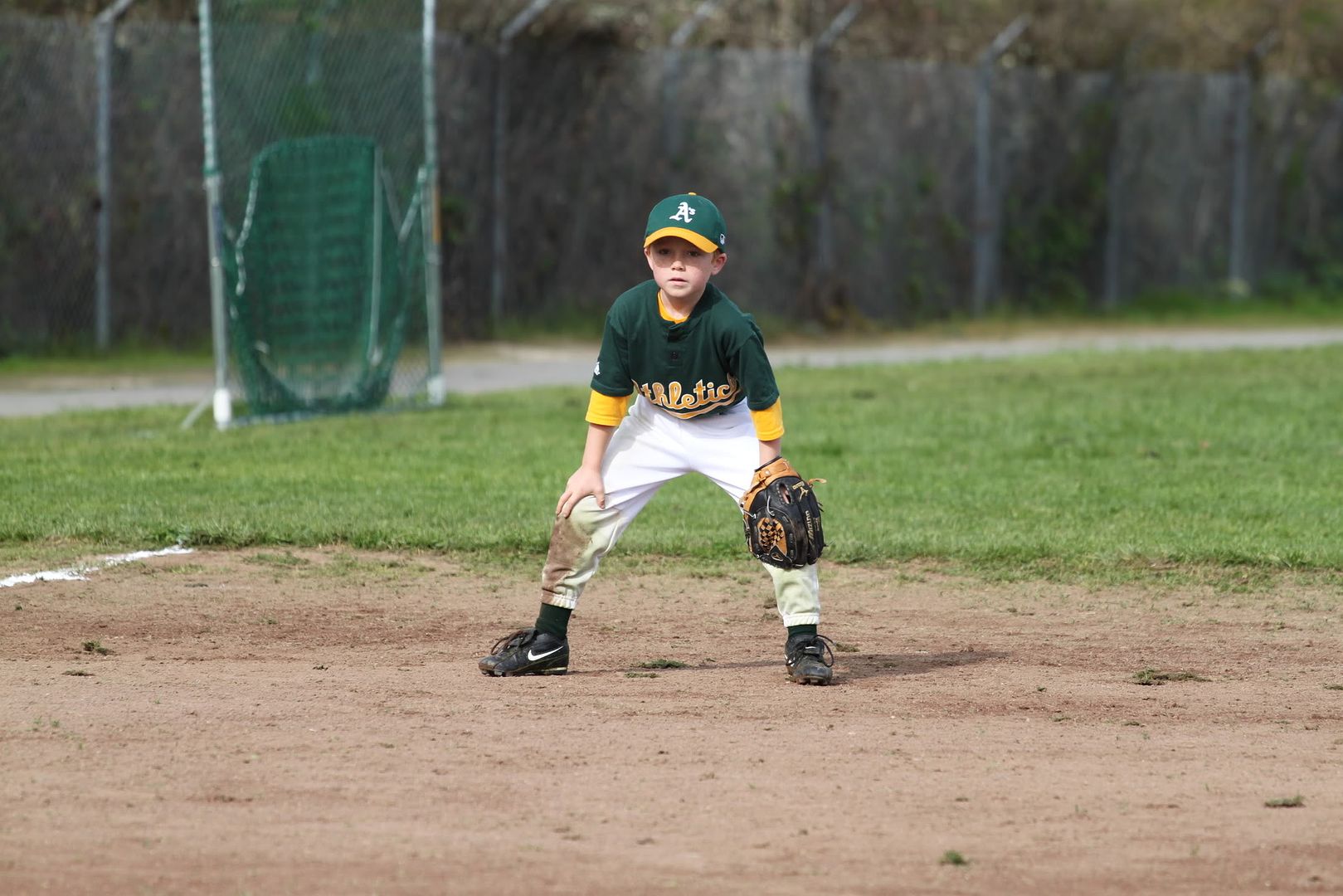
The A's prevailed over the Red Sox 17-5 in the first week, and beat the Orioles 12-4 in the second game, with a rainout in between. Yesterday, the A's obliterated the Yankees 22-2. The game was notable for several things. The least surprising development, based on our practices, was that our bats woke up in a big way. Considering that teams are limited to five runs per inning, and that the A's only batted five times because they were the home team (and did not bat in the bottom of the last inning because of the lead), we scored 22 out of a possible 25 available runs. Michael is not a big hitter, but he hits the ball sharply. He went 4-for-4, with three runs scored and three runs batted in. More significantly, this game confirmed what we were beginning to suspect, that all the work we have done on basic defense is paying off. The A's have given up far fewer runs than any team in the league, and our boys made a bunch of solid defensive plays. The one play that none of us expected to ever see was a triple play. Michael started it by catching a line drive from the pitcher position. He threw to first to double off the runner, then our first baseman (our best player) threw a dart across the diamond to third base to catch the runner leaving from third. That one play showed both skill and smarts by several different players.
Our comeuppance will arrive at some point during the season, but for now, the boys are really showing progress. There is something exceptionally pleasing about watching the boys take infield grounders adeptly and make throws smoothly, and even line up cutoff throws accurately, as they did at practice this afternoon, things that only our best few players could do with any alacrity at the beginning of the season. What matters most of all is when Michael declares on the way home from practice, as he did today, "I love baseball!" As long as he keeps saying that, all the work will be worth it.
Warming up:
The pitch is on its way:
Ready to run:
Manning the hot corner:
After one practice and one practice game (which her "Penn State" team won), Kelly's volleyball team is now 2-0 for the season. The difference in quality of play between sixth grade and seventh/eighth grade is dramatic. It helps that Kelly's coach drafted a team of girls who all have good basic skills, but throughout the league, bump-set-spike is much closer to reality than it ever was last year. Kelly has proven to be a reliable, contributing member of the team, with a surprisingly effective underhand serve, solid passing skills, and an ability to set the ball wherever it is needed. She also saved a key point this weekend with an outstretched left hand that was pure instinct, coupled with some skill and court awareness.
For the record, Penn State beat St. Mary's 2-1 in the first week, coming from behind to win the first game. This week, Penn State beat USC 2-0, after again falling way behind in the first game only to roar back to win 25-22.
Scenes from the practice game against Pepperdine:
Michael's baseball team is off to a good start. You never know how good you are until you get in the arena with someone else who has the same goal. As an unofficial assistant coach, I have been to most of the practices from the beginning, and have been witness to the many, many drills devoted to the simple act of catching and throwing the ball. That basic skill was a challenge to much of our team in the early practices. The rainy weather that forced us to play on the blacktop probably did us a favor, as all we could do was stick to basic skill practices rather than get ahead of ourselves with baseball drills.
The A's prevailed over the Red Sox 17-5 in the first week, and beat the Orioles 12-4 in the second game, with a rainout in between. Yesterday, the A's obliterated the Yankees 22-2. The game was notable for several things. The least surprising development, based on our practices, was that our bats woke up in a big way. Considering that teams are limited to five runs per inning, and that the A's only batted five times because they were the home team (and did not bat in the bottom of the last inning because of the lead), we scored 22 out of a possible 25 available runs. Michael is not a big hitter, but he hits the ball sharply. He went 4-for-4, with three runs scored and three runs batted in. More significantly, this game confirmed what we were beginning to suspect, that all the work we have done on basic defense is paying off. The A's have given up far fewer runs than any team in the league, and our boys made a bunch of solid defensive plays. The one play that none of us expected to ever see was a triple play. Michael started it by catching a line drive from the pitcher position. He threw to first to double off the runner, then our first baseman (our best player) threw a dart across the diamond to third base to catch the runner leaving from third. That one play showed both skill and smarts by several different players.
Our comeuppance will arrive at some point during the season, but for now, the boys are really showing progress. There is something exceptionally pleasing about watching the boys take infield grounders adeptly and make throws smoothly, and even line up cutoff throws accurately, as they did at practice this afternoon, things that only our best few players could do with any alacrity at the beginning of the season. What matters most of all is when Michael declares on the way home from practice, as he did today, "I love baseball!" As long as he keeps saying that, all the work will be worth it.
Warming up:
The pitch is on its way:
Ready to run:
Manning the hot corner:
Wednesday, March 24, 2010
Gaels Country
The attention that the St. Mary's basketball team has brought to itself by its run to the Sweet 16 round of the NCAA tournament reminds me of why I enjoy college basketball. Little else in the sports world compares to the intense national focus the tournament can bring to schools that would not otherwise garner notice. The unexpected triumph of David over Goliath, when the whole sports world is watching, is a good time, guaranteed. When it happens to a college with an enrollment of 3,500 in a town of 15,000 people, it's a great time. Moraga is abuzz about the Gaels (as much as this laid back town can abuzz about anything), and St. Mary's success has taken the sting out of the failure of the much larger local favorite, Cal, to advance in the tournament.
Click here for video of the team receiving a hero's welcome upon its return to campus in Moraga earlier this week after its memorable, two-win weekend in Providence. (Here is another nice article about the team coming home.) In the video, it is the slightly bashful look on the faces of the first players off the bus that reminds us that these are still boys playing a game. Overnight, their world has changed. For most of them, these two weeks will be the high point of their sporting lives. For one of them (center Omar Samhan, the gregarious kid at the end of the video), a future as a professional athlete that was a laughable thought a week ago may now be a possibility.
Samhan is living everything that is right about this team. He grew up locally, he is outgoing and funny and clearly enjoying everything about this improbable run in the national spotlight, and he is a senior with loads of game experience. Four years of collegiate practices and games have given him moves on the basketball floor that few big men in the college game can match.
(It is so rare for a top player to stay in school that teams with talented seniors can surprise the best teams that are stocked only with underclassmen. Samhan has developed skills in four years that gave him a tremendous advantage over his opposition in the first two rounds of the NCAA tournament. No matter how much high school and AAU ball a top recruit has played before getting to college, talent can only take a player so far against a player who has been through thousands of hours of practice and games at the collegiate level. Cornell, for example, an even more improbable Sweet 16 participant than St. Mary's, relies heavily on smart, experienced upperclassmen.)
Now that St. Mary's is no longer a secret, other teams may neutralize Samhan and clamp down on the Gaels' outside shooters. Even if Baylor (or Duke) sends St. Mary's home, it will take up residence as a happy footnote to this year's tournament.
St. Mary's plays at 7:30 Eastern on Friday. Tune in to see a bunch of guys playing the game well, with joy.
Click here for video of the team receiving a hero's welcome upon its return to campus in Moraga earlier this week after its memorable, two-win weekend in Providence. (Here is another nice article about the team coming home.) In the video, it is the slightly bashful look on the faces of the first players off the bus that reminds us that these are still boys playing a game. Overnight, their world has changed. For most of them, these two weeks will be the high point of their sporting lives. For one of them (center Omar Samhan, the gregarious kid at the end of the video), a future as a professional athlete that was a laughable thought a week ago may now be a possibility.
Samhan is living everything that is right about this team. He grew up locally, he is outgoing and funny and clearly enjoying everything about this improbable run in the national spotlight, and he is a senior with loads of game experience. Four years of collegiate practices and games have given him moves on the basketball floor that few big men in the college game can match.
(It is so rare for a top player to stay in school that teams with talented seniors can surprise the best teams that are stocked only with underclassmen. Samhan has developed skills in four years that gave him a tremendous advantage over his opposition in the first two rounds of the NCAA tournament. No matter how much high school and AAU ball a top recruit has played before getting to college, talent can only take a player so far against a player who has been through thousands of hours of practice and games at the collegiate level. Cornell, for example, an even more improbable Sweet 16 participant than St. Mary's, relies heavily on smart, experienced upperclassmen.)
Now that St. Mary's is no longer a secret, other teams may neutralize Samhan and clamp down on the Gaels' outside shooters. Even if Baylor (or Duke) sends St. Mary's home, it will take up residence as a happy footnote to this year's tournament.
St. Mary's plays at 7:30 Eastern on Friday. Tune in to see a bunch of guys playing the game well, with joy.
Thursday, March 18, 2010
Giving
One of the unique features of our area is the very sharp delineation between prosperity and poverty. Our three little contiguous communities (Orinda, Lafayette and Moraga) together comprise a tranquil valley of moderate affluence, with Orinda on the high side, Moraga on the low (relatively speaking) and Lafayette somewhere in between. Just on the other side of the hills that shelter Moraga and Orinda lies Oakland, one of the most notoriously poor and crime-ridden metropolitan areas in the country. In truth, there are many nice areas of Oakland, but the majority of the city is governed by gangs and struggles to rise above the material and spiritual poverty that the criminality of the gang culture cultivates.
Those who live in the so-called Lamorinda area are very self-aware of the stark disparity in living conditions between the two areas that are only separated by a one mile long tunnel. There are many readily available opportunities for people of greater means and available time on the east side of the hill to serve those on the west side of the hill. There are rescue missions, soup kitchens and the like which many members of our community support faithfully with their hands and feet as well as their dollars.
Thankfully, the lesson to reach out to others evidently is being taught to the children of our community. A player and former player in the baseball league Michael plays in recently held a donation drive to collect used baseball equipment to give to inner city baseball organizations on the other side of the hill. These two kids collected $30,000 worth of bats, balls, gloves, shoes and other equipment, which has now been distributed to nearby inner city areas.
Direct, meaningful involvement in the lives of your neighbors is how society is best lived and its prospects raised. The plight of the desperately poor kids in Haiti after the earthquake, especially the orphans, affected Michael deeply. Of his own volition, out of his personal empathy for kids his age, he chose to give his old baseball glove to a group of people from church who coordinated a donation effort for Haitian orphans. By the same token, if these local donations not only get a bunch more kids out in the sunshine playing a game instead of waiting for the gangs to swallow them up, but also show some materially blessed kids how to live in kindness and kinship with their peers, there will be hope yet for the generation to come.
Those who live in the so-called Lamorinda area are very self-aware of the stark disparity in living conditions between the two areas that are only separated by a one mile long tunnel. There are many readily available opportunities for people of greater means and available time on the east side of the hill to serve those on the west side of the hill. There are rescue missions, soup kitchens and the like which many members of our community support faithfully with their hands and feet as well as their dollars.
Thankfully, the lesson to reach out to others evidently is being taught to the children of our community. A player and former player in the baseball league Michael plays in recently held a donation drive to collect used baseball equipment to give to inner city baseball organizations on the other side of the hill. These two kids collected $30,000 worth of bats, balls, gloves, shoes and other equipment, which has now been distributed to nearby inner city areas.
Direct, meaningful involvement in the lives of your neighbors is how society is best lived and its prospects raised. The plight of the desperately poor kids in Haiti after the earthquake, especially the orphans, affected Michael deeply. Of his own volition, out of his personal empathy for kids his age, he chose to give his old baseball glove to a group of people from church who coordinated a donation effort for Haitian orphans. By the same token, if these local donations not only get a bunch more kids out in the sunshine playing a game instead of waiting for the gangs to swallow them up, but also show some materially blessed kids how to live in kindness and kinship with their peers, there will be hope yet for the generation to come.
March Madness Tips Off
The NCAA men's basketball tournament kicks off again this morning, with a few items of local interest. The most prominent media story is Cal (23-10, 13-5 in Pac-10), which won the Pac-10 regular-season title for the first time in 50 years. However, Cal comes into the tournament like the first runner up in an ugly contest. The Pac-10 was horrible this year; the only reason two Pac-10 teams are in the tournament is because Washington earned an automatic bid by winning the conference tournament -- by beating Cal. Cal was rewarded with a number eight seed, and will face off against talented number nine seed Louisville. With the game being played in Jacksonville, Florida, Cal's prospects for advancement are even money at best.
Of interest even more local to us than Berkeley is Moraga's own St. Mary's. St. Mary's finally forced its way into the tournament after posting a 26-5 record (11-3 in the West Coast Conference). St. Mary's went 25-6 through the conference tournament last year, but did not make the NCAA tournament. The one-game improvement was a crucial one: a win over conference regular-season champion and NCAA tournament darling Gonzaga to earn the conference's automatic bid into the big dance. St. Mary's, seeded at number 10, has drawn a matchup against Richmond, a number seven seed, to be played tonight in Providence. St. Mary's is a better team than most people realize, and they are a strong candidate to pull the upset. (Gonzaga, long a favorite of the NCAA tournament organizers for its consistent runs to the Sweet 16 from what could be described as a mid-major conference only with a large helping of charity, was given a number eight seed and a matchup against Florida State, a game Gonzaga should win.)
Our personal interests run to our beloved Gauchos of UC Santa Barbara (20-9, 12-4 in the Big West), who return to the NCAA tournament for only the fourth time in their history, and the first time since 2002. UCSB won the Big West conference regular-season title and the conference tournament game. For those accomplishments, UCSB received a 15 seed and a matchup against number two seed and likely Final Four contender Ohio State. At least the high-profile opponent will probably mean that the Gauchos gets some airtime Friday night. That is, until the score inevitably gets out of hand. Of course, 15s have beaten 2s before; this would be a fun upset for us. Go Gauchos!
Of interest even more local to us than Berkeley is Moraga's own St. Mary's. St. Mary's finally forced its way into the tournament after posting a 26-5 record (11-3 in the West Coast Conference). St. Mary's went 25-6 through the conference tournament last year, but did not make the NCAA tournament. The one-game improvement was a crucial one: a win over conference regular-season champion and NCAA tournament darling Gonzaga to earn the conference's automatic bid into the big dance. St. Mary's, seeded at number 10, has drawn a matchup against Richmond, a number seven seed, to be played tonight in Providence. St. Mary's is a better team than most people realize, and they are a strong candidate to pull the upset. (Gonzaga, long a favorite of the NCAA tournament organizers for its consistent runs to the Sweet 16 from what could be described as a mid-major conference only with a large helping of charity, was given a number eight seed and a matchup against Florida State, a game Gonzaga should win.)
Our personal interests run to our beloved Gauchos of UC Santa Barbara (20-9, 12-4 in the Big West), who return to the NCAA tournament for only the fourth time in their history, and the first time since 2002. UCSB won the Big West conference regular-season title and the conference tournament game. For those accomplishments, UCSB received a 15 seed and a matchup against number two seed and likely Final Four contender Ohio State. At least the high-profile opponent will probably mean that the Gauchos gets some airtime Friday night. That is, until the score inevitably gets out of hand. Of course, 15s have beaten 2s before; this would be a fun upset for us. Go Gauchos!
Wednesday, March 17, 2010
Enterprise To Fly Again
The first space shuttle, the Enterprise, will be moved soon from its current home at the Smithsonian's Air and Space Museum Annex near the Dulles airport. The Udvar-Hazy Center will receive the Discovery once its flights have concluded later this year. That means the Enterprise, NASA's approach and landing test vehicle in the early days of the shuttle program and current star resident of teh Udvar-Hazy Center, will be looking for a new home. It will get one more trip atop a modified 747, just as it did back when it proved the shuttle design was viable for a controlled-flight return to earth from space.
The final resting place of the Enterprise has not yet been determined. With any luck, the Enterprise or one of the other three remaining shuttles will be displayed somewhere on the West Coast. It was a thrill to see the Enterprise at very close range (the Udvar-Hazy Center is outstanding); I hope the permanent shuttle displays to come are equally as viewer-friendly.
The final resting place of the Enterprise has not yet been determined. With any luck, the Enterprise or one of the other three remaining shuttles will be displayed somewhere on the West Coast. It was a thrill to see the Enterprise at very close range (the Udvar-Hazy Center is outstanding); I hope the permanent shuttle displays to come are equally as viewer-friendly.
Friday, March 12, 2010
Stranger in a Strange Land: Prologue
In preparation for our trip to China, I found myself at the Chinese Consulate in San Francisco twice this week. On my first visit, I learned what should have been some self-evident facts. The Chinese consulate in San Francisco is the primary point of contact on this part of the West Coast for anyone wishing to interact with China; consulates handle travel and immigration business of its own citizens, not just that of prospective tourists; and San Francisco has a large population of Chinese nationals and immigrants. I first rolled past consulate at about 1:30 on Monday afternoon, and was able to identify quickly entrance to the visa office by following the line of people -- almost entirely Chinese -- that extended all the way down the block. After finding parking (no easy task) and joining the line myself, I realized that the limited hours of the visa office meant that there was no chance of getting in before the office closed. I resolved to return later in the week and lineup concert-style an hour before the office opened.
On Thursday, I returned to the consulate on a beautifully bright, clear morning and hour before the Visa office opened. Even that early, I was in about 25th place in line; I was also the second Caucasian person in line. Once the doors opened at nine, we all took numbers and were called to separate windows to meet with consular officers to submit the visa paperwork. My officer, a smiling young Chinese woman with the incongruous name of Sofia (according to her name tag), cheerfully approved us for a longer-term visa because the cost would be the same and because it would give us an opportunity to return to China more than once, which she indicated a great thing for us to do. She also got a good laugh out of Michael's application picture, in which he gave his usual charming grin. As a consular officer efficiently processed my paperwork and conversed briefly with me in broken English, I gained some insight into what Greg has been doing, in mirror image, for two years. I immediately regretted not having enough confidence to speak the simplest Chinese pleasantries I have learned.
Judging by the consular officer's reaction to kid's photographs, and my experience standing in line and being inside the consulate, being a distinct racial minority may turn out to be the most profound experience of our trip. It was not particularly surprising that I was at least 6 inches taller than every other person in the long line at the visa office (except for some of the Caucasians). More interestingly, once inside the visa office, the few westerners tended to seek each other out. My unscientific observations were that a few Caucasians in the room appeared to sit near each other and conversed with each other, to the limited extent that anyone was chatting at all. I suppose it is natural to do so if we assume that it is more likely that a Caucasian will speak English. On the other hand, we were still in San Francisco, and presumably many of the Chinese folks in the office would be just as able to speak English.
Do we ever set aside an impulse to align with what we perceive to be our own tribe? When in the comfort of our home, be it a house, school or town, I think even the marginally enlightened among us can feel perfectly at ease (or can learn to be so) with people of any race or creed. However, when we find ourselves away from familiar surroundings, particularly if we are others who are in surroundings familiar to them, it feels natural to cling to anything that is more familiar than the environment. The point of commonality need not simply the race. It could be a common identification by language, school, state or nation.
Experiencing life as a distinct, and distinctive, minority should be an important experience for all of us, and especially the kids. Not only are we Caucasian, but I am significantly taller than typical Chinese person, and the kids have red hair. Plus, will we be in the company of a Caucasian family in which the wife and two kids are blonde. We have had experience with this; Latino women used to follow Cheryl around in the Burbank 99 Cents store just to get a closer look at our redheaded kids. I expect more of the same in Shanghai, at least to some degree. Thankfully, the kids have grown up in places and in an age in which racial identity is neutral for them (unless members of a particular race choose to make an issue of it). Still, the experience of drawing attention to themselves as a result of their race will likely make a strong impression on them.
The visas will be ready next week. Then it will be time to think seriously about how we are going to pack for this adventure. Just what is fashionable in Shanghai this time of year?
On Thursday, I returned to the consulate on a beautifully bright, clear morning and hour before the Visa office opened. Even that early, I was in about 25th place in line; I was also the second Caucasian person in line. Once the doors opened at nine, we all took numbers and were called to separate windows to meet with consular officers to submit the visa paperwork. My officer, a smiling young Chinese woman with the incongruous name of Sofia (according to her name tag), cheerfully approved us for a longer-term visa because the cost would be the same and because it would give us an opportunity to return to China more than once, which she indicated a great thing for us to do. She also got a good laugh out of Michael's application picture, in which he gave his usual charming grin. As a consular officer efficiently processed my paperwork and conversed briefly with me in broken English, I gained some insight into what Greg has been doing, in mirror image, for two years. I immediately regretted not having enough confidence to speak the simplest Chinese pleasantries I have learned.
Judging by the consular officer's reaction to kid's photographs, and my experience standing in line and being inside the consulate, being a distinct racial minority may turn out to be the most profound experience of our trip. It was not particularly surprising that I was at least 6 inches taller than every other person in the long line at the visa office (except for some of the Caucasians). More interestingly, once inside the visa office, the few westerners tended to seek each other out. My unscientific observations were that a few Caucasians in the room appeared to sit near each other and conversed with each other, to the limited extent that anyone was chatting at all. I suppose it is natural to do so if we assume that it is more likely that a Caucasian will speak English. On the other hand, we were still in San Francisco, and presumably many of the Chinese folks in the office would be just as able to speak English.
Do we ever set aside an impulse to align with what we perceive to be our own tribe? When in the comfort of our home, be it a house, school or town, I think even the marginally enlightened among us can feel perfectly at ease (or can learn to be so) with people of any race or creed. However, when we find ourselves away from familiar surroundings, particularly if we are others who are in surroundings familiar to them, it feels natural to cling to anything that is more familiar than the environment. The point of commonality need not simply the race. It could be a common identification by language, school, state or nation.
Experiencing life as a distinct, and distinctive, minority should be an important experience for all of us, and especially the kids. Not only are we Caucasian, but I am significantly taller than typical Chinese person, and the kids have red hair. Plus, will we be in the company of a Caucasian family in which the wife and two kids are blonde. We have had experience with this; Latino women used to follow Cheryl around in the Burbank 99 Cents store just to get a closer look at our redheaded kids. I expect more of the same in Shanghai, at least to some degree. Thankfully, the kids have grown up in places and in an age in which racial identity is neutral for them (unless members of a particular race choose to make an issue of it). Still, the experience of drawing attention to themselves as a result of their race will likely make a strong impression on them.
The visas will be ready next week. Then it will be time to think seriously about how we are going to pack for this adventure. Just what is fashionable in Shanghai this time of year?
Sunday, March 07, 2010
Saturday Sports Highlights
After a wet winter that played havoc with the practice schedule, the Moraga Baseball Association held its opening day ceremonies and first games on Saturday. All of the teams, led by Michael's Pinto-division A's (led by Michael) ran into the junior high gym to applause, raffle prizes and general merriment.
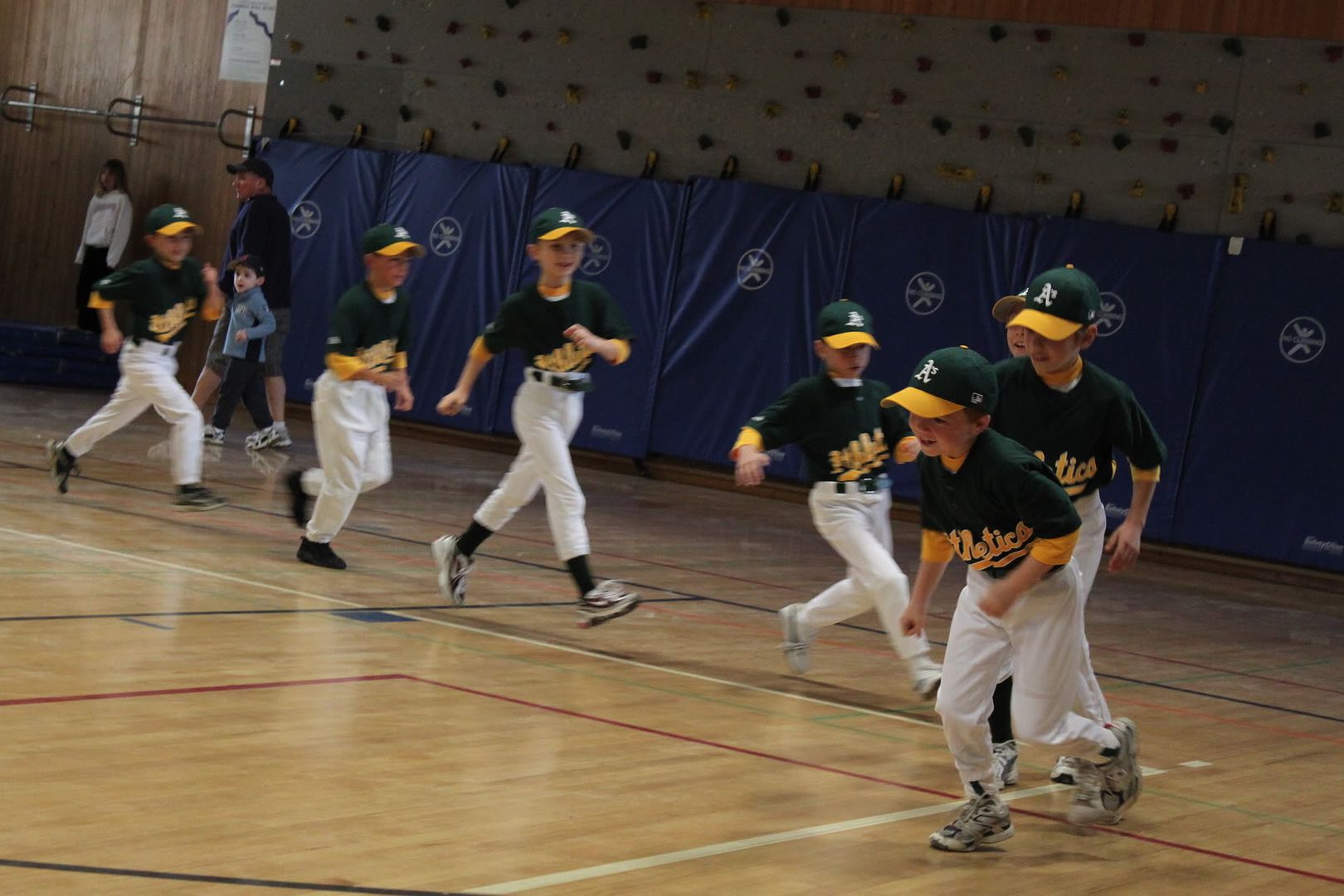
The local high school team, most of whose members played in MBA for many years, were also introduced to the assembly (towering like Greek gods over the little Pinto-level players).
Under grey skies that gave way to warm sun, Michael's Pinto A's took on the Red Sox. As with every other sport in town, they boys know just about everyone on the other teams. After some first inning jitters, the A's got their game into shape and prevailed 17-4. Basic skills like throwing accurately and catching reliably are still a challenge for most kids in the league, but our team showed the effects of active coaching right away with their good slides, outfielders backing up throws to first base, and aggressive baserunning. Michael had a decent game, making a couple of smart plays at second after a rough first inning at the pitcher position. He also got on base in each of his three at-bats, scoring on run and driving in another.
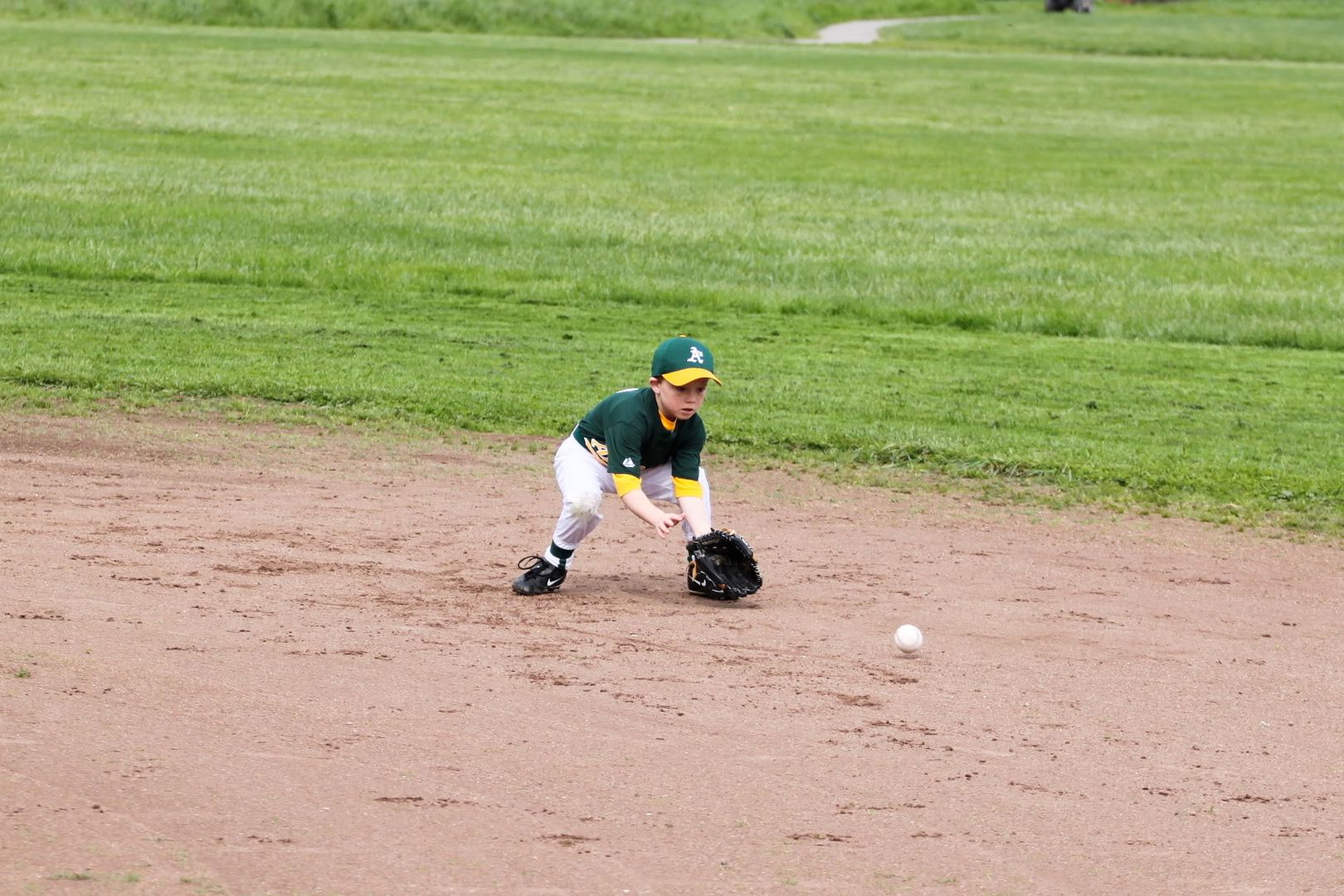

The best thing about the season is that the kid just loves the game.
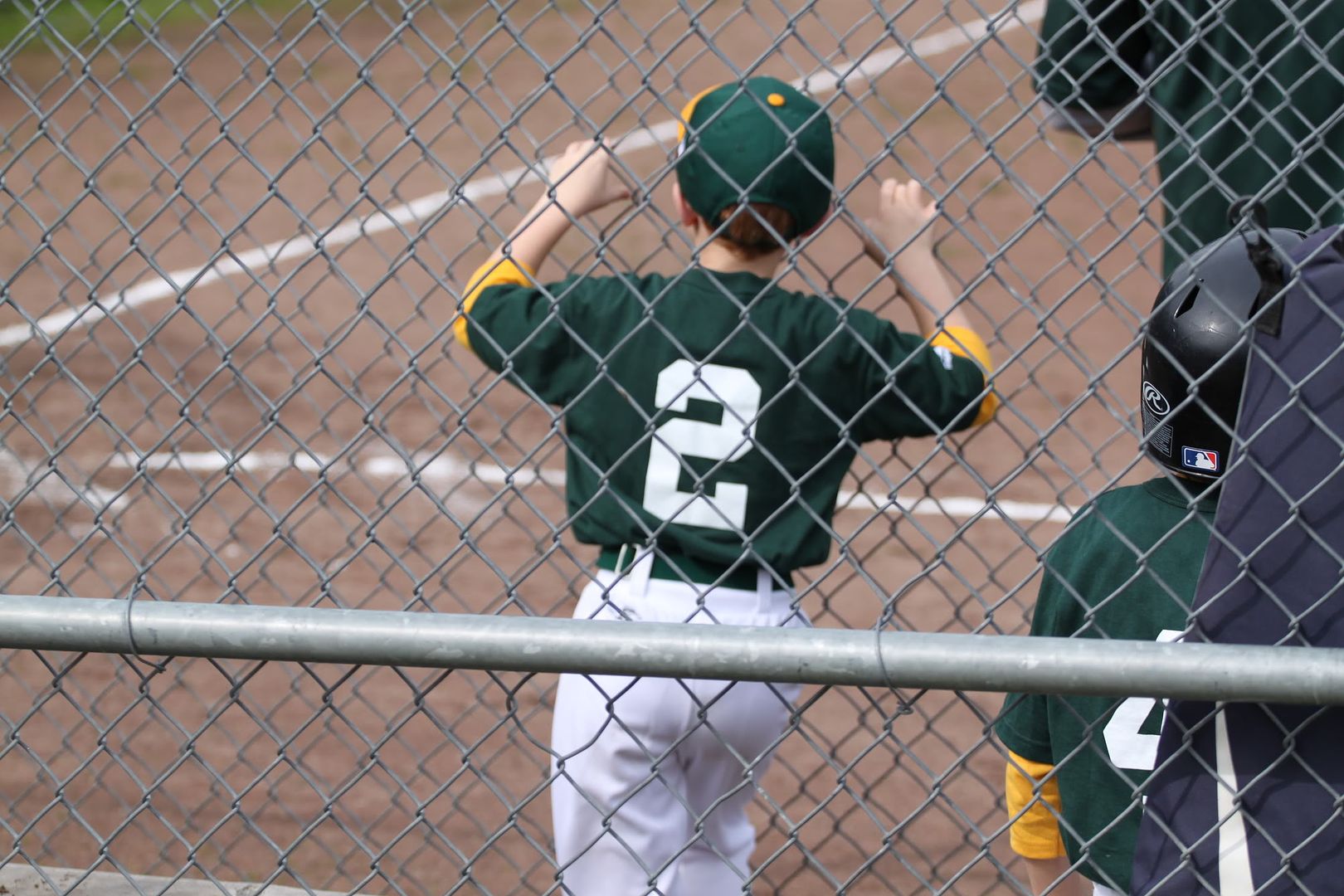
The local high school team, most of whose members played in MBA for many years, were also introduced to the assembly (towering like Greek gods over the little Pinto-level players).
Under grey skies that gave way to warm sun, Michael's Pinto A's took on the Red Sox. As with every other sport in town, they boys know just about everyone on the other teams. After some first inning jitters, the A's got their game into shape and prevailed 17-4. Basic skills like throwing accurately and catching reliably are still a challenge for most kids in the league, but our team showed the effects of active coaching right away with their good slides, outfielders backing up throws to first base, and aggressive baserunning. Michael had a decent game, making a couple of smart plays at second after a rough first inning at the pitcher position. He also got on base in each of his three at-bats, scoring on run and driving in another.
The best thing about the season is that the kid just loves the game.
Thursday, March 04, 2010
Also Turning 40
The Boeing 747.
Bigger than expected, but versatile, and usually makes people happy when they see it. Yeah, that's sounds about right.
Bigger than expected, but versatile, and usually makes people happy when they see it. Yeah, that's sounds about right.
Tuesday, March 02, 2010
Further Evidence of the Decline of the English Language
The part of the world that turned "google" into a verb, and gave the world the means to carry out that action, may be on the cusp of adding to the world's scientific lexicon. There is a movement afoot to give a name to numbers of 27 orders of magnitude (27 zeros after the initial digit). The proposed appellation is "hella," a slang term that has its roots in San Francisco, which means, simply, "a lot."
This dubious development is brought to us not by the news parody site The Onion, but is instead a real campaign by a Cal physics student to petition the International Committee for Weights and Measures to add "hella" to the International System of Units. The student is getting his message out to the people through that venerated method of social change: a Facebook petition.
There is no truth to the rumor that a high school English teacher/surfing instructor from Santa Cruz has started a Twitter campaign to convince the Oxford English dictionary to change the superlative form of "better" from "best" to "most epic."
Yet.
This dubious development is brought to us not by the news parody site The Onion, but is instead a real campaign by a Cal physics student to petition the International Committee for Weights and Measures to add "hella" to the International System of Units. The student is getting his message out to the people through that venerated method of social change: a Facebook petition.
There is no truth to the rumor that a high school English teacher/surfing instructor from Santa Cruz has started a Twitter campaign to convince the Oxford English dictionary to change the superlative form of "better" from "best" to "most epic."
Yet.
Time Keeps On Slippin'
Cataclysmic seismic events have obvious local consequences. They also can have much more far-reaching consequences that are not visible to most observers.
According to a geophysicist at JPL, a computer model of the earthquake that struck Chile last weekend indicates that the shift in land mass from that event has affected the balance of the entire planet. As a result, each day has been shortened by a projected 1.26 microseconds. The Indonesian earthquake of 2004 also shortened the day, by an estimated 6.8 microseconds.
Finally, an explanation; the days really are going faster these days.
According to a geophysicist at JPL, a computer model of the earthquake that struck Chile last weekend indicates that the shift in land mass from that event has affected the balance of the entire planet. As a result, each day has been shortened by a projected 1.26 microseconds. The Indonesian earthquake of 2004 also shortened the day, by an estimated 6.8 microseconds.
Finally, an explanation; the days really are going faster these days.
Friday, February 26, 2010
Citius, Altius, Fortius ... Fecundius?
Olympic athletes represent the pinnacle of human physical ability (except, perhaps, for curlers). "Faster, higher, stronger" is an apt phrase for the Olympic motto.
Olympians do not confine their prodigious capabilities to their chosen sporting arenas, apparently. The 7,000 athletes and officials have nearly exhausted their supply of 100,000 complementary condoms. That's 14 condoms per person, gone. In news sure to ease the concerns of all involved, an emergency supply of 8,500 additional prophylactics has been rushed to Vancouver.
This is in Vancouver. A lovely little city on the cozy west coast of prim, polite Canada. What will happen to the world's stock of latex in 2016, when the summer games take place in Rio de Janeiro, whose very name is synonymous with sensual decadence? NBC will have to run its telecasts at night just to guard the morals of our youth. So the International Olympic Committee got its knickers in a twist over a few female Canadian hockey players swigging beer on the ice after they won the gold medal? Committee members had better pack some defibrillators when they head to Rio.
Olympians do not confine their prodigious capabilities to their chosen sporting arenas, apparently. The 7,000 athletes and officials have nearly exhausted their supply of 100,000 complementary condoms. That's 14 condoms per person, gone. In news sure to ease the concerns of all involved, an emergency supply of 8,500 additional prophylactics has been rushed to Vancouver.
This is in Vancouver. A lovely little city on the cozy west coast of prim, polite Canada. What will happen to the world's stock of latex in 2016, when the summer games take place in Rio de Janeiro, whose very name is synonymous with sensual decadence? NBC will have to run its telecasts at night just to guard the morals of our youth. So the International Olympic Committee got its knickers in a twist over a few female Canadian hockey players swigging beer on the ice after they won the gold medal? Committee members had better pack some defibrillators when they head to Rio.
The Horror
Due to some technical glitch, I was without e-mail or Internet access for six hours yesterday. That was the day, of course, that I also left my iPhone at home for probably the second time in 18 months I have had it. That left me with absolutely no ability to contact or hear from the rest of the world, other than my office telephone.
Please don't take my interwebs away again.
Except for those rare occasions when I will intentionally substitute an ever-present connection to the Internet with overpowering natural beauty (camping in the high Sierras, sipping daiquiris on a South Pacific beach), I'm afraid I am too far gone to be saved. I have been assimilated into the technological web. The temporary inability to look up random facts on a whim, like the altitude of Nepal's capital city or Sandy Koufax's winning percentage (Kathmandu, 4,600 feet - surprisingly low - and .655 - highest in history, respectively) left me with the shakes and clammy hands.
As that noted blogger, Scarlett O'Hara, tweeted, "As God is my witness, I'm going to live through this and when it's all over, I'll never be offline again. No, nor any of my folk. If I have to lie, steal, cheat or kill. As God is my witness, I'll never be offline again!"
Please don't take my interwebs away again.
Except for those rare occasions when I will intentionally substitute an ever-present connection to the Internet with overpowering natural beauty (camping in the high Sierras, sipping daiquiris on a South Pacific beach), I'm afraid I am too far gone to be saved. I have been assimilated into the technological web. The temporary inability to look up random facts on a whim, like the altitude of Nepal's capital city or Sandy Koufax's winning percentage (Kathmandu, 4,600 feet - surprisingly low - and .655 - highest in history, respectively) left me with the shakes and clammy hands.
As that noted blogger, Scarlett O'Hara, tweeted, "As God is my witness, I'm going to live through this and when it's all over, I'll never be offline again. No, nor any of my folk. If I have to lie, steal, cheat or kill. As God is my witness, I'll never be offline again!"
Wednesday, February 24, 2010
Adventures In Advertising
The sport of basketball, and especially its collegiate variant, is particularly vulnerable to influence by gamblers. Although it is a team game, individuals have a much greater effect on the outcome of games than in other popular team sport. Football squads are too big for a single player (other than, perhaps, the quarterback) to influence the outcome of the game. Although baseball is nominally a team game, its unique structure boils down to a series of individual confrontations between pitcher and batter, with random outcomes dictated by where the ball happens to be hit. In contrast, only five players are on the floor in basketball at any one time, which allows each of them the opportunity to have a significant impact on game action. Basketball is particularly prone to point shaving, the preferred illicit tactic of professional gamblers.
The NCAA has an uneasy detente with gambling interests. It educates its student-athletes about the dangers of gambling and tries to prevent gambling scandals at its institutions. However, the annual NCAA men's basketball tournament is one of the biggest and most popular gambling events in the world. People who have never set foot in a casino or horse track routinely throw a few dollars into their office bracket pool every March. It is a practice that the NCAA, the IRS and the FBI are powerless to stop.
College basketball players, like college students of all stripes, are particularly vulnerable to influence the gamblers because they are, generally speaking, poor. The promise of a cash payout for simply having a bad shooting night can be difficult for a morally conflicted basketball player to resist. Many institutions with prominent basketball teams have fallen victim to point shaving scandals, most recently Arizona State.
All of this makes what I heard on the radio yesterday particularly jarring. Stanford, rightfully known for drawing the best and brightest to its campus, aired a radio ad for its men's basketball team. The tagline at the end of the ad was, "we’re all in." Of all the slogans Stanford could have used to express enthusiasm and commitment to a cause, why use a well-known poker phrase?
I have no particular beef with gambling, but I think the dangerous influence major gambling interests can have on college student-athletes is obvious. For that reason, the "appearance of impropriety" that governs the ethical conduct of judges and lawyers is a concept relevant to collegiate athletics. Stanford is needlessly relying on gambling terminology to advertise its upcoming basketball game, unnecessarily dragging a shadow over its sport and institution. Stanford's opponent in the game advertised on the radio? Arizona State.
(Could it be that Stanford's clever band of tricksters in the athletic department intentionally alluded to gambling because the opponent is Arizona State? I'd say there is a slight chance of that; if it were confirmed that any member of the notorious Stanford band was involved in the production of the radio spot, that likelihood goes straight to 100%.)
The NCAA has an uneasy detente with gambling interests. It educates its student-athletes about the dangers of gambling and tries to prevent gambling scandals at its institutions. However, the annual NCAA men's basketball tournament is one of the biggest and most popular gambling events in the world. People who have never set foot in a casino or horse track routinely throw a few dollars into their office bracket pool every March. It is a practice that the NCAA, the IRS and the FBI are powerless to stop.
College basketball players, like college students of all stripes, are particularly vulnerable to influence the gamblers because they are, generally speaking, poor. The promise of a cash payout for simply having a bad shooting night can be difficult for a morally conflicted basketball player to resist. Many institutions with prominent basketball teams have fallen victim to point shaving scandals, most recently Arizona State.
All of this makes what I heard on the radio yesterday particularly jarring. Stanford, rightfully known for drawing the best and brightest to its campus, aired a radio ad for its men's basketball team. The tagline at the end of the ad was, "we’re all in." Of all the slogans Stanford could have used to express enthusiasm and commitment to a cause, why use a well-known poker phrase?
I have no particular beef with gambling, but I think the dangerous influence major gambling interests can have on college student-athletes is obvious. For that reason, the "appearance of impropriety" that governs the ethical conduct of judges and lawyers is a concept relevant to collegiate athletics. Stanford is needlessly relying on gambling terminology to advertise its upcoming basketball game, unnecessarily dragging a shadow over its sport and institution. Stanford's opponent in the game advertised on the radio? Arizona State.
(Could it be that Stanford's clever band of tricksters in the athletic department intentionally alluded to gambling because the opponent is Arizona State? I'd say there is a slight chance of that; if it were confirmed that any member of the notorious Stanford band was involved in the production of the radio spot, that likelihood goes straight to 100%.)
Thursday, February 18, 2010
An Overdue Thanks

As the news industry turns its focus to economy's struggle to survive under its own weight and the intensified war in Afganistan, let's not forget the work of our men and women in Iraq. Thankfully, the military's activities in that region have largely disappeared from the front pages, not because its efforts are not worthy of comment, but because the customary criteria for major coverage (failure, real or perceived) has not been applicable in quite some time.
Among the many units over there, the Oregon National Guard's 41st Infantry Brigade Combat Team has been serving with distinction in Iraq since last May. The best news is the last line in the linked report: "The 41st Infantry Brigade Combat Team will return to Oregon in May."
Well done, Sgt. Beverly. Keep up the good work, and come home safe and on time.
Wednesday, February 17, 2010
Least Surprising News Story of theYear
File this under the category "Dog Bites Man":
"Man on 'bad trip' found hugging tree in Santa Cruz."
A 23 year old transient was picked up in Santa Cruz for public intoxication, hugging a palm tree while on a self-described "bad LSD trip."
Turning now to other equally shocking news, there are reports coming out of Beverly Hills that a Mercedes Benz parked next to a BMW. And in Omaha, Nebraska today, McDonald's sold a cheeseburger.
"Man on 'bad trip' found hugging tree in Santa Cruz."
A 23 year old transient was picked up in Santa Cruz for public intoxication, hugging a palm tree while on a self-described "bad LSD trip."
Turning now to other equally shocking news, there are reports coming out of Beverly Hills that a Mercedes Benz parked next to a BMW. And in Omaha, Nebraska today, McDonald's sold a cheeseburger.
Wednesday, February 10, 2010
Sparkling Vistas
As the eastern seaboard hunkers down under record snowfalls, Los Angeles is bidding farewell to its latest bout with crummy weather. The unexpectedly heavy rainfall this past weekend finally loosened the La Canada hillsides denuded by last fall's wildfires.
The payoff for storms in LA, though, is the natural beauty the area displays after it has been scrubbed clean by rain. In the winter, that includes snow in the mountains that form the northern boundary of the region.
The Mt. Wilson webcam that supplied dramatic views of those oncoming wildfires even as it seemed to chronicle its own demise seems to have survived just fine:
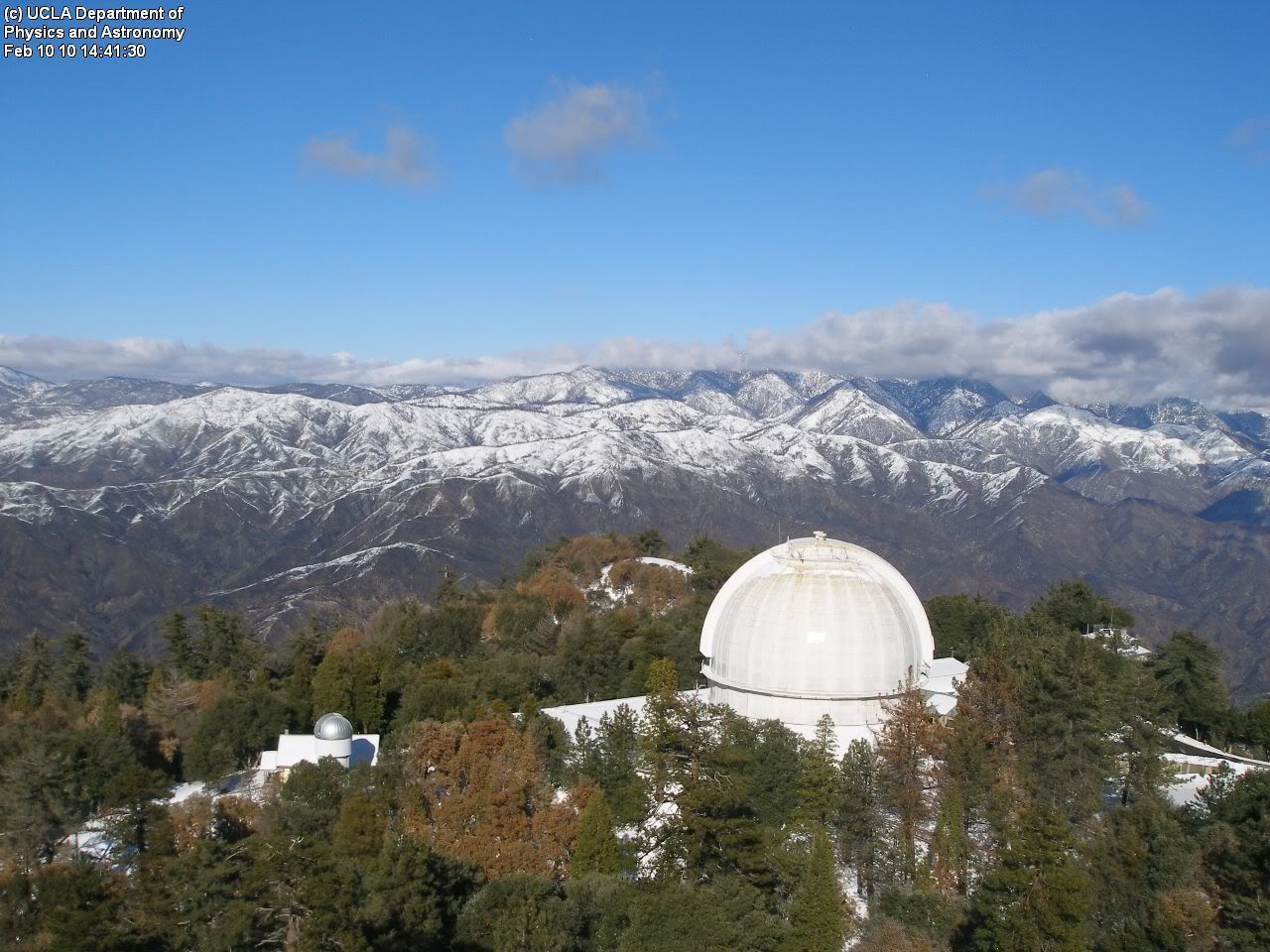
In larger form, this is my new desktop picture.
The payoff for storms in LA, though, is the natural beauty the area displays after it has been scrubbed clean by rain. In the winter, that includes snow in the mountains that form the northern boundary of the region.
The Mt. Wilson webcam that supplied dramatic views of those oncoming wildfires even as it seemed to chronicle its own demise seems to have survived just fine:
In larger form, this is my new desktop picture.
Friday, February 05, 2010
An Epic Journey
Two months from now, we'll be on the biggest adventure of our lives. We will be taking a trip, over the kids' spring break, to carry through on our promise to visit our old friends wherever they find themselves posted by the United States State Department . We visited them twice at their first post, in the Bahamas. Go figure.
Like the classic Clipper Pan Am routes of old, at the beginning of April we will be winging our way from San Francisco to our friends' current assignment Shanghai, China.

Today we booked passage on one of these:
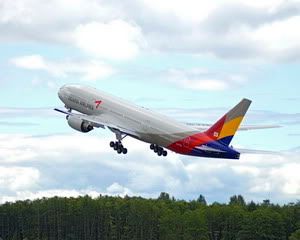
Don't recognize it? It is the livery of Asiana Airlines. One of Korea's two major airlines, Asiana is generally considered to be one of the finest airlines for customer service in the world.
Our original travel preference was for a 13-hour nonstop United flight between San Francisco and Shanghai. However, because of uncertainties about medical bills a couple of months ago, we were unable to commit to the trip when that flight’s prices were at its lowest. With that flight now 40% more expensive, we were forced to look at lower-cost alternatives that still did not unduly extend the total travel time. For a while, we were considering an Air China flight that was only three hours longer because of a stopover in Beijing. However, the online reviews from various sources are uniformly terrible for that airline. If you are going to be trapped in a metal tube for 13 straight hours, basic comfort and cleanliness take on greater importance than they might otherwise for short haul trips.
By the time we started to have real misgivings about the Air China option, only three tickets were left, which took it out of contention. The next lowest cost flight was a combined United/Asiana flight that was significantly longer and had two stops. However, the more we looked at it, the more we realized that it might work very well for us. The first leg is simply a United flight from San Francisco to Los Angeles late in the evening. We were planning to take the kids out of school for Thursday and Friday of the week we left anyway; we realized that we could also travel late Wednesday night if the flight scheduling required it. The second leg of the flight, on Asiana, goes from Los Angeles to Seoul, Korea. After a moderate layover, it is only a one-hour hop to Shanghai, arriving Friday morning.
By taking this flight, we would be able to arrive about eight hours earlier in Shanghai than we originally expected, without taking any additional time off from work or school. More importantly, not only is the flight cheaper than the nonstop we originally targeted, but we may well have a more pleasant travel experience. Everything we have read about Asiana and Seoul’s Incheon Airport suggests that the travel itself might actually be a pleasurable part of the trip, not simply something to be endured. The airport, in particular, sounds like a marvel for the weary traveler. Having the opportunity to refresh ourselves before the short hop from Seoul to Shanghai to see our friends could prove to be very beneficial.
The delights of the Orient await. This trip will undoubtedly be a lifetime highlight for each of us.
That doesn't mean we aren't already looking forward to our next visit to our diplomatic buddies. Their next posting: the Barbados.

China is exotic and all, but there are some real attractive advantages to becoming a specialist in Caribbean issues.
Like the classic Clipper Pan Am routes of old, at the beginning of April we will be winging our way from San Francisco to our friends' current assignment Shanghai, China.
Today we booked passage on one of these:
Don't recognize it? It is the livery of Asiana Airlines. One of Korea's two major airlines, Asiana is generally considered to be one of the finest airlines for customer service in the world.
Our original travel preference was for a 13-hour nonstop United flight between San Francisco and Shanghai. However, because of uncertainties about medical bills a couple of months ago, we were unable to commit to the trip when that flight’s prices were at its lowest. With that flight now 40% more expensive, we were forced to look at lower-cost alternatives that still did not unduly extend the total travel time. For a while, we were considering an Air China flight that was only three hours longer because of a stopover in Beijing. However, the online reviews from various sources are uniformly terrible for that airline. If you are going to be trapped in a metal tube for 13 straight hours, basic comfort and cleanliness take on greater importance than they might otherwise for short haul trips.
By the time we started to have real misgivings about the Air China option, only three tickets were left, which took it out of contention. The next lowest cost flight was a combined United/Asiana flight that was significantly longer and had two stops. However, the more we looked at it, the more we realized that it might work very well for us. The first leg is simply a United flight from San Francisco to Los Angeles late in the evening. We were planning to take the kids out of school for Thursday and Friday of the week we left anyway; we realized that we could also travel late Wednesday night if the flight scheduling required it. The second leg of the flight, on Asiana, goes from Los Angeles to Seoul, Korea. After a moderate layover, it is only a one-hour hop to Shanghai, arriving Friday morning.
By taking this flight, we would be able to arrive about eight hours earlier in Shanghai than we originally expected, without taking any additional time off from work or school. More importantly, not only is the flight cheaper than the nonstop we originally targeted, but we may well have a more pleasant travel experience. Everything we have read about Asiana and Seoul’s Incheon Airport suggests that the travel itself might actually be a pleasurable part of the trip, not simply something to be endured. The airport, in particular, sounds like a marvel for the weary traveler. Having the opportunity to refresh ourselves before the short hop from Seoul to Shanghai to see our friends could prove to be very beneficial.
The delights of the Orient await. This trip will undoubtedly be a lifetime highlight for each of us.
That doesn't mean we aren't already looking forward to our next visit to our diplomatic buddies. Their next posting: the Barbados.
China is exotic and all, but there are some real attractive advantages to becoming a specialist in Caribbean issues.
Thursday, February 04, 2010
The Boys of Summer in Winter
It is common knowledge that elite athletes become so through a combination of God-given talent and sheer hard work. At the youth level, there is a long-established dual track system of recreational leagues and competition leagues. Up until now, both kids have been involved only in recreational leagues, which generally require 60 to 90 minutes of practice a week plus a game on the weekend. The amount of competitive fire in the team depends solely on the motivations of the individual players. Having fun and learning the sport are the hallmarks of recreational leagues
Starting this week, Michael stepped up to a competitive league for baseball. He loves the sport and has been excited to do this ever since last season ended. We bought all the gear, attended the preseason meetings, and hit the ground running on Monday.
And running.
And running.
As he got into the car on Tuesday evening after his second 90 minute practice in as many days, Michael sighed and said "I had no idea baseball was this much work." Michael's practices have consisted of simple throwing and catching drills and footwork/running drills, all conducted at a high pace. (There are not too many other ways to keep 12 eight-year-old boys engaged in any activity for more than an hour.)
Because the school district is fanatically protective of its fields, all of the league's teams have been forced to practice on blacktop this week due to a little bit of wet weather. Given the basic nature of the skills Michael and his teammates need to develop, this has not been a serious impediment. It has not prevented them from working very hard at those basic skills.
The only kid at the practice is smaller than Michael is the coach’s six-year-old son who tags along (and, frankly, shows more skill than all but about three of the players actually on the team), but Michael's throwing and catching are among the best on the team, and the others are improving rapidly. Michael is reasonably quick as well, but he is so small that it is all he can do to keep up with some of his taller teammates (i.e., all of them). This weekend, Michael will have another four hours of practice. Weather permitting, the boys will be allowed to use the fields and start hitting for the first time. That is sure to be chaotic but great fun as well.
The progress all of the boys have made in just two days of practice is remarkable, and illustrates the most fundamental difference between recreational leagues and competitive leagues. There is simply not enough time in recreational leagues to practice enough to develop skills quickly or significantly. In a competitive league, the pace and duration of practice is dramatically higher, with corresponding results. In addition, the teams will practice for a month before games begin, so that their skills will have developed significantly before they have to learn to use them in game situations.
Thankfully, Michael loves baseball. He is tired after practice, but he plays because he enjoys the game. As long as that remains true, the extra workload will be a joy, not a burden.
Starting this week, Michael stepped up to a competitive league for baseball. He loves the sport and has been excited to do this ever since last season ended. We bought all the gear, attended the preseason meetings, and hit the ground running on Monday.
And running.
And running.
As he got into the car on Tuesday evening after his second 90 minute practice in as many days, Michael sighed and said "I had no idea baseball was this much work." Michael's practices have consisted of simple throwing and catching drills and footwork/running drills, all conducted at a high pace. (There are not too many other ways to keep 12 eight-year-old boys engaged in any activity for more than an hour.)
Because the school district is fanatically protective of its fields, all of the league's teams have been forced to practice on blacktop this week due to a little bit of wet weather. Given the basic nature of the skills Michael and his teammates need to develop, this has not been a serious impediment. It has not prevented them from working very hard at those basic skills.
The only kid at the practice is smaller than Michael is the coach’s six-year-old son who tags along (and, frankly, shows more skill than all but about three of the players actually on the team), but Michael's throwing and catching are among the best on the team, and the others are improving rapidly. Michael is reasonably quick as well, but he is so small that it is all he can do to keep up with some of his taller teammates (i.e., all of them). This weekend, Michael will have another four hours of practice. Weather permitting, the boys will be allowed to use the fields and start hitting for the first time. That is sure to be chaotic but great fun as well.
The progress all of the boys have made in just two days of practice is remarkable, and illustrates the most fundamental difference between recreational leagues and competitive leagues. There is simply not enough time in recreational leagues to practice enough to develop skills quickly or significantly. In a competitive league, the pace and duration of practice is dramatically higher, with corresponding results. In addition, the teams will practice for a month before games begin, so that their skills will have developed significantly before they have to learn to use them in game situations.
Thankfully, Michael loves baseball. He is tired after practice, but he plays because he enjoys the game. As long as that remains true, the extra workload will be a joy, not a burden.
Subscribe to:
Comments (Atom)